
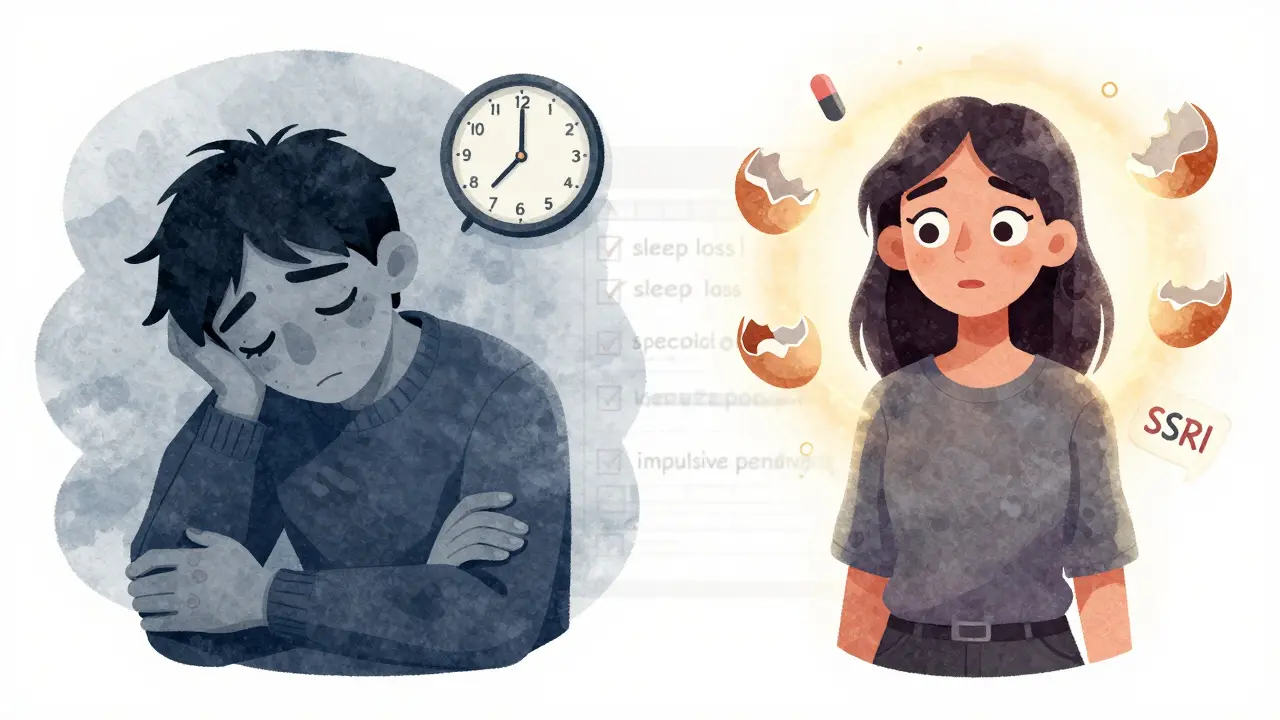
Getting diagnosed with depression can feel like a relief-until the treatment doesn’t work. For many people, what starts as a simple diagnosis of depression turns into years of trial and error, hospital visits, and worsening symptoms. The reason? They might have bipolar depression, not unipolar. And the difference isn’t just subtle-it changes everything about how you’re treated.
What’s the Real Difference Between Bipolar and Unipolar Depression?
On the surface, both conditions look the same: low mood, fatigue, trouble sleeping, loss of interest in things you used to enjoy. But unipolar depression, also called Major Depressive Disorder (MDD), only involves depressive episodes. Bipolar depression is part of bipolar disorder, which means the person has also experienced at least one manic or hypomanic episode-periods of unusually high energy, impulsivity, or euphoria-even if it was mild or short-lived.
This isn’t just semantics. It’s the difference between taking a daily antidepressant that helps and taking one that pushes you into a full-blown manic episode. Studies show that about 30-40% of people initially diagnosed with unipolar depression later turn out to have bipolar disorder. That’s not rare. That’s common enough that every clinician should be asking the right questions from day one.
How Do You Tell Them Apart?
There’s no blood test or brain scan that can definitively say, “This is bipolar.” Diagnosis still relies on careful history-taking. But certain patterns show up more often in bipolar depression than in unipolar.
- Early morning waking: 57% of people with bipolar depression wake up hours before their alarm, often feeling worse in the morning. In unipolar, it’s closer to 39%.
- Psychomotor slowing: Moving or speaking slowly, feeling physically heavy-this happens in 68% of bipolar cases versus 42% in unipolar.
- Psychotic symptoms: Hearing voices or having delusions during a depressive episode is twice as likely in bipolar depression (22%) compared to unipolar (8%).
- Family history: If a close relative has bipolar disorder, your risk jumps from 1-2% to 5-10%.
- Antidepressant reaction: Did your mood get worse after starting an SSRI? Did you suddenly feel “too good,” impulsive, or unable to sleep? That’s a red flag. People with bipolar disorder are 4.2 times more likely to develop mania after antidepressants.
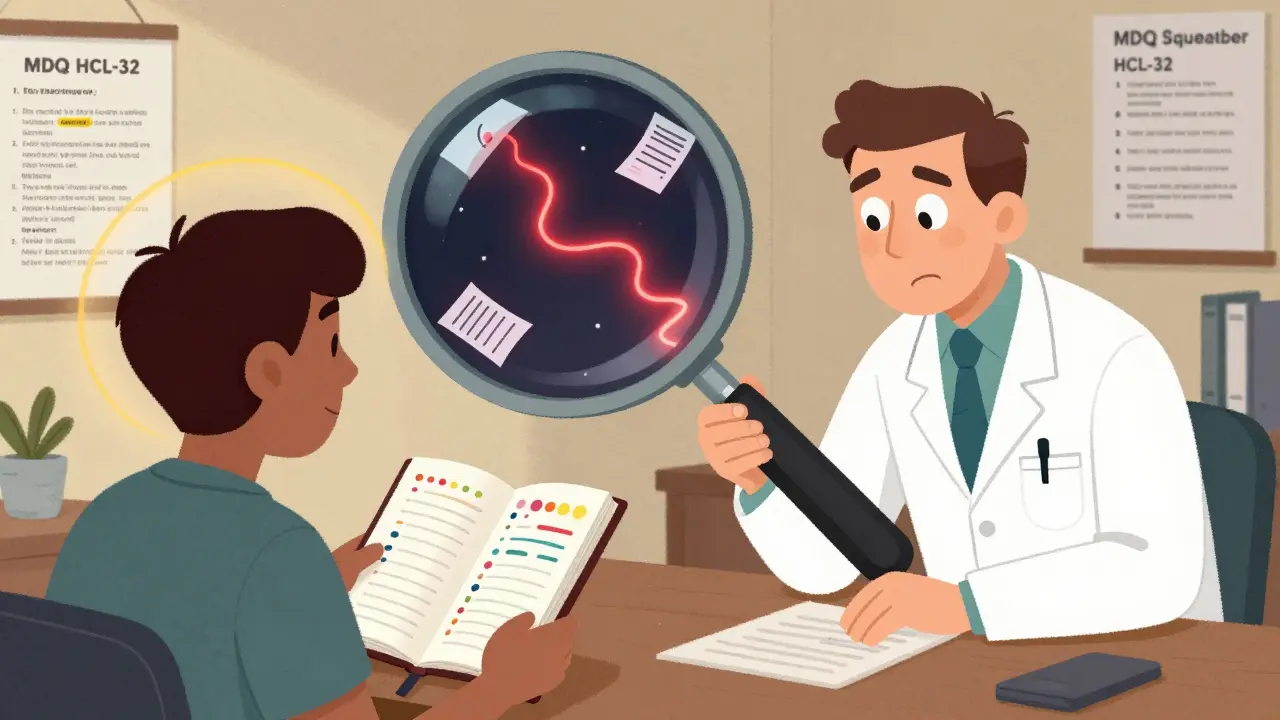
The Mood Disorders Questionnaire (MDQ) is a quick 13-item screen that clinicians use. Scoring 7 or higher suggests bipolar disorder, with 94% accuracy in ruling it out. But it’s not perfect-it misses about 72% of cases. The Hypomania Checklist-32 (HCL-32) is more sensitive, catching 69% of cases, though it’s less specific. Neither replaces a thorough clinical interview.
Why Misdiagnosis Is So Dangerous
When someone with bipolar depression is treated like they have unipolar depression, the consequences are serious-and often preventable.
A 2017 study found that people misdiagnosed with unipolar depression spent, on average, 8.2 more years getting the wrong treatment. During that time, 63% of them ended up in the hospital because antidepressants triggered manic episodes. One Reddit user, u/BipolarSurvivor, shared: “I was on Prozac for 7 years. My mood episodes went from two a year to twelve. I didn’t know I was cycling until my psychiatrist finally asked about the times I didn’t sleep for days and spent $10,000 on online shopping.”
The National Comorbidity Survey found that 40% of people with bipolar disorder were first diagnosed with unipolar depression. And in 90% of those cases, they were given antidepressants alone-exactly what they shouldn’t have been given.
How Treatment Is Completely Different
Here’s where the stakes get real. The first-line treatment for unipolar depression is usually an SSRI like sertraline or escitalopram. About 60-65% of people respond within 8-12 weeks.
But for bipolar depression? Antidepressants alone are dangerous. The STEP-BD study showed that when people with bipolar disorder took antidepressants without a mood stabilizer, 76% experienced mood destabilization-switching into mania, rapid cycling, or worse.
First-line treatments for bipolar depression are:
- Lithium: One of the oldest mood stabilizers. It reduces depressive symptoms in about 48% of cases, compared to 28% with placebo.
- Quetiapine (Seroquel): An atypical antipsychotic approved specifically for bipolar depression. It works in 58% of patients versus 36% on placebo.
- Lurasidone (Latuda): Another antipsychotic with strong evidence for bipolar depression, especially when weight gain is a concern.
Antidepressants? Only used as a last resort-and only when a mood stabilizer is already in place. Even then, they’re added cautiously and monitored closely.
Therapy looks different too. For unipolar depression, Cognitive Behavioral Therapy (CBT) helps reframe negative thoughts. For bipolar, Interpersonal and Social Rhythm Therapy (IPSRT) focuses on keeping daily routines stable-sleep, meals, activity-because disruptions can trigger episodes. One study showed 68% of people on IPSRT stayed in remission after a year, compared to just 42% with standard care.
What About Long-Term Management?
If you have unipolar depression and respond well to treatment, you might be able to stop medication after 6-12 months of being symptom-free, especially if it’s your first episode.
But bipolar disorder? Most people need lifelong treatment. Stopping mood stabilizers leads to a 73% relapse rate within five years. With continued treatment, that drops to 37%. That’s not a choice-it’s a medical necessity.
And it’s not just about pills. Regular sleep, avoiding alcohol, managing stress, and tracking mood changes are all part of staying stable. Apps that log sleep, mood, and energy levels are becoming common tools in clinics, helping spot early signs of a shift before it becomes an episode.
What’s New in Treatment?
There’s progress. In 2019, the FDA approved esketamine nasal spray (Spravato) for treatment-resistant unipolar depression. It works fast-some people feel better within hours. But it’s not approved for bipolar depression yet.
For bipolar depression, cariprazine (Vraylar) got FDA approval in 2019. In trials, it helped 37% of patients achieve full remission, compared to 23% on placebo.
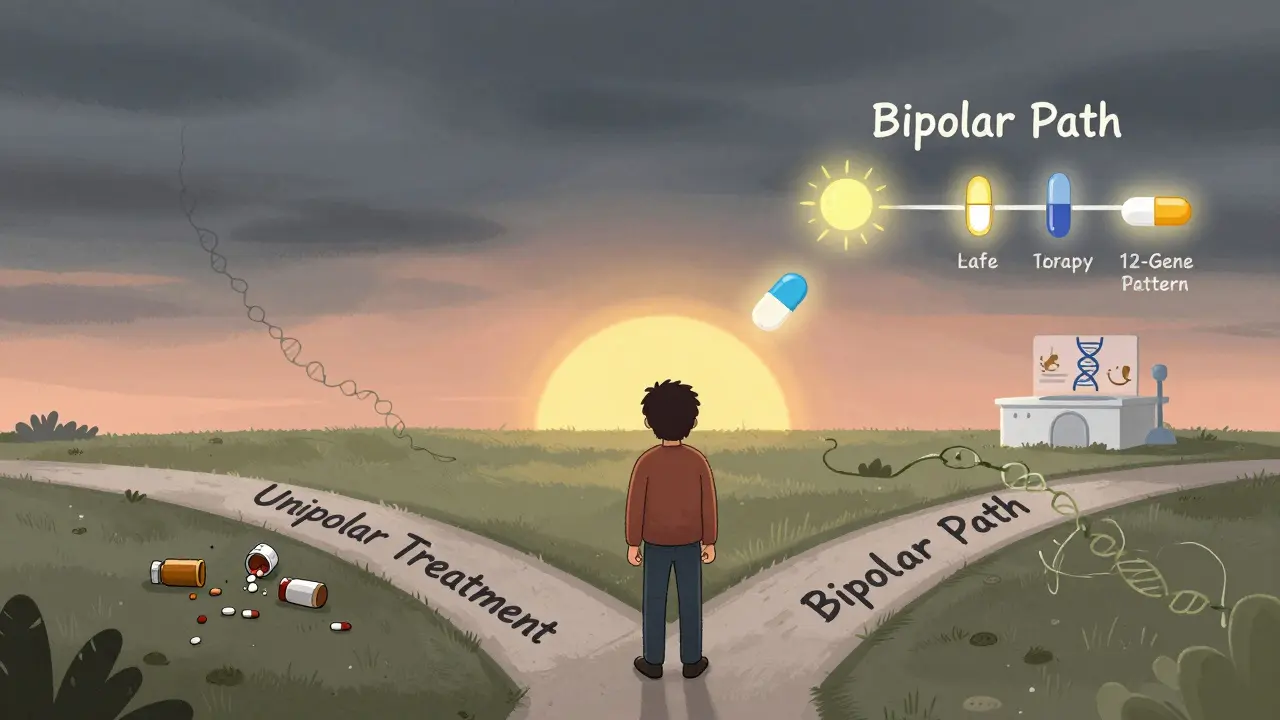
And research is moving beyond symptoms. A 2023 Lancet Psychiatry study identified a 12-gene pattern that can distinguish bipolar from unipolar depression with 83% accuracy. That’s not in clinics yet-but it’s coming. Future diagnosis may involve blood tests, not just interviews.
What Should You Do If You’re Not Getting Better?
If you’ve tried two or more antidepressants and still feel stuck, that’s a red flag. The STAR*D trial showed that people who don’t respond to two adequate antidepressant trials are 3.7 times more likely to have bipolar disorder.
Ask your doctor:
- “Have you asked me about times I felt unusually energetic, impulsive, or slept very little?”
- “Is there a family history of bipolar disorder or suicide?”
- “Could my depression be part of bipolar disorder?”
- “If I’ve ever had a manic episode-even a mild one-should I be on a mood stabilizer?”
Don’t assume your doctor already knows. Many general practitioners aren’t trained to spot hypomania. If you’re unsure, ask for a referral to a psychiatrist who specializes in mood disorders.
Final Thought: It’s Not About Labels-It’s About Getting Better
Calling something bipolar or unipolar isn’t about putting you in a box. It’s about giving you the right treatment. The wrong medication can make you sicker. The right one can give you your life back.
It’s okay to ask for a second opinion. It’s okay to push for more questions. You’re not overreacting-you’re being smart. And if you’ve been struggling for years, it’s not your fault. It’s a system that’s missed the signs.
The good news? Once you get the right diagnosis, the chances of recovery go up dramatically. People on the correct treatment see a 52% drop in hospitalizations and a 47% improvement in work and daily functioning. That’s not a small win. That’s life-changing.
Can you have bipolar depression without ever having a manic episode?
No. By definition, bipolar depression is part of bipolar disorder, which requires at least one manic or hypomanic episode. If someone has only depressive episodes, they’re diagnosed with unipolar depression. However, many people don’t recognize hypomania as abnormal-they might think their high energy and productivity are just “being productive.” That’s why clinicians must ask about past periods of decreased sleep, impulsivity, or risky behavior.
Are antidepressants ever safe for bipolar depression?
Yes-but only as an add-on, never alone. Antidepressants should only be used after a mood stabilizer or atypical antipsychotic is already working. Even then, they’re used cautiously and monitored closely. The risk of triggering mania or rapid cycling is too high otherwise. Guidelines from NICE and the American Psychiatric Association both warn against antidepressant monotherapy in bipolar disorder.
How long does it take to get a correct bipolar diagnosis?
On average, it takes 8 to 10 years. Many people see multiple doctors, try several medications, and even get hospitalized before someone connects the dots. The delay happens because manic episodes are often brief, forgotten, or dismissed. If you’ve had depression for years with poor response to treatment, ask about bipolar disorder-don’t wait.
Can bipolar disorder turn into unipolar depression?
No. Once someone has had a manic or hypomanic episode, they’re diagnosed with bipolar disorder for life-even if they haven’t had one in years. The depressive episodes may become more frequent, but the underlying condition doesn’t change. Some people go long periods without mania, but the risk of recurrence remains. That’s why long-term treatment is critical.
What should I do if I think I was misdiagnosed?
Start by keeping a mood journal for at least a month-track sleep, energy, mood, and any periods of unusual activity or impulsivity. Then, ask your doctor for a referral to a psychiatrist who specializes in mood disorders. Bring your journal, list of medications, and family history. Don’t stop your current meds without supervision, but do ask if your treatment plan might need to change based on your full history.


14 Comments
So basically we’re just gambling with people’s brains now? Antidepressants = bad unless you’re lucky enough to have a psychiatrist who remembers to ask about that one time you bought 30 pairs of shoes in a week? I’m not mad, I’m just disappointed.
Depression’s not a diagnosis-it’s a symptom. Bipolar’s not a label-it’s a survival mode. We keep treating the mood and ignoring the rhythm. Sleep, meals, social rhythm… these aren’t self-help tips, they’re biological anchors. And nobody talks about that until you’ve been hospitalized three times.
They give you SSRIs like they’re candy. Then wonder why you’re screaming at your cat at 3 a.m. because your brain forgot how to be normal.
The pathophysiological divergence between unipolar and bipolar depression is underpinned by neuroendocrine dysregulation, particularly HPA axis hyperactivity and dopaminergic sensitization in the mesolimbic circuitry. SSRIs, in the absence of mood stabilization, exacerbate glutamatergic excitotoxicity, precipitating affective switch phenomena. The MDQ’s sensitivity is statistically inadequate (72% false negatives), rendering it clinically obsolete without adjunctive HCL-32 and longitudinal affective chronometry.
I’ve been on lithium for 12 years. People think it’s just for ‘crazy people.’ Nah. It’s like insulin for your mood. You don’t ask if your pancreas is ‘weak’-you just take the pill. Same here. And yeah, I had hypomania once-thought I was just ‘on fire’ at work. Turned out I was maxing out credit cards and sleeping 2 hours a night for 10 days. That’s not productivity. That’s a warning light.
PS: IPSRT saved my life. I track my sleep like it’s my job. And it is.
I was misdiagnosed for 9 years. Now I’m stable. But I’ll never forgive how many doctors dismissed me.
Bro. The gene study? 83% accuracy? 🤯 That’s wild. We’re literally one blood test away from rewriting psychiatry. No more ‘you seem sad’ → ‘try Zoloft.’ Soon it’ll be ‘your 12-gene signature says bipolar’ → ‘here’s your lithium script.’ 🧬💊
If you’ve been on antidepressants for years and nothing’s changed… please, just ask. No shame. No judgment. Just ask your doctor about bipolar. You deserve to feel better. I’m rooting for you.
I took an SSRI once. Felt like I was running on a treadmill made of lightning. Then I slept for 18 hours. Then I spent $800 on Amazon. That was hypomania. I didn’t know it. My doctor didn’t know it. I just thought I was ‘going through a phase.’
The STEP-BD data is terrifying. 76% destabilized on antidepressants alone? That’s not a side effect-that’s a systemic failure. We’re treating a neurological condition like it’s a bad mood. And we’re losing people in the process.
Look, I’m a GP. I didn’t know how to spot hypomania until I had a patient who came in after spending $20K on crypto and then trying to start a podcast while naked. That’s when I learned. Most of us aren’t trained. But we’re learning. Ask for a referral. Push. You’re not being dramatic-you’re being smart.
You ever feel like your brain is a car with no brakes? That’s bipolar. Antidepressants are like stomping on the gas. Lithium? That’s the brake pedal. You don’t stop driving-you just learn how to drive safely. And yeah, you gotta do it for life. But life’s better with brakes.
I used to think I was just ‘high energy.’ Turns out I was just unmedicated.
The 8-10 year diagnostic delay? That’s not a gap in medicine-it’s a failure of imagination. We’re still diagnosing mental illness like it’s 1985. We need biomarkers. We need AI-assisted mood tracking. We need to stop pretending every depressed person is the same.
Canada’s doing better than the US. We have access to cariprazine and Lurasidone without jumping through insurance hoops. You Americans think you’re ‘free’? You’re just stuck on Prozac while we’re getting real treatment. 🇨🇦💪
My sister was misdiagnosed for 11 years. She finally got lithium and now she’s teaching yoga. 🙏 I’m so proud of her. If you’re reading this and you’re struggling… you’re not broken. You just haven’t found the right key yet. Keep going. You’re not alone.