
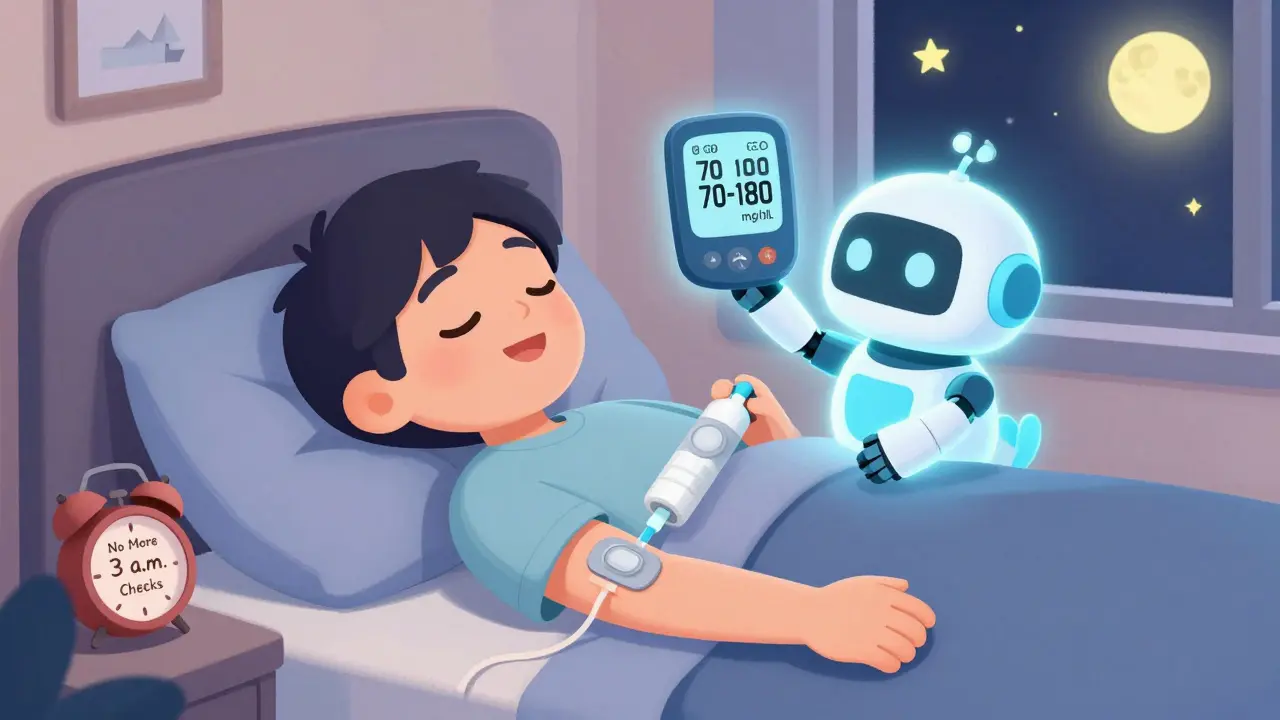
For people living with type 1 diabetes, managing blood sugar used to mean constant calculations, finger pricks, and guesswork. You’d wake up wondering if your overnight insulin dose was too high or too low. You’d stress before every meal: How many carbs? Did I bolus enough? Will I crash at 3 a.m.? Then came closed-loop systems - the real-world version of an artificial pancreas. These aren’t sci-fi anymore. They’re here, and they’re changing lives.
What Exactly Is a Closed-Loop System?
A closed-loop insulin delivery system links three things together: a continuous glucose monitor (CGM), an insulin pump, and a smart algorithm that reads glucose data and automatically adjusts insulin delivery. No manual input needed for basal insulin. It works like a thermostat for your blood sugar - if it climbs too high, the system delivers more insulin. If it dips too low, it cuts back. The goal? Keep glucose levels steady between 70 and 180 mg/dL.
These are called hybrid closed-loop (HCL) systems because they still need you to tell them when you eat. You have to enter your carb count for meals. But after that? The system does the rest. It’s not fully automatic yet - but it’s close. And for many, that’s enough.
How Real-World Users Are Responding
Real people aren’t just testing these systems in labs. They’re using them every day - at work, while traveling, during sleep, and while exercising. A 2023 survey from the T1D Exchange Forum tracked 1,245 users. Seventy-eight percent said their sleep improved dramatically. One user wrote: “I haven’t had a severe low in eight months. Before Control-IQ, I had one every month.”
Reddit’s r/insulinpumps community had over 3,400 threads in early 2024. Sixty-eight percent of those posts were positive. Common themes? “My morning sugars are stable.” “I don’t have to think about insulin all day.” “I actually took a weekend trip without stressing about my pump.”
But it’s not perfect. Forty-two percent of negative reviews on DiabetesMine pointed to one issue: post-meal spikes. Even with carb entry, some systems lag. Control-IQ, for example, can take 20 minutes to respond to a rapid glucose rise - long enough for a spike to happen. Omnipod 5 originally required manual meal announcements - though its 2023 update added smarter auto-bolus features.
How These Systems Compare
| System | Key Feature | Insulin Capacity | Setup Time | Meal Requirement | Approx. Annual Cost (USD) |
|---|---|---|---|---|---|
| Tandem t:slim X2 with Control-IQ | Automatic correction boluses | 200 units | 3-4 hours | Carb entry required | $6,800 ($299 software + pump) |
| Insulet Omnipod 5 | No external pump; patch design | 150 units per pod | 2-3 hours | Carb entry required (improved in 2023) | $3,900 (pods only, no pump) |
| Beta Bionics iLet | One-input setup (weight only) | 250 units | 4-5 hours | Recommended, not required | $7,200 (pump + accessories) |
Control-IQ stands out because it doesn’t just adjust basal insulin - it also gives automatic correction boluses when glucose is too high. Omnipod 5 is popular for its tubeless, wearable design. iLet is the most advanced in theory: you only input your weight. The algorithm figures out your insulin needs without needing ratios or targets. But it’s still not widely available in the U.S. yet.

What the Data Shows
Studies don’t just say these systems help - they show how much.
- Time-in-range (70-180 mg/dL) jumps from 55% with traditional pumps to 72-75% with HCL systems.
- HbA1c drops by 0.3% to 0.5% - enough to reduce long-term complications.
- Hypoglycemia (below 70 mg/dL) decreases from 6% to under 3% of the day.
- A 2023 Lancet Diabetes & Endocrinology study found HCL users had 37% fewer low blood sugar events than those using manual pumps.
But there’s a catch. That same study found a 1.2x higher rate of diabetic ketoacidosis (DKA) in HCL users. Why? Sometimes, if the pump stops working - say, a clogged catheter - the system doesn’t warn you fast enough. No insulin delivery means blood sugar skyrockets. That’s why user education matters as much as the tech.
Who Benefits Most?
Not everyone finds these systems easy. People with unpredictable routines - like shift workers, parents of young kids, or those who eat irregular meals - often struggle. A 2023 JDRF survey found 35% of users with erratic eating patterns abandoned their systems within six months.
On the other hand, children and teens are thriving. In the U.S., 35% of insulin pump users under 18 now use HCL systems. Parents report fewer nighttime alarms and less anxiety. One mom said: “I used to check my son’s glucose every hour. Now I sleep through the night.”
Adults with high HbA1c (over 8.0%) see the biggest improvement. The American Diabetes Association now recommends HCL systems as “preferred therapy” for eligible patients - a Level A recommendation, meaning the evidence is strong and consistent.

Challenges and Limitations
These systems aren’t magic. They still rely on sensors that can fail. About 15% of users report frequent calibration errors. Sensor placement matters - if the adhesive fails, the data goes wrong. Skin Tac patches help, but not everyone knows about them.
Algorithm fatigue is real. Some users say they feel like they’re babysitting the system. If glucose spikes after a high-fat meal, the algorithm might not respond fast enough. You end up overriding it manually - which defeats part of the purpose.
And then there’s cost. In the U.S., the t:slim X2 pump costs around $6,500. Omnipod 5 pods run $320 every three days - that’s about $3,900 a year. Medicare covers 80%, but patients pay the rest. For low-income users, that’s a barrier.
Even with all the tech, you still need to understand insulin-to-carb ratios and correction factors. If you don’t, the system won’t work right. Most users need 2-4 weeks of training. But 45% of people surveyed by Diabetes UK said they got inadequate training from their clinic.
What’s Next?
By 2026, we’re seeing real progress. Tandem’s Control-IQ 3.0 (released late 2023) reduces time below range by another 1.8%. Omnipod 5’s “Autonomous” mode is in beta - and it eliminates meal announcements. That’s huge. It means the system will start learning your patterns without you having to type in carbs.
Looking ahead, interoperable systems are coming. In 2025, you’ll be able to mix and match your CGM and pump. Want to use Abbott’s FreeStyle Libre with a Tandem pump? It’ll be possible. And Beta Bionics’ Project Eiger, targeting 2026, will add stress and activity tracking - meaning the algorithm might one day know you’re having a panic attack or ran 5K and adjust accordingly.
Dr. Ed Damiano, co-creator of the iLet, predicts fully closed-loop systems will become standard in five years. That means no more carb counting. Just eat. The system adapts.
Final Thoughts
Closed-loop systems aren’t about perfection. They’re about reducing burden. They’re about sleep. About fewer hospital visits. About having your life back.
If you’re tired of guessing, if you’re tired of waking up at 3 a.m. to check your glucose, if you want to eat a pizza without calculating insulin for three hours - this technology is the closest thing we have to a cure right now.
It’s not easy. It’s not cheap. But for thousands, it’s life-changing.




14 Comments
This is life-changing. I went from 12% HbA1c to 6.8% in 6 months with Control-IQ. No more 3 a.m. panic checks. No more carb counting anxiety. I ate a damn burrito last weekend and didn't die. 🤘
I can't believe how much sleep I've regained. My daughter used to wake me up 4-5 times a night. Now? I sleep through. I cried the first time I woke up to a normal glucose reading. This tech is a gift. 💕
So we're glorifying a $7k device that still can't handle a pizza? Cool. I'll stick to my fingers and insulin pens. At least I know when I'm dying.
The data is compelling. Time-in-range improvements are statistically significant. However, the rise in DKA incidents warrants serious attention. We must not conflate technological advancement with clinical safety. Vigilance remains non-negotiable.
The paradox of autonomy: we seek liberation from calculation, yet we remain tethered to the algorithm's limitations. Is this progress, or merely a reconfiguration of dependence? The body, after all, is not a thermostat.
Look, I've been using this for two years. The system isn't perfect, but it's the closest thing we've got to normalcy. The post-meal lag? Yeah, it sucks. But I'd rather have 72% time-in-range with occasional spikes than 55% with constant fear. I've had three years without a hospital visit. That's not luck. That's engineering. And yeah, the cost is insane. But so is dialysis. So is blindness. So is amputation. We're trading money for dignity. That's not a bad deal.
As a mom of a 12-year-old with T1D, I just want to say thank you to every engineer, researcher, and parent who pushed this forward. My kid went from being terrified of school trips to hiking with his class. He didn't even mention his pump once. That's magic.
So I paid $4k for a fancy insulin pump that still needs me to tell it when I'm eating pizza? That's not automation. That's a very expensive calculator with a Bluetooth connection. I'll take my syringes and a nap.
I used to hate the beeping. Now I miss it. When my pump failed last month and the system didn't alert me, I went into DKA. Took 12 hours to get help. The tech is incredible, but the safety nets aren't foolproof. Training matters. Communication matters. Don't let the hype blind you to the risks.
It's interesting how we frame this as liberation. But isn't it also a new kind of burden? The expectation to manage, monitor, optimize? The guilt when the numbers aren't perfect? The system doesn't care if you're tired. It just wants data. I wonder if we're trading one form of control for another.
The iLet's one-input paradigm is revolutionary. Weight-based dosing eliminates the need for carb ratios, ISF, and target ranges. This is the future. The algorithm learns your physiology. Not your preferences. Not your mood. Your biology. That's the real innovation. Others are just iterative tweaks.
If you're not using a closed-loop system and you're eligible, you're making it harder on yourself. This isn't a luxury. It's a tool for survival. Stop waiting for perfect. Start using what works.
I got my Omnipod 5 last year. I used to be scared to leave the house. Now I went to a concert. No panic. No checking every 20 minutes. I danced. I didn't die. That's worth every penny.
Jane, you're missing the point. It's not about perfection. It's about not waking up at 3 a.m. screaming because your glucose is 42. I'd rather have a spike after tacos than a coma. And yeah, I'm still here. Alive. And I'm not apologizing for that.