
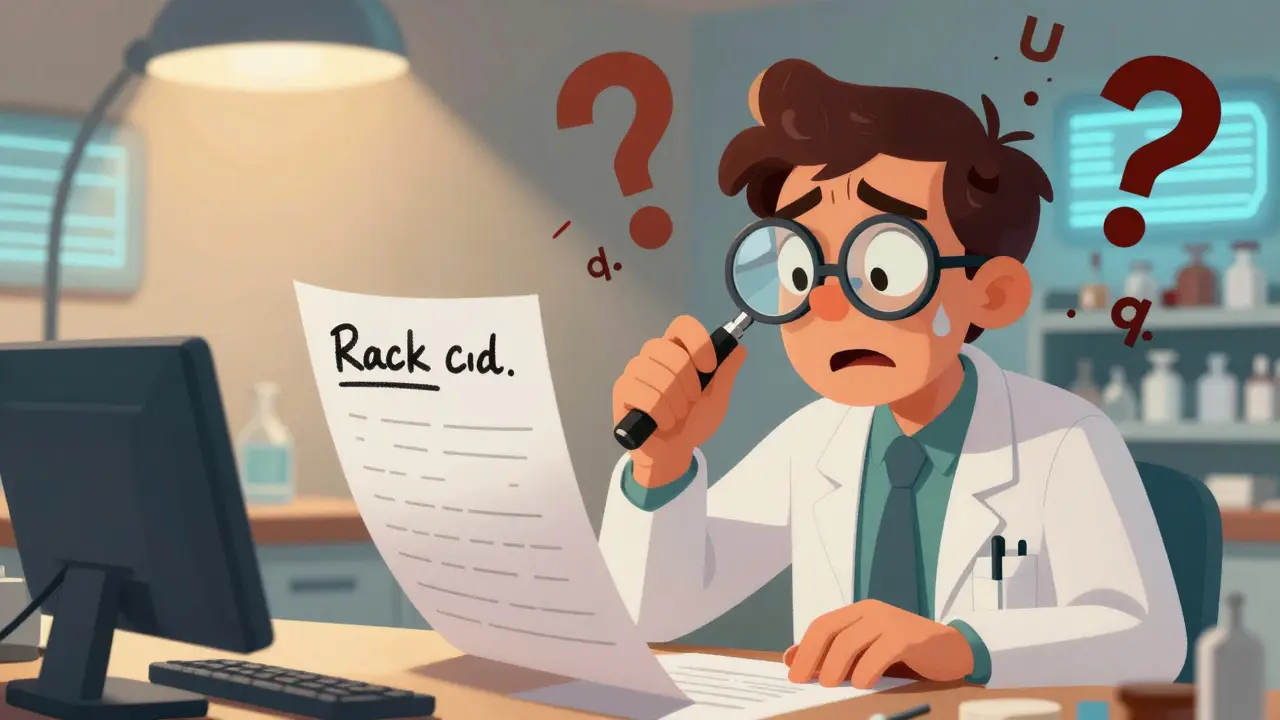
Why Your Doctor’s Scribble Could Kill You
Imagine you’re in pain. You visit your doctor, get a prescription, and head to the pharmacy. But when the pharmacist tries to read it, they can’t tell if it’s 500mg or 50mg. Or if it’s amoxicillin or acetaminophen. Or if the dose is meant to be taken three times a day or three times a week. This isn’t a horror story. It’s real. And it happens more often than you think.
In the U.S. alone, an estimated 7,000 deaths each year are directly tied to unreadable handwriting on prescriptions. That’s more than the number of people who die in plane crashes annually. And it’s not just about death - it’s about delays, wrong doses, allergic reactions, and hospitalizations that could have been avoided. The problem isn’t new. Back in 2000, experts called handwritten prescriptions a “dinosaur long overdue for extinction.” Yet, for years, little changed.
The Hidden Cost of Bad Handwriting
It’s not just doctors who suffer from this. Nurses spend an average of 12.7 minutes per prescription just trying to figure out what was written. Pharmacists make 150 million phone calls a year in the U.S. just to clarify orders. That’s not just wasted time - it’s delayed care. A patient waiting for antibiotics might get sicker. Someone on blood thinners might get the wrong dose and bleed internally.
A 2005 study in a British hospital found that only 24% of handwritten operative notes were rated as “excellent” or “good” by healthcare staff. Nearly 40% were deemed “poor.” And here’s the kicker: 92% of medical students and doctors admitted to making prescription errors - averaging two mistakes per person. Most didn’t even realize they’d made them.
Why does this keep happening? Time pressure. Doctors are rushed. They’re juggling patients, charts, and insurance forms. Writing clearly takes longer. And many still think, “I know what I meant.” But in a pharmacy, that doesn’t matter. What matters is what’s on the paper.
What’s Actually Wrong With Handwritten Prescriptions?
It’s not just messy cursive. It’s the tiny details that kill:
- Missing prescriber initials - so no one knows who ordered it
- Wrong dosage - “.5 mg” instead of “5 mg” (a tenfold error)
- Incorrect frequency - “q.d.” (once daily) confused with “q.i.d.” (four times daily)
- Wrong route - “PO” (by mouth) mistaken for “IV” (into the vein)
- Unsafe abbreviations - “U” for units (could be mistaken for “0” or “4”) or “cc” instead of “mL”
The Joint Commission banned many of these abbreviations over 20 years ago. But they still show up. Why? Because old habits die hard. And in high-pressure environments, shortcuts creep back in.

The Solution: Electronic Prescribing (e-Prescribing)
There’s a fix. And it’s not magic. It’s technology.
Electronic prescribing - or e-prescribing - lets doctors type orders directly into a system. The computer auto-fills the drug name, standard dosage, route, and frequency. It flags dangerous interactions. It blocks unsafe abbreviations. It sends the prescription straight to the pharmacy, digitally.
The results? Staggering.
A 2025 study in JMIR found that e-prescriptions had an 80.8% accuracy rate in meeting safety standards. Handwritten ones? Just 8.5%. That’s a 95% drop in errors - just by switching to typing.
Even when clinicians typed e-prescriptions from scratch - no templates, no presets - they still hit a 56% accuracy rate. That’s still more than six times safer than handwriting.
By 2019, 80% of U.S. office-based doctors were using e-prescribing. The shift was driven by federal incentives, like the Medicare Improvements for Patients and Providers Act of 2008, and later the 21st Century Cures Act. It wasn’t just about safety - it was about efficiency, compliance, and money.
It’s Not Perfect - But It’s Way Better
Some say e-prescribing creates new problems. And they’re right.
Alert fatigue is real. When a system pops up with 15 warnings for every prescription, doctors start ignoring them. That’s dangerous. Poor system design can slow down workflows. Some doctors say it takes longer to type than to scribble.
And in rural clinics or low-resource hospitals, the cost of installing e-prescribing systems can be a barrier. Setup costs average $15,000-$25,000 per provider. Training takes 8-12 hours. Integration with old electronic health records can be messy.
But here’s the thing: these are implementation problems. Not flaws in the solution. You don’t throw out a seatbelt because it’s uncomfortable. You fix the buckle.
And the cost of not fixing it? $20 billion a year in preventable medical errors in the U.S. alone. That’s billions spent on hospital stays, lawsuits, and lost productivity because someone couldn’t read a signature.
What If You Can’t Go Digital Yet?
Not every clinic has the budget or bandwidth for full e-prescribing. In those cases, there are still steps to reduce risk:
- Print, don’t cursive. Block letters are easier to read than loops and swirls.
- Avoid banned abbreviations. Never use “U” for units. Never use “q.d.” or “q.i.d.” Spell it out: “once daily,” “four times daily.”
- Write everything. Patient name, drug name, dose, frequency, route, prescriber name and contact info. No shortcuts.
- Use numbers, not words. Write “5 mg,” not “five milligrams.” Words are harder to interpret.
- Double-check before signing. Ask a colleague to glance at it. A second pair of eyes catches 30% more errors.
One study showed that using a simple 15-item checklist for handwritten prescriptions cut errors by nearly half. It’s not perfect - but it’s better than nothing.
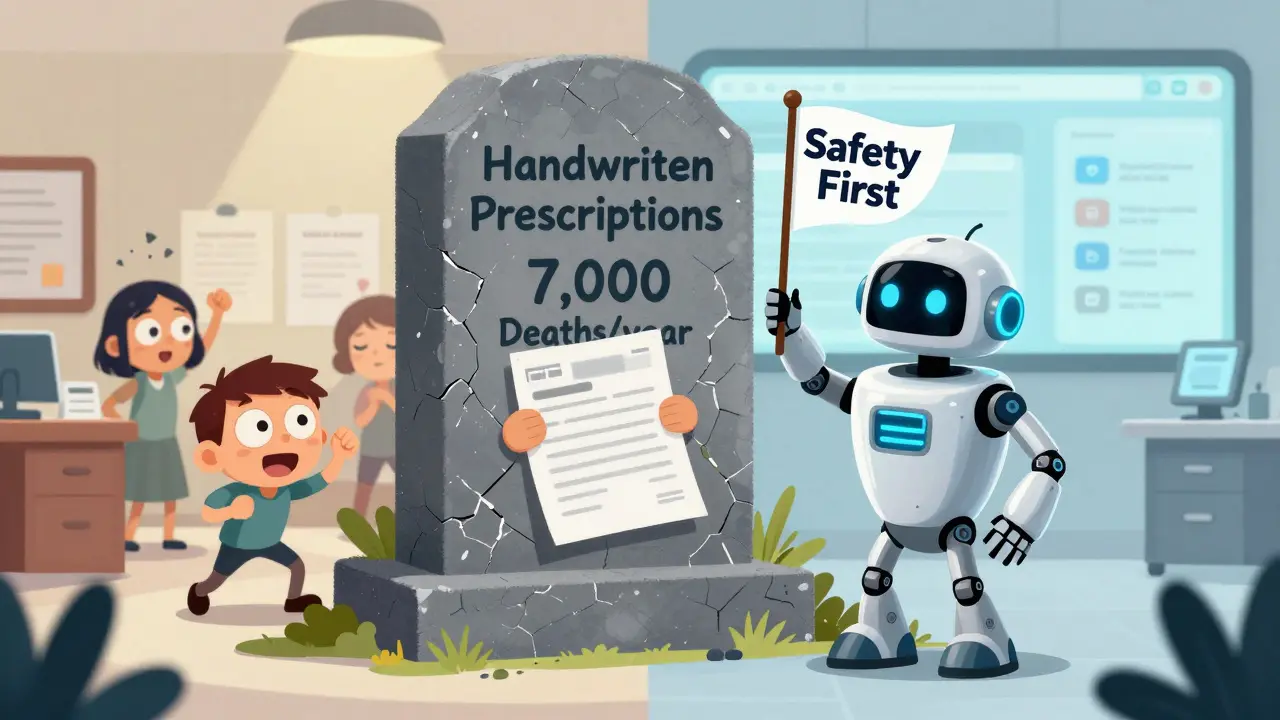
The Future: AI Can Read Handwriting - But Should It?
Some startups are now using AI to interpret handwritten prescriptions. Early tools can recognize medication names with 85-92% accuracy. That sounds promising.
But here’s the catch: AI doesn’t replace safety. It just masks the problem. If a doctor keeps writing illegibly, the system learns to guess. And guesses can be wrong. A 90% accuracy rate still means one in ten prescriptions gets misread. That’s unacceptable.
The goal isn’t to make bad handwriting readable. The goal is to eliminate it.
By 2030, handwritten prescriptions will be rare in developed countries. They’re already disappearing in hospitals. The only places they linger are in underfunded clinics, emergency rooms under stress, or in countries without digital infrastructure.
What You Can Do
Patients aren’t powerless here. If you get a prescription and can’t read it:
- Ask the pharmacist to call the doctor.
- Ask the doctor to print a copy or send it electronically.
- Take a photo of the prescription and show it to your pharmacist - sometimes the image helps.
- Don’t be afraid to say, “I’m not sure what this says. Can we double-check?”
Medication safety isn’t just the doctor’s job. It’s everyone’s job.
Final Thought: This Isn’t About Penmanship
This isn’t about whether your doctor has good handwriting. It’s about whether your life matters enough to be clearly communicated.
Handwritten prescriptions are a relic of a time when medicine moved slower and errors were accepted as “part of the job.” We don’t accept that anymore. We don’t fly planes with paper maps. We don’t drive cars without airbags. Why do we still hand out life-or-death doses on napkin scribbles?
The answer is simple: we don’t have to. Technology gave us the tool. All we needed to do was use it.




15 Comments
I've seen this in Nigeria too. Doctors write like they're racing against time, and patients pay the price. I once had to wait 3 hours because the pharmacist couldn't read the dose. We need tech, but we also need training. Not everyone can afford e-prescribing, but everyone deserves to be understood.
It's not just about money-it's about dignity.
The data here is compelling, and the shift to e-prescribing is long overdue. According to the Institute of Medicine, medication errors cost the U.S. healthcare system over $40 billion annually-not just in direct costs, but in lost productivity and patient trust. The 95% reduction in errors with e-prescribing isn’t just a statistic; it’s a moral imperative. Let’s stop romanticizing handwriting and start prioritizing safety.
LMAO 😂 so now we're gonna blame doctors for being human? I bet if you forced every lawyer to type their contracts instead of handwriting them, they'd also 'make more mistakes'. This is tech-bro nonsense dressed up as public health. The real problem? Overworked staff and underfunded clinics. Not that doctors can't write legibly. 🤷♂️
bro like why do we even care if the doc writes bad? pharmacy just calls em. its not that hard. also e-prescribe is just another thing that makes the system slower. i got my meds fine before all this tech crap.
I work in a rural clinic in Wales and we still use paper. We don’t have the budget for e-prescribing, but we use the checklist from the article-block letters, no abbreviations, double-check with a nurse. It’s not perfect, but it’s cut our error rate way down. Tech’s great, but sometimes the cheapest fix is just slowing down and being a little more careful.
Also, I write like a chicken scratch, but my pharmacist knows me by name now. That helps.
THIS IS WHY AMERICA IS FALLING APART. WE LET DOCTORS WRITE LIKE KINDERGARTENERS AND THEN WONDER WHY PEOPLE DIE. THIS ISN’T A ‘PROBLEM’-IT’S A CRIME. EVERY SINGLE DOCTOR WHO HANDWRITES A PRESCRIPTION IS ONE STEP AWAY FROM MURDER. E-PRESCRIBING ISN’T A CHOICE. IT’S A REQUIREMENT. FIX IT OR GET OUT.
NO MORE EXCUSES.
Interesting piece. I’ve worked in Irish hospitals where handwritten scripts were common-even in tertiary care. The real issue isn’t just illegibility, it’s the lack of standardized training. Medical schools still don’t teach clear documentation as a core competency. We focus on diagnosis, not communication. That needs to change at the root.
I used to be the guy who rolled my eyes at e-prescribing. Took me 3 years to admit I was wrong. The first time I typed a script and the system flagged a drug interaction I didn’t even know existed… I cried a little. Not because I was saved-I was saved before. But because I realized I’d been lucky, not skilled.
Now I teach residents to use templates. Not because I’m lazy. Because I care.
This is why America needs to stop importing doctors from Nigeria and India who can't even write English properly. We have the technology. We have the resources. What we don't have is the will to enforce standards. Handwriting errors are a symptom of cultural decay. Fix the system, not the pen.
From a clinical informatics perspective, the real bottleneck isn’t the technology-it’s interoperability. Many e-prescribing systems don’t integrate well with legacy EHRs, leading to duplicate data entry and workflow fragmentation. The 80% adoption rate is misleading; true adoption requires seamless integration, not just a checkbox on a dashboard. We need standards, not just software.
I just want to say thank you to every pharmacist who’s ever called my doctor to ask if ‘500mg’ was actually ‘50mg’ because they cared enough to double-check. You’re the unsung heroes. And to every doctor who took 2 extra minutes to write clearly-even when tired-you’re changing lives. We see you. We appreciate you. And yes, we’re finally catching up with tech. But don’t forget the humans behind the screens.
Also, I printed out the checklist and taped it to my fridge. It’s my new daily mantra.
My grandma got the wrong antibiotic because the doc wrote ‘amox’ and the pharmacy thought it was ‘amoxicillin’-but the dose was wrong. She ended up in the ER. We were lucky. She’s fine now. But that could’ve been the end. I didn’t know this was so common until I read this. Now I always ask my doc to send it electronically. No more guessing. No more stress.
Okay but what if you’re a doctor who hates computers? What if you’re 65 and you’ve been writing scripts since 1980 and now you’re supposed to learn a whole new system? You’re not lazy-you’re just not tech-savvy. And the system doesn’t care. It just says ‘comply or lose funding.’ That’s not progress. That’s punishment. We need better onboarding, not just mandates. Not everyone can be a millennial coder.
I’ve worked in 12 ERs across 7 states. Handwritten scripts are a death sentence. I’ve seen patients die because someone couldn’t read ‘0.5’ vs ‘5’. I’ve seen nurses cry because they had to call 17 times just to confirm a dose. This isn’t opinion. This is trauma. Stop pretending this is a debate. It’s not. It’s a massacre. And the people who defend handwriting are either ignorant or complicit.
The ethical obligation to ensure accurate medication delivery supersedes all logistical and financial considerations. The continued use of handwritten prescriptions constitutes a breach of the principle of non-maleficence. Adoption of electronic prescribing is not merely a technological upgrade-it is a moral necessity. Failure to implement it systematically is indefensible.