
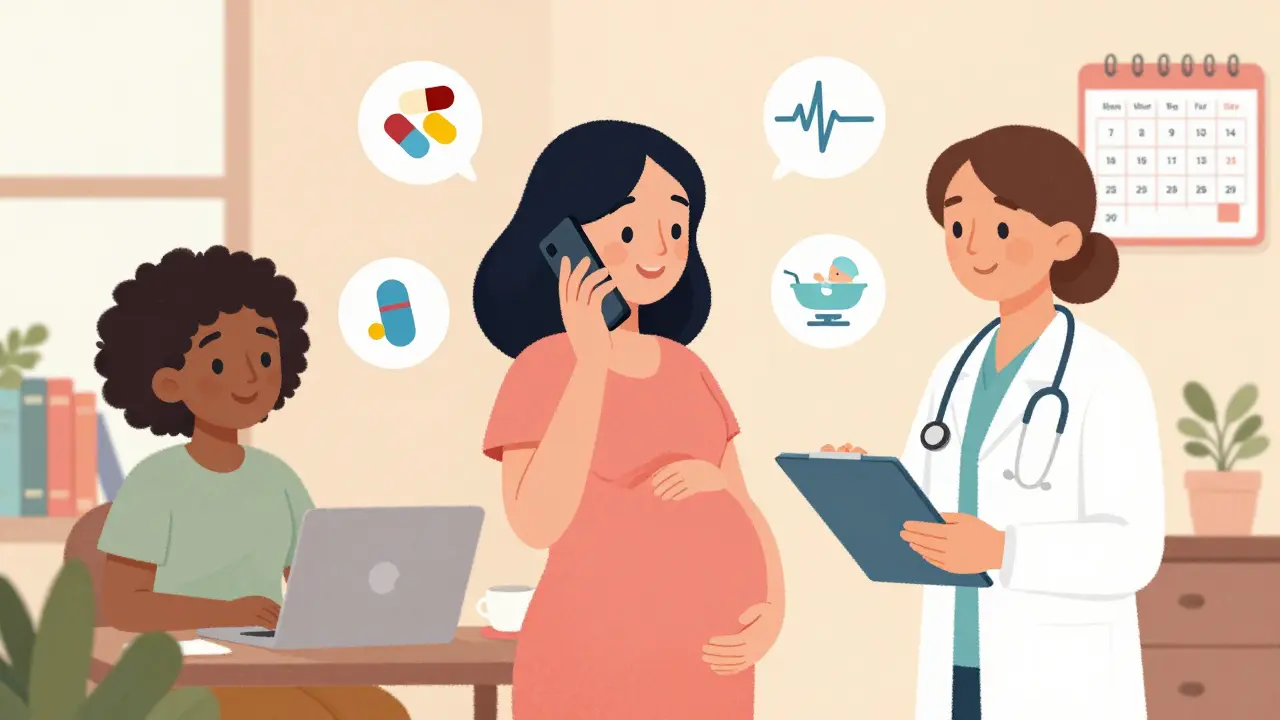
When a woman takes medication during pregnancy, no one knows for sure if it’s safe-not even her doctor. Clinical trials don’t include pregnant women, and animal studies don’t always predict what happens in humans. That’s why pregnancy registries exist: to fill the biggest gap in drug safety we’ve ever faced.
These aren’t just databases. They’re active, ongoing studies that follow women from the moment they start a medication through birth and sometimes beyond. The goal? To find out if a drug causes birth defects, preterm labor, low birth weight, or long-term developmental issues. And over the last decade, they’ve started giving us real answers-slowly, carefully, and one pregnancy at a time.
How Pregnancy Registries Work
Pregnancy registries don’t wait for problems to happen. They get in early. A woman finds out she’s pregnant while taking a medication-maybe for epilepsy, depression, or an autoimmune disease-and she’s offered a chance to join a registry. She consents. She answers questions about the drug, the dose, when she started it, whether she smoked or drank, and what other medications she’s on. Then, her healthcare providers report back on her pregnancy outcome: was it full-term? Was the baby healthy? Were there any physical abnormalities?
Unlike passive systems like the FDA’s Adverse Event Reporting System (FAERS), which rely on doctors or patients to report problems after they occur, registries proactively collect data before outcomes are known. This reduces guesswork and recall bias. If a woman forgets she took a pill at week 5, it’s not a problem-the registry asks her right away.
Some registries go even further. The National Pregnancy Registry for Psychiatric Medications, run by Massachusetts General Hospital, follows children for up to 12 months after birth to check for delays in motor skills, speech, or social development. That’s not something you can get from a hospital chart or insurance claim.
What We’ve Learned So Far
Registries have changed how we think about certain drugs. Take lamotrigine, a common anti-seizure medication. Before registries, many doctors avoided it in pregnancy because of theoretical risks. But data from the North American Antiepileptic Drug Pregnancy Registry showed no increased risk of major birth defects compared to the general population. Today, it’s one of the first-line choices for women with epilepsy who are pregnant.
Same with SSRIs like sertraline. Early studies suggested a link to heart defects, but registry data from over 1,500 pregnancies showed no consistent pattern. The risk, if any, is small-smaller than the risk of untreated depression. That’s huge. It means women can now make informed choices instead of being told to stop their medication cold.
For newer biologic drugs-like those used for rheumatoid arthritis or psoriasis-registries are often the only source of human data. Drugs like adalimumab and etanercept were once avoided entirely during pregnancy. Now, registry data from over 2,000 pregnancies show no clear signal of birth defects. That’s not proof of safety, but it’s enough reassurance for many doctors and patients to proceed.
The Limits of the Data
Here’s the hard truth: registries can’t prove a drug is completely safe. They can only say it doesn’t cause major defects at a higher rate than expected.
Why? Sample size. Most registries enroll between 50 and 500 women. To detect a doubling of a rare defect-say, from 1 in 100 to 2 in 100-you’d need over 1,200 exposed pregnancies. Very few registries reach that number. And if a drug is only taken by a few hundred women a year, like those for rare diseases, enrollment becomes a slow crawl.
Also, these studies rely on volunteers. Only 15-20% of eligible women enroll. Those who do are often more informed, more anxious, or more motivated to contribute. That creates selection bias. The women who don’t join? We don’t know why. Maybe they’re scared. Maybe they don’t trust the system. Maybe their doctor never told them about the registry.
And even when data comes in, it takes years to analyze. A registry might start in 2020, collect data through 2024, and not publish findings until 2026. That’s too slow for a woman who’s pregnant right now.

Who Runs These Registries?
Most are funded by pharmaceutical companies-required by the FDA and EMA as part of post-market safety commitments. But they’re not run by the drugmakers. Independent research institutions manage them: hospitals, universities, nonprofit organizations like MotherToBaby.
In the U.S., over 80 active registries are currently tracking medications used in pregnancy. The biggest categories? Psychiatric drugs (12 registries), antiepileptics (8), and biologics for autoimmune diseases (15). These are areas where the benefit of treatment often outweighs the unknown risk. That’s why regulators push hardest here.
Europe and the U.S. have similar systems, but coordination is improving. In 2022, the FDA launched the Pregnancy Safety Research Network to standardize data collection across registries. That means better comparisons, fewer gaps, and eventually, more reliable conclusions.
What Women Say About Participating
Many women who join registries say it gives them peace of mind. One mother in Ohio, who took fluoxetine during her pregnancy and enrolled in the psychiatric registry, told researchers: “I didn’t want to be the one who didn’t tell anyone. I wanted to help the next woman.”
According to MotherToBaby’s 2022 report, 78% of participants felt they made a meaningful contribution. They appreciated getting personalized updates, even if the answers weren’t always clear. The biggest complaint? Not being able to get immediate answers. Registries aren’t urgent care-they’re long-term science.
But the emotional toll is real. Women taking psychiatric meds often feel guilty. They worry they’re harming their baby. Joining a registry doesn’t erase that fear, but it can turn it into something productive. For many, it’s the first time they’ve been asked: “What do you need to feel safe?”
The Future: Better Data, Smarter Systems
The next big step? Linking registries with electronic health records. Right now, data is collected manually-phone calls, paper forms, clinic visits. It’s slow. It’s error-prone. If registries could automatically pull data from EHRs-medication history, lab results, delivery notes-they’d get bigger, cleaner datasets without asking women to fill out more forms.
Researchers are also starting to use registry data alongside large insurance databases. A woman in a registry might be one of 500. But if you combine her data with 50,000 other pregnancies from claims systems, you get statistical power you never had before. This hybrid approach is already being tested.
And regulators are listening. The FDA’s 2023 Strategic Plan for Regulatory Science explicitly calls for integrating registry data with real-world evidence. That’s a game-changer. It means we won’t have to wait 10 years to learn if a drug is safe. We’ll start seeing patterns in 2-3 years.
What This Means for You
If you’re pregnant and taking medication, don’t stop without talking to your doctor. But do ask: “Is there a registry for this drug?” If there is, consider joining. You’re not just protecting your baby-you’re helping other women make better choices.
If you’re a healthcare provider, don’t assume your patient knows about registries. Mention them. Offer the contact info. Make it part of your routine counseling. Many women never hear about them unless someone brings it up.
And if you’re someone who’s ever wondered whether a medication is safe during pregnancy-you now know the answer isn’t simple. But it’s being built, one woman, one pregnancy, one registry at a time.
Are pregnancy registries mandatory for drug manufacturers?
Yes, for certain drugs. The U.S. FDA and European Medicines Agency (EMA) require pregnancy registries as part of post-marketing safety commitments, especially for biologics, psychiatric medications, and antiepileptics. These requirements became more common after the 2015 FDA Pregnancy and Lactation Labeling Rule, which pushed for better safety data collection. Not every drug needs one, but if a medication is likely to be used by women of childbearing age, regulators often ask for a registry.
Can I join a pregnancy registry if I’m not in the U.S.?
Yes, but options are limited. Most U.S.-based registries accept international participants if they’re taking a drug studied in the registry and can communicate in English. Some European registries exist, especially for drugs approved by the EMA. MotherToBaby and other nonprofit groups often help coordinate global participation. If you’re outside the U.S., ask your doctor or pharmacist if your medication has a registry and whether international enrollment is possible.
Do pregnancy registries track vaccines too?
Yes. Several registries now track vaccines given during pregnancy, including the flu shot and COVID-19 vaccines. The CDC and FDA have supported these efforts since 2020. Data from these registries helped confirm that mRNA vaccines don’t increase the risk of birth defects or preterm birth. This was critical in rebuilding public trust in vaccine safety during pregnancy.
How long does it take to get results from a pregnancy registry?
It can take 3-5 years or longer. Registries need enough pregnancies to reach statistical significance. For example, if a drug is taken by only 100 women a year, it might take 5 years to gather 500 cases. Then, data must be cleaned, analyzed, peer-reviewed, and published. The National Pregnancy Registry for Psychiatric Medications, for instance, published its first major findings in 2021 after collecting data since 2012. Patience is part of the process.
Is my information private in a pregnancy registry?
Yes. Registries follow strict privacy rules. Personal identifiers like your name, address, or Social Security number are never linked to your medical data. Instead, you’re assigned a code. Only de-identified data is shared with researchers or regulators. Most registries are certified under HIPAA (in the U.S.) or GDPR (in Europe). You can ask the registry team for their privacy policy before enrolling.




15 Comments
I joined the psychiatric registry when I was pregnant on sertraline-best decision I ever made. I got monthly updates, even when they said, ‘No new data yet.’ It felt like I was part of something bigger. Not just for me, but for every woman who’s ever been told to ‘just quit’ without options.
Let me be perfectly clear: pregnancy registries are not ‘science’-they’re glorified observational studies with selection bias so thick you could spread it on toast. The FDA and EMA demand them because they’re legally obligated, not because they’re statistically sound. We’re talking about n=500 cohorts trying to detect a 0.5% increase in limb malformations. That’s not research-it’s wishful thinking wrapped in IRB paperwork. Real science requires randomized controlled trials, not self-selected volunteers filling out forms after the fact. And don’t even get me started on the pharmaceutical funding-don’t pretend this isn’t industry-sponsored PR dressed up as maternal care.
Okay but can we just talk about how terrifying it is that we have to rely on this? I mean, I took lamotrigine during pregnancy and I was terrified every single day. Not because I didn’t trust my doctor-but because the silence was louder than any warning label. When I got that first registry update saying ‘no increased risk found,’ I cried in the grocery store aisle. I didn’t even know I was holding my breath until I finally exhaled. It’s not just data-it’s emotional survival. And yes, the system is slow. And yes, it’s imperfect. But it’s the only thing that made me feel like I wasn’t alone in the dark.
Interesting. So we’re collecting data on women who voluntarily opt in, mostly those who are already anxious and well-informed, and using that to make public health decisions? Sounds like a classic confirmation bias loop. Also, 3-5 years to publish? That’s not science. That’s bureaucracy with a lab coat. If we’re serious about maternal health, we need real-time data streams-not paper forms and phone calls. And why aren’t we using EHRs yet? This feels like 2005 thinking in a 2025 world.
Registries are a necessary evil. However, their efficacy is undermined by the fact that they are not universally accessible. In India, for instance, the majority of pregnant women have no access to such programs due to socioeconomic barriers, lack of digital infrastructure, and inadequate physician awareness. The Western-centric model of registry participation assumes a level of healthcare literacy and access that simply does not exist globally. Therefore, while the data may be statistically valid within its narrow scope, its generalizability is severely limited.
Bro, this is why I love science. You see a problem-meds during pregnancy, no data-and instead of panicking, people built a system to slowly, carefully, fix it. One woman at a time. One pregnancy at a time. I know it’s slow. But think about it: 15 years ago, we had zero. Now? We’ve got 80+ registries. That’s progress. And if you’re a mom out there reading this-join one. You’re not just protecting your kid. You’re giving hope to the next person who’s scared to take their pill.
omg i just joined the fluoxetine registry!! i was so nervous but the team was so nice and sent me a little welcome packet!! i feel like i’m helping even though i don’t know much about science lol. also-can we talk about how weird it is that we still use paper forms? like… why??
I’m a doc. I mention registries to every pregnant patient on meds now. Not because I’m required to-but because they deserve to know they’re not alone. Last week, a woman told me she’d been terrified to take her antidepressant for three years because no one ever told her there was a registry. That’s on us. We’re the ones who have to make this visible. It’s not just about data-it’s about dignity.
So the registries are run by hospitals but funded by pharma? Hmm. That’s kinda sketchy. I mean, I get it-they need the $$, but still. Who’s watching the watchers? Just saying. Also, I signed up for the lamotrigine one. Took me 3 weeks to fill out the first form. Why so long? My phone’s got a calendar app. Why not just sync it?
My sister joined the autoimmune meds registry. She got a handwritten letter from the researcher after her baby was born-no template, no bot. Just: ‘Thank you. Your data helped.’ That’s the kind of thing that sticks with you. This isn’t just about statistics. It’s about human connection. We forget that when we talk about ‘data collection.’
As an Irishman, I find this entire system deeply problematic. The U.S. is treating pregnancy as a clinical variable rather than a natural biological state. This is over-medicalization at its finest. Why are we so obsessed with quantifying every breath a pregnant woman takes? We’ve turned motherhood into a risk assessment spreadsheet. And let’s not pretend the pharmaceutical industry doesn’t profit from this fear. Registries are a corporate shield dressed as compassion.
While the intent behind pregnancy registries is commendable, their operational structure reveals a fundamental tension between public health imperatives and private sector interests. The reliance on industry funding creates a structural conflict of interest, even if oversight is ostensibly independent. Furthermore, the exclusion of non-English-speaking populations and those without consistent healthcare access renders the data culturally and demographically skewed. A truly equitable system would require not merely data collection, but systemic investment in global maternal health infrastructure.
They’re lying. They always lie. The registries? A distraction. The real data is buried in the VAERS-like systems they don’t want you to see. Why else would they avoid linking EHRs? Why do they take 5 years to publish? Because they’re hiding something. I know a woman who had a baby with a cleft palate after taking an SSRI-she was told to ‘just be grateful’ the baby survived. No registry helped her. They just took her data and disappeared. I’m not joining. I’m watching.
I took 17 different meds during pregnancy. 17. And not one doctor mentioned a registry. Not one. I found out by accident on Reddit. Now I’m mad. Like, furious. Why is this information so hard to find? Why does it take a random comment thread to save someone’s peace of mind? Someone needs to make a billboard: ‘IF YOU’RE PREGNANT AND ON MEDS-ASK ABOUT THE REGISTRY.’
Oh, so now we’re treating pregnant women like lab rats with better Wi-Fi? ‘Join our registry and help science!’ Meanwhile, the same pharma companies that fund these registries are the ones lobbying to keep drug labels vague. Classic. And yes, I’m sarcastic. Because this whole system is a performance. We’re collecting data from the most anxious, educated, privileged 20%-and pretending it applies to everyone. The rest? They’re just ‘risk.’