
Sulfonylurea Weight Gain Estimator
Estimate your potential weight gain while taking sulfonylurea medications based on clinical data.
Enter values above to see your estimated weight gain.
Why Sulfonylureas Make You Gain Weight
Sulfonylureas have been around since the 1950s and still help millions of people with type 2 diabetes keep their blood sugar under control. But there’s a downside most people don’t talk about: weight gain. It’s not just a side effect-it’s a real problem that can make diabetes harder to manage over time.
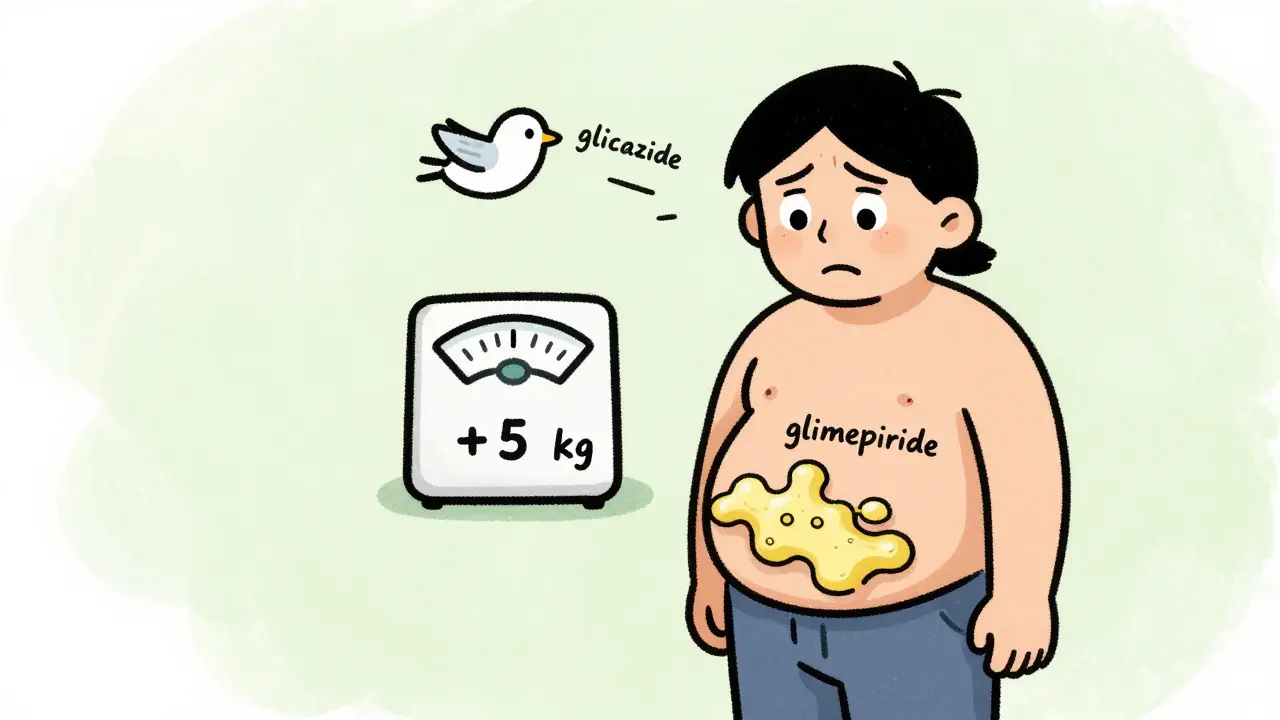
These drugs work by forcing your pancreas to pump out more insulin. More insulin means your body stores more glucose as fat, especially around your belly. It’s not about eating more-it’s about how your body handles what you already eat. Studies show most people gain 2 to 5 kilograms (4.4 to 11 pounds) in the first year on sulfonylureas. For someone already struggling with weight, that’s enough to derail progress.
Not All Sulfonylureas Are the Same
Not every sulfonylurea acts the same way when it comes to weight. Glimepiride and glyburide are the most likely to cause weight gain. In one 2016 study of 51 patients, over 60% of those who gained weight were on glimepiride. Meanwhile, gliclazide stood out as an exception. In a separate 1988 trial, patients on gliclazide actually lost weight over three years.
Why the difference? It’s not fully understood, but it likely has to do with how tightly each drug binds to receptors on fat cells. Glimepiride seems to trigger fat storage more aggressively. If you’re starting a sulfonylurea and weight is a concern, asking for gliclazide instead could make a measurable difference.
How Much Weight Are We Talking About?
Numbers matter here. Clinical trials often report averages: 3-5 kg gained. But real-world experiences tell a different story. On diabetes forums like Reddit and the American Diabetes Association’s community site, 70% of users say they gained 5 pounds or more within six months. One user on Reddit lost 12 pounds after switching from glipizide to metformin-just by changing pills.
That’s not just about the scale. Extra weight makes insulin resistance worse, which means you might need higher doses of medication just to keep blood sugar in check. It’s a cycle: more insulin → more fat storage → worse insulin resistance → more insulin. And it’s not just about appearance. That extra weight raises your risk for heart disease, joint pain, and sleep apnea-all things people with diabetes already face.

Compared to Other Diabetes Drugs
Here’s where sulfonylureas really fall behind:
- Metformin: Weight-neutral or even helps you lose 2-3 kg.
- GLP-1 agonists (like semaglutide): Cause 3-7 kg weight loss.
- SGLT2 inhibitors (like empagliflozin): Also lead to 3-7 kg loss by making you pee out sugar.
- Sulfonylureas: Cause 2-5 kg gain.
It’s not even close. Newer drugs don’t just control blood sugar-they improve your body’s metabolism. Sulfonylureas? They make your body hold onto more fat. And while newer drugs cost $600+ a month, sulfonylureas can be as cheap as $8. That’s why they’re still prescribed, especially for people on Medicare or without insurance. But cost shouldn’t be the only factor.
What Doctors Are Saying
Experts are split. Some, like Dr. John B. Buse, say weight gain with sulfonylureas creates a "therapeutic paradox"-your blood sugar improves, but your overall health gets worse. The American Association of Clinical Endocrinologists now advises against using sulfonylureas in people with a BMI over 35.
But others, like Dr. Ralph A. DeFronzo, argue the weight gain is often exaggerated. Real-world data suggests most people gain only 1.8-2.7 kg over two years, not the 5 kg from old trials. The truth? It depends on the drug, the dose, and the person. If you’re already overweight, even a 2 kg gain can feel like a big setback. If you’re lean, it might not matter as much.
What You Can Do About It
You don’t have to just accept weight gain. Here’s what actually works:
- Choose gliclazide over glimepiride or glyburide-it’s the least likely to pack on pounds.
- Add metformin. Combining it with a sulfonylurea cuts weight gain by about 1.2 kg over a year.
- Move more. 150 minutes of walking or cycling a week cuts sulfonylurea-related weight gain by 63%, according to a Veterans Affairs study.
- Eat within an 8-hour window. A 2024 study showed time-restricted eating reduced weight gain by 78% in people on sulfonylureas.
- Track your weight monthly. If you gain more than 3% of your starting weight in six months, talk to your doctor about switching.

The Bigger Picture
Sulfonylureas aren’t going away. In 2022, they still made up 18% of the global oral diabetes drug market. Why? Because they’re cheap, simple, and work. For someone making $15 an hour with no insurance, $8 a month for glyburide is the only option.
But the tide is turning. In the U.S., prescriptions for sulfonylureas dropped 34% between 2017 and 2022. Meanwhile, GLP-1 drugs jumped 187%. Insurance companies are starting to cover newer drugs more often, especially for people with obesity or heart disease.
Still, 85% of low-income patients worldwide rely on sulfonylureas. That’s why experts aren’t calling to ban them-they’re calling for better alternatives. Some researchers are already working on modified sulfonylureas that don’t trigger fat storage. Until then, knowing which one to pick and how to fight the weight gain is your best defense.
When to Consider Switching
If you’re on a sulfonylurea and:
- You’ve gained more than 5 pounds in 6 months
- Your waist size increased by 2 inches or more
- Your blood sugar is stable but you feel worse overall
- You’re struggling with hunger or constant fatigue
It’s time to have a conversation. You don’t need to stop the drug cold turkey. Ask about switching to gliclazide, adding metformin, or trying a newer agent if your insurance allows it. Many people find their energy improves and their clothes fit better within weeks of switching.
Final Thought
Sulfonylureas saved lives decades ago. Today, they’re a tool-not a default. Weight gain isn’t inevitable. It’s predictable. And if you know how to manage it, you can still use these drugs without letting them control your body. The goal isn’t just to lower blood sugar. It’s to live better. That means thinking about weight, energy, and long-term health-not just numbers on a glucose meter.
Do all sulfonylureas cause weight gain?
No. While most sulfonylureas like glimepiride and glyburide are linked to weight gain, gliclazide is an exception. Studies show patients on gliclazide often experience little to no weight gain, and in some cases, even lose weight. If weight is a concern, ask your doctor if gliclazide is an option.
Can I lose the weight I gained on sulfonylureas?
Yes. Many people report losing the extra weight after switching to metformin, GLP-1 agonists, or SGLT2 inhibitors. Lifestyle changes like regular exercise and eating within an 8-hour window also help reverse the gain. The key is not just stopping the drug, but replacing it with something that doesn’t promote fat storage.
Is it safe to stop sulfonylureas on my own?
No. Stopping suddenly can cause your blood sugar to spike dangerously. Always work with your doctor to taper off and switch to another medication safely. Your doctor can help you transition without risking hypoglycemia or uncontrolled diabetes.
Why are sulfonylureas still prescribed if they cause weight gain?
They’re cheap, effective, and easy to use. For people without insurance or with limited income, sulfonylureas like glyburide can cost as little as $8 a month. Newer drugs may be better for weight and heart health, but they’re often unaffordable. Until prices drop, sulfonylureas remain a necessary option for many.
How does weight gain from sulfonylureas affect long-term health?
Extra weight worsens insulin resistance, making diabetes harder to control. It also increases risks for heart disease, high blood pressure, fatty liver, and sleep apnea. Studies link sulfonylureas to a higher risk of cardiovascular events, and weight gain is one of the contributing factors. Managing weight while on these drugs isn’t optional-it’s part of your treatment plan.




13 Comments
I gained 8 lbs on glimepiride and thought it was just me being lazy 😭 Then I switched to gliclazide and lost it all in 3 months. Why isn’t this common knowledge?? 🤦♀️
Ugh, another ‘big pharma is evil’ post. People who don’t work manual labor can’t afford these fancy GLP-1 drugs. Sulfonylureas keep my grandma alive and she’s 78. Stop pretending everyone’s got a $600/month budget.
Honestly? If you’re gaining weight on these, you’re probably not tracking your carbs. It’s not the drug-it’s the donuts. Just saying.
The data presented here is methodologically sound and aligns with recent ADA guidelines. However, it’s important to contextualize weight gain within the broader spectrum of glycemic control and patient autonomy. Not all outcomes are quantifiable by BMI alone.
I know it’s easy to get frustrated when the scale won’t budge, but hear me out-you’re not failing. You’re just on a medication that’s working too well at storing energy. That’s not your fault. The fact that you’re even reading this means you care, and that’s half the battle. Small changes, like walking after dinner or switching to gliclazide, can totally flip the script. I’ve seen people go from exhausted to energized just by tweaking their script. You got this.
gliclazide is the secret weapon. i switched from glyburide and lost 7lbs in 2 months without changing anything else. also, 8hr eating window? game changer. i was skeptical but now i’m hooked. ps: spelling is bad, sorry, typing on phone 😅
It’s fascinating how a molecule that binds to a receptor on beta cells can cascade into systemic fat accumulation. The body doesn’t distinguish between ‘medically necessary insulin’ and ‘excess insulin’. It just stores. The real question isn’t whether sulfonylureas cause weight gain-it’s why we still treat diabetes as a problem of glucose, not energy flux.
To everyone feeling defeated by the scale: Your worth is not measured in kilograms. The fact that you’re managing diabetes, researching your meds, and seeking change? That’s courage. You’re not broken. You’re adapting. And if gliclazide + movement + time-restricted eating helped even one person? That’s a win. Keep going. You’re not alone.
Actually, the 2016 study you cited had a sample size of 51 with no control group. The 1988 gliclazide trial was open-label and lasted 3 years with no HbA1c adjustment. Also, metformin doesn’t cause weight loss-it reduces hepatic glucose output. You’re conflating correlation with causation. Read the original papers before posting.
I was on glipizide for 2 years and gained 15 lbs. Felt like a balloon. Switched to metformin + gliclazide combo and now I fit into my jeans again. 🎉 Also, walking 30 mins after dinner? Non-negotiable. You don’t have to be perfect-just consistent. I believe in you!
If you can’t afford newer drugs, you shouldn’t be on insulin secretagogues at all. This isn’t about cost-it’s about responsibility. Prescribing a drug that worsens metabolic health in obese patients is malpractice. Stop normalizing harm because it’s cheap.
I cried when I lost 11 lbs after switching from glyburide to empagliflozin. 🥲 I felt like myself again. Like I could breathe. Like my body wasn’t betraying me. If you’re on a sulfonylurea and gaining weight… please, please talk to your doctor. You deserve better.
In India, we use glibenclamide (glyburide) because it’s ₹50/month. But my patients who eat roti with dal and walk 6k steps daily? They don’t gain weight. It’s not the drug-it’s the roti. Change the plate, not just the pill.