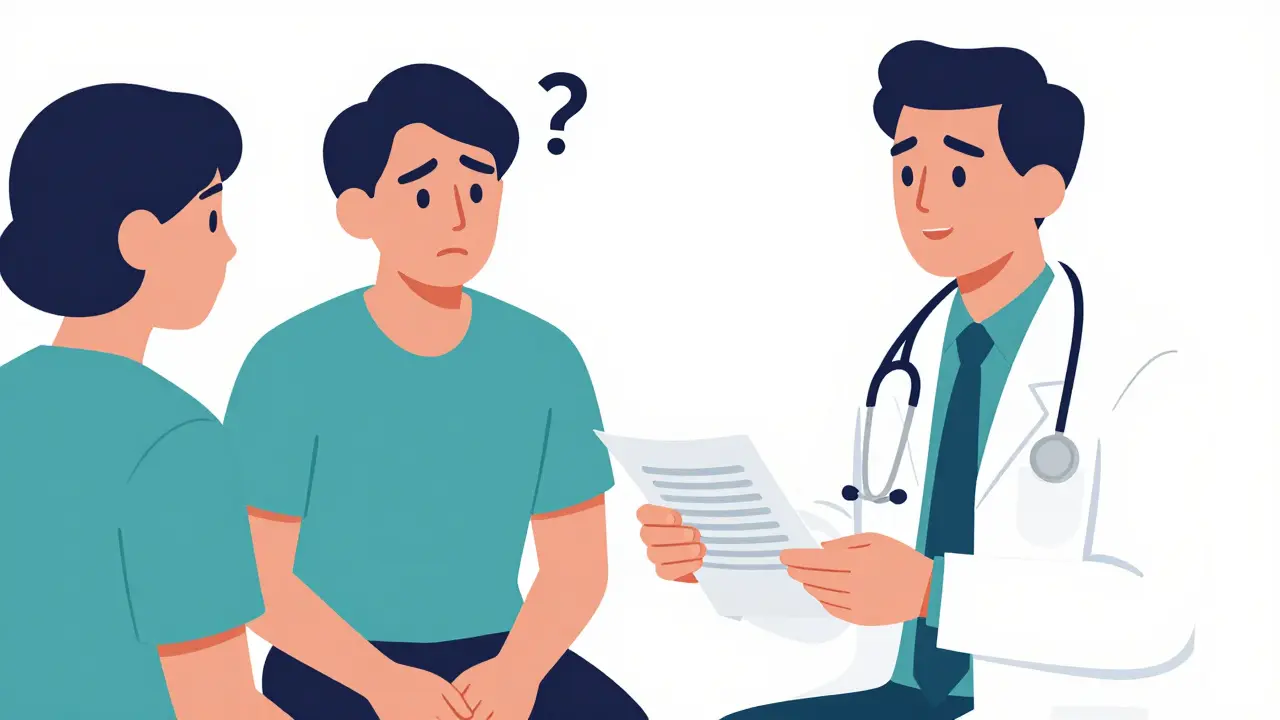
Giving a patient a brochure and asking, "Do you have any questions?" is not a measurement tool-it's a formality. Most patients will nod and say they understand, even when they are completely lost. The real challenge in healthcare isn't just delivering information; it's proving that the person receiving it actually "gets it." This is where education effectiveness is the systematic process of evaluating whether a learner has acquired the specific knowledge, skills, and competencies intended by an educational experience comes into play. To truly track generic understanding, we have to move past guessing and start using evidence-based assessment methodologies.
The Two Pillars of Tracking Understanding
When you're trying to figure out if a patient understands their new medication or a post-op care routine, you generally have two ways to do it. One tells you how they're doing right now, and the other tells you how they did at the end.
Formative assessment is an ongoing feedback mechanism used to monitor learning and provide immediate adjustments during the educational process. Think of this as a pulse check. In a clinical setting, this could be as simple as asking a patient to explain the most confusing part of their treatment plan midway through a session. It's not about a grade; it's about catching gaps before they become dangerous mistakes.
On the flip side, Summative assessment is an evaluation of student or patient performance at the end of an instructional unit to determine total knowledge acquisition. This is the "final exam." For a patient, this might be a final demonstration of how to administer an insulin injection or a short quiz before they are discharged from the hospital. While formative tells you where to pivot, summative tells you if the goal was actually met.
Direct vs. Indirect Measures: Evidence vs. Perception
Not all data is created equal. If you want to know if a patient is safe to go home, you need to distinguish between what they say they know and what they can actually do.
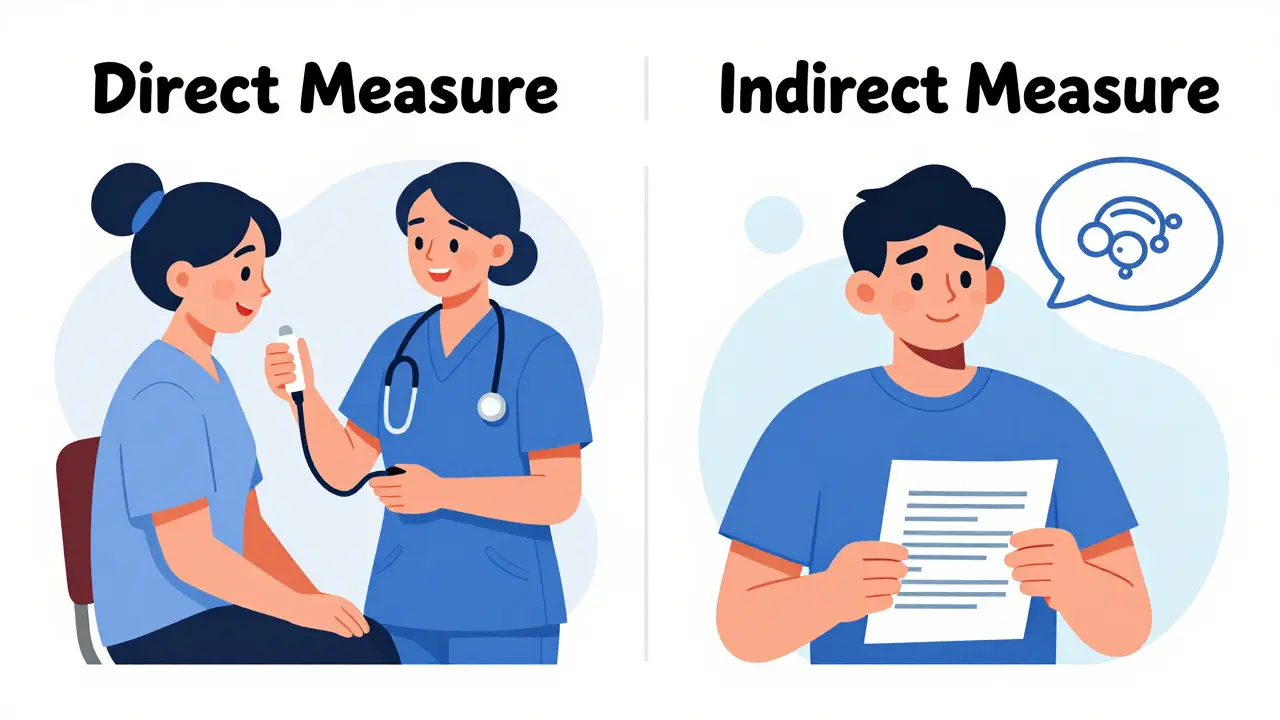
Direct measures provide concrete evidence of learning through performance. These are the gold standard. If a patient can successfully use a peak flow meter in front of you, that's a direct measure. It's an observable action that leaves no room for ambiguity. Common direct tools include:
- Teach-back method: Asking the patient to explain the instructions in their own words.
- Return demonstration: Having the patient perform a clinical skill (like changing a dressing).
- Case analysis: Giving the patient a hypothetical scenario and asking how they would react.
Indirect measures rely on self-reporting and perceived skills. These are essentially opinions. An exit survey asking, "Do you feel confident in managing your diabetes?" is an indirect measure. While useful for understanding the patient's emotional state or confidence, it doesn't prove they know the correct dosage. Expert guidance from sources like Faculty Focus suggests a balanced approach: lean heavily on direct assessments but use indirect surveys to add context to those results.
| Method | Primary Goal | Example | Reliability |
|---|---|---|---|
| Formative | Immediate Improvement | Mid-session Q&A | High (for agility) |
| Summative | Final Validation | Discharge Checklist | High (for outcome) |
| Direct | Proof of Competency | Skill Demonstration | Very High |
| Indirect | Patient Perception | Satisfaction Survey | Moderate/Low |
Using Criterion-Referenced Standards to Find Gaps
A common mistake in measuring effectiveness is comparing one patient to another. In healthcare, we don't care if Patient A understands their meds better than Patient B; we care if Patient A understands them well enough to stay alive. This is why criterion-referenced assessment is vital.
Unlike norm-referenced testing (which ranks people against each other), a criterion-referenced approach compares performance against a fixed standard. For example, if the standard for "safe discharge" is that a patient must identify three side effects of a medication, any patient who identifies only two has a learning gap. This allows providers to pinpoint exactly what is missing and fix it, rather than vaguely deciding the patient is "doing okay for their age."
The Holistic Approach: Beyond the Checklist
Traditional exams often fail to capture the "generic understanding"-the ability to apply knowledge in a new, real-world situation. UNESCO has long advocated for moving beyond rote memorization toward a holistic strategy. This means measuring not just the facts, but the critical thinking involved.
To implement this, consider incorporating Portfolio assessments, where you track a patient's progress over time through a collection of their work, logs, and demonstrated skills. While these are administratively heavy, they provide a cinematic view of a patient's journey toward health literacy rather than a single snapshot from a quiz.
Another powerful tool is the use of detailed rubrics. Instead of a simple "Pass/Fail," a rubric breaks down performance into levels (e.g., Novice, Proficient, Expert). For instance, a rubric for a patient using a glucose monitor might grade them on: 1) Equipment preparation, 2) Site selection, and 3) Accuracy of reading. This specificity helps the educator know exactly where the breakdown in understanding occurred.
Practical Pitfalls to Avoid
Even with the best tools, a few common errors can ruin your data. First, avoid over-relying on indirect measures. If your only proof of effectiveness is a survey saying "I feel good about this," you are measuring confidence, not competence. Confidence without competence is a recipe for medical errors.
Second, don't ignore the "intangibles." As noted in NIH research, performance measures often miss variables like values, beliefs, and emotional affect. A patient might be able to demonstrate a skill perfectly in a clinic (direct measure) but may have a belief system that prevents them from doing it at home. True effectiveness tracking must bridge the gap between can they do it and will they do it.
What is the fastest way to check if a patient understood my instructions?
The most efficient method is the "Teach-Back" technique. Instead of asking "Do you understand?", ask the patient to explain the instructions back to you as if they were explaining it to a family member. If they stumble or omit key steps, you can immediately correct the misunderstanding.
How does formative assessment differ from summative assessment in a clinic?
Formative assessment happens during the teaching process (e.g., asking a question every few minutes to check for confusion), while summative assessment happens at the end (e.g., a final check-off list before the patient leaves the facility).
Why are indirect measures like surveys considered less reliable?
Indirect measures track perceptions rather than actual skills. A patient may honestly believe they understand a process (perceived learning) but fail to perform the task correctly when tested (actual learning).
What is a criterion-referenced assessment?
It is a method of evaluation where a person's performance is measured against a pre-defined set of criteria or standards, rather than comparing them to other patients. It focuses on whether the individual has mastered the specific required skill.
Can AI help in tracking education effectiveness?
Yes, emerging AI-powered adaptive assessments can track individual learning trajectories in real-time, adjusting the difficulty of questions based on the patient's responses to pinpoint exact gaps in understanding more precisely than a static quiz.
Next Steps for Implementation
If you're looking to improve how you track understanding in your practice, start small. You don't need a complex digital system to see results. Try implementing a "three-question exit ticket"-ask patients to list one thing they learned, one thing they are still unsure about, and one goal for their recovery. This simple formative tool can significantly reduce the need for major reteaching and improve patient outcomes.
For those in administrative roles, the goal should be to shift the culture from "assessment of learning" (checking a box) to "assessment for learning" (using data to improve the experience). This transition usually takes a few months of faculty or staff development but results in a much higher standard of care and a safer patient population.