
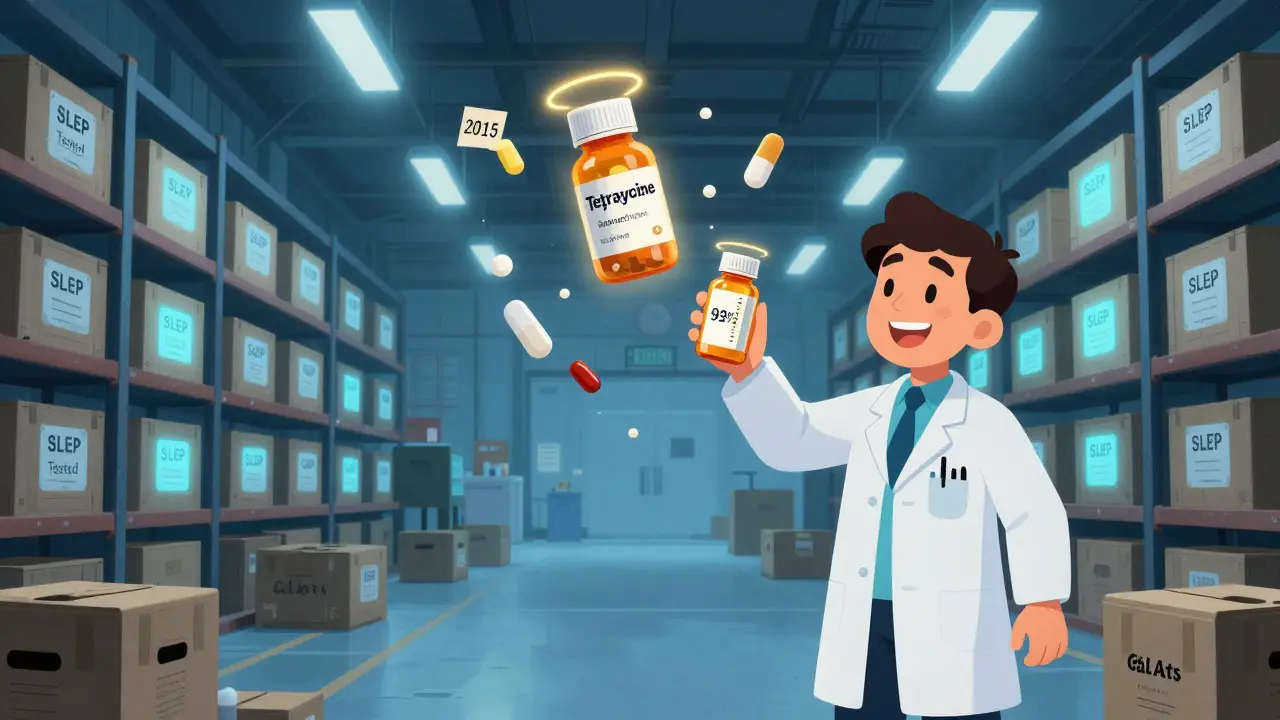
The U.S. military doesn’t throw away pills just because they’ve passed their expiration date. In fact, it’s done the opposite for decades - and the results are reshaping how we think about drug safety, waste, and storage. The Military Shelf Life Extension Program (SLEP) is a government-run system that tests stockpiled medications to see if they’re still effective years after their labeled expiration dates. And the findings? Many of these drugs are as good as new.
Started in 1986, SLEP was born out of necessity. The Department of Defense had tons of life-saving drugs - antibiotics, antivirals, epinephrine, painkillers - sitting in warehouses, waiting for emergencies. But the labels said they expired in two or three years. Should they be tossed? The military didn’t think so. So they started testing them. And what they found was shocking: most of these drugs still worked.
Here’s how it works. Every 1 to 3 years, samples from military stockpiles are sent to the FDA’s labs. Scientists test for potency, chemical breakdown, and contamination. The rule is simple: if a drug still contains at least 85% of its original active ingredient, it gets a shelf-life extension. No guesswork. No assumptions. Just hard data.
Since 1986, over 2,500 different drug products have been tested. The results? About 92% of tested lots passed. That means more than 9 out of 10 medications were still safe and effective - sometimes 10, 15, even 20 years past their original expiration date. A 2006 study in the Journal of Pharmaceutical Sciences looked at 122 drugs and found 88% were still potent after expiration. Some, like tetracycline and amoxicillin, held up for over 15 years when stored properly.
Why This Matters for Everyone
Most people think expiration dates are hard deadlines. They’re not. They’re conservative estimates based on manufacturer testing under ideal conditions - not real-world storage. Pharmaceutical companies test for only 2-3 years because it’s cheaper and easier than running long-term studies. The FDA allows this because it’s legally safer to set short dates than risk liability.
SLEP flips that script. It proves that many drugs don’t suddenly become useless or dangerous on a specific date. They degrade slowly. If kept cool, dry, and away from light - like in a military warehouse - they last far longer than anyone expected. This isn’t just about saving money. It’s about having access to critical drugs during disasters, pandemics, or war.
In 2019, the Strategic National Stockpile extended the shelf life of oseltamivir (Tamiflu) by three years. That saved 22 million treatment courses. During the H1N1 outbreak, those extra doses likely saved lives. Without SLEP, those drugs would’ve been incinerated - even though they still worked.
The Real Cost of Throwing Away Pills
The federal government saved an estimated $2.1 billion between 2005 and 2015 just by extending shelf lives. That’s not a typo. Billions. And it’s not just the military. The Department of Health and Human Services, the CDC, and the VA all rely on SLEP to keep their emergency supplies ready.
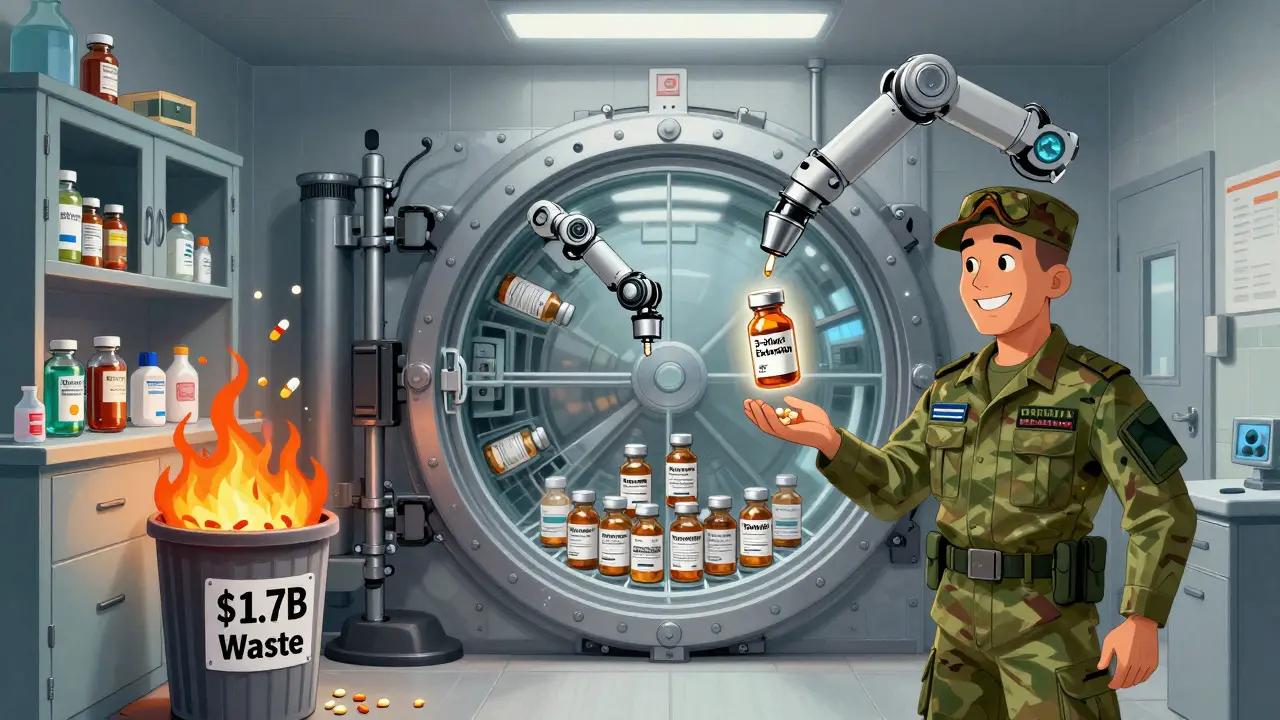
Meanwhile, the private sector throws away $1.7 billion worth of expired drugs every year. Pharmacies, hospitals, and clinics follow the expiration date like gospel. If a pill’s date is one day past, it’s trash. No exceptions. That’s not science - it’s policy. And it’s wasteful.
The Army Medical Logistics Support Activity found that after adopting SLEP protocols, their pharmaceutical waste dropped by 42%. Military treatment facilities that followed the rules saved $87 million annually. That’s enough to fund dozens of rural clinics.
How SLEP Works - Step by Step
- Step 1: Federal agencies nominate drugs for testing. These are usually critical medical countermeasures - things like anthrax antidotes, nerve agent treatments, or antibiotics for mass casualties.
- Step 2: The FDA collects samples from approved storage sites. These aren’t random samples. They’re taken from sealed containers stored under strict conditions (temperature-controlled, low humidity, no sunlight).
- Step 3: The samples are tested for chemical stability, potency, and microbial contamination. The FDA uses advanced lab equipment to measure exact levels of active ingredients.
- Step 4: If the drug meets the 85% potency threshold, the FDA approves a shelf-life extension. The extension is specific to that lot number, packaging, and storage environment.
- Step 5: The updated expiration date is added to the DoD Shelf Life Extension System (SLES), a secure database only accessible to authorized personnel.
There’s no gray area. If a drug doesn’t pass, it’s retired. No exceptions. The system is designed to be strict - because public safety comes first.
What SLEP Doesn’t Tell You
Some people hear “SLEP” and think: “So I can keep my old antibiotics?” Not so fast.
SLEP only applies to drugs stored under government-controlled conditions. That means: sealed, climate-controlled, and tracked from day one. Your medicine cabinet? Your garage? Your basement? Those aren’t the same.
Dr. Michael D. Swartzburg from UCSF puts it bluntly: “SLEP’s findings shouldn’t be generalized to all drugs or all storage conditions.”
A pill stored at 90°F and 80% humidity? That’s not the same as one kept at 68°F and 40% humidity. Heat, moisture, and light break down drugs. A bottle of ibuprofen left in a hot car for a month? It’s not safe to use - even if it’s two months from its expiration date.
The FDA is clear: shelf-life extensions under SLEP are specific to each lot. You can’t use SLEP data to justify using your expired prescription. That’s not how it works. The program is for emergency stockpiles - not personal medicine cabinets.
The Bigger Picture: Global Impact
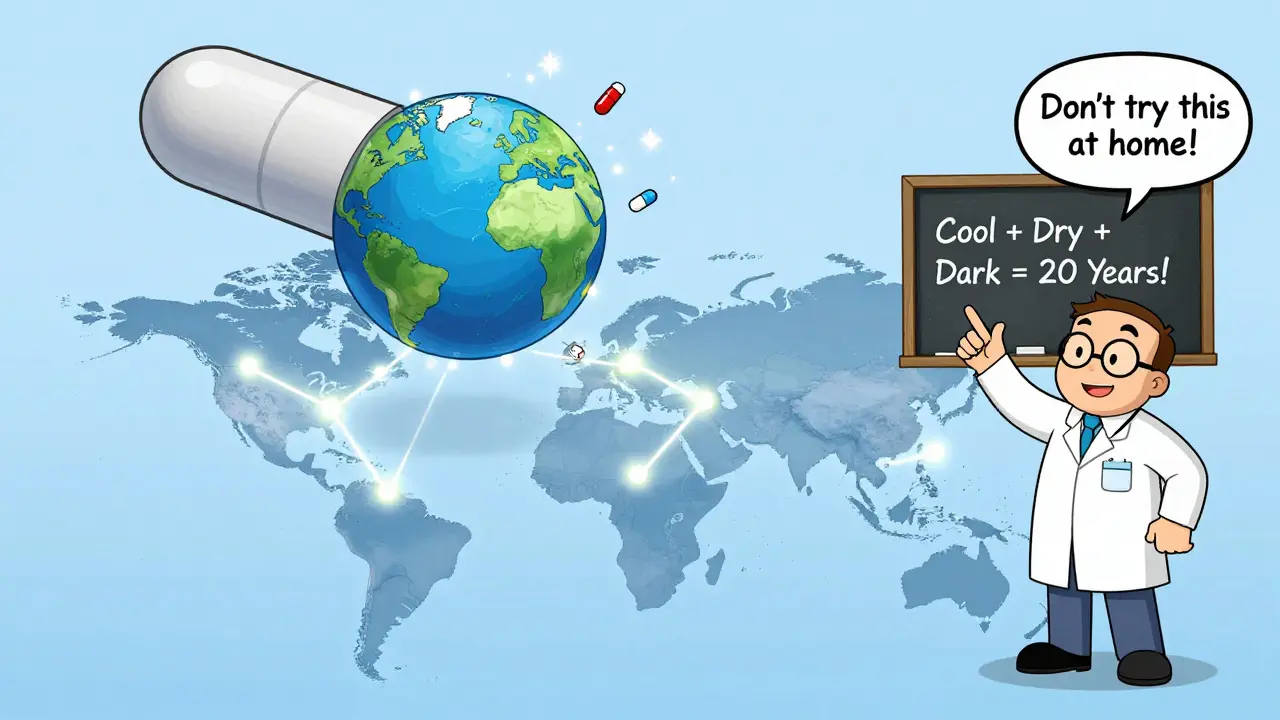
SLEP didn’t just save money. It changed global standards. Twelve NATO countries now run similar programs based on the U.S. model. Canada, Australia, and the UK have adopted elements of it for their own emergency stockpiles.
In 2021, SLEP expanded to include certain biological products - like vaccines and antitoxins - for the first time. That was a big deal. Biologicals are usually more unstable than pills. But even these showed surprising stability when stored right.
And the science is evolving. In 2022, the FDA and DoD rolled out a new digital system that cut extension review times from 14 months to just 8. That’s faster, smarter, and more efficient.
But challenges remain. The 2023 National Defense Authorization Act wants to expand SLEP to cover more chemical and radiological countermeasures. That’ll cost $75 million a year. And while the savings are huge, the funding isn’t guaranteed.
What’s Next?
The future of drug stability testing is moving toward predictive modeling. Instead of waiting years to test, scientists are using machine learning and accelerated aging tests to forecast how drugs will behave over time. If this works, we might not need to wait 10 years to know if a drug still works.
For now, SLEP remains the gold standard. It’s not flashy. It doesn’t make headlines. But every time a soldier gets the right dose of antibiotics, or a hospital has enough antivirals during a surge, SLEP is working in the background.
Expired doesn’t mean useless. That’s the quiet truth SLEP revealed. It’s not about ignoring expiration dates. It’s about replacing guesswork with science.
Does the Military Shelf Life Extension Program apply to civilian pharmacies?
No. SLEP is a federal program limited to government stockpiles managed by the Department of Defense and FDA. Civilian pharmacies, hospitals, and individuals must follow standard expiration dates. The program’s findings cannot be used to justify using expired drugs outside of approved military or federal storage conditions.
How long can drugs last past their expiration date?
Under proper storage conditions - cool, dry, and dark - many solid medications like tablets and capsules remain stable for 10-20 years past their expiration date. Studies show some drugs retain over 90% potency even after 15 years. However, liquids, injectables, and biological products degrade faster and are less likely to extend as long.
Are all drugs eligible for shelf-life extension?
No. Only Type II products - those deemed stable enough for testing - are eligible. Type I products, like insulin or nitroglycerin, are not extendable due to their chemical instability. The FDA evaluates each drug class individually. Antibiotics, painkillers, and antivirals are common candidates. Biologics were added in 2021 but still make up less than 5% of extended products.
Why don’t drug manufacturers extend expiration dates?
Manufacturers aren’t required to test beyond a few years. Long-term stability studies are expensive and time-consuming. Setting shorter expiration dates reduces legal risk and encourages regular repurchasing. The FDA allows this because it’s a conservative safety standard - not a reflection of actual drug longevity.
Can I trust expiration dates on my medicine?
Yes - but understand what they mean. Expiration dates are the last day the manufacturer guarantees full potency and safety under labeled storage conditions. If you store your medicine properly (in a cool, dry place), it may still be effective after that date. But if it’s been exposed to heat, moisture, or sunlight, it could be degraded. Never use visibly damaged, discolored, or smelly medication.



8 Comments
So let me get this straight… the government has been quietly extending drug shelf lives for decades, but you’re NOT allowed to use your expired ibuprofen? LOL. Classic. They’ll save billions by not incinerating perfectly good antibiotics… but if YOU try to take your 14-year-old amoxicillin? ‘UNSAFE.’
Meanwhile, the FDA’s website still says ‘don’t use expired meds’ like it’s gospel-while their own labs are proving it’s a scam. Who’s really protecting whom here? The public? Or the pharmaceutical lobby that makes bank off people repurchasing pills they don’t need?
I’m not saying take your grandma’s 2008 Zoloft… but if it’s sealed, stored in a dark drawer, and still looks like a pill… maybe don’t toss it. Maybe… just maybe… we’ve been lied to.
And don’t even get me started on how they ‘test’ it. ‘Oh, we sampled 3 pills from a batch of 500,000.’ Sure. And I’m the Queen of England.
They say ‘SLEP only applies to government stockpiles’-but if the science is sound, why not make it public? Why not update the labels? Why not let pharmacists DO THEIR JOB instead of being forced to throw away perfectly good medicine?
It’s not paranoia. It’s pattern recognition. And this whole thing stinks of corporate greed dressed up as ‘safety.’
Next up: ‘The government discovered that milk doesn’t spoil after 7 days… but you still can’t drink your expired carton.’
Wake up, people. The system is rigged.
It is of paramount importance to underscore that the Military Shelf Life Extension Program, while empirically compelling in its data collection methodologies, must not be misconstrued as a validation of unsanctioned pharmaceutical usage by the civilian populace.
The conditions under which military-grade pharmaceuticals are stored-namely, climate-controlled, hermetically sealed, and continuously monitored environments-are not replicable in domestic settings.
Furthermore, the statistical robustness of the 92% pass rate is contingent upon a highly controlled sampling protocol, wherein lot-specific integrity is preserved through traceable logistics chains.
It is a fallacy, therefore, to extrapolate these findings to over-the-counter medications stored in humid bathrooms or sun-exposed cabinets.
The FDA’s conservative expiration labeling is not a corporate conspiracy-it is a risk-averse regulatory posture designed to mitigate liability, not to deceive the public.
Moreover, the degradation kinetics of pharmaceutical compounds vary significantly by molecular structure; for instance, insulin and epinephrine are inherently unstable, whereas tetracycline derivatives demonstrate remarkable resilience.
One must not confuse statistical trends with universal truths.
Respect for regulatory frameworks is not blind obedience-it is informed prudence.
Interesting. I've seen this in Nigeria too-when you're in remote areas with no reliable supply chains, expired drugs become a last resort. Not because people are reckless, but because they have no choice.
But here's the thing: even in Nigeria, we don't just grab random expired pills. We check for discoloration, odor, texture. If it looks off, we don't use it. If it's sealed and stored in a cool, dry room? Maybe.
The military program is brilliant because it's science-based, not guesswork. But it's also not a license to hoard. It's a system built on logistics, tracking, and accountability.
What's missing from this conversation? Access. In many countries, people die because they can't get medicine at all-not because they're using expired ones.
SLEP should be a model for global health equity. Not just for saving money, but for saving lives where supply chains collapse.
And yes-proper storage matters. A pill in a hot car isn't the same as one in a climate-controlled warehouse. That's basic chemistry.
Let's stop pretending this is about rebellion. It's about justice.
It’s wild how something so simple-like a pill lasting longer than we think-can expose how much of our system is built on convenience, not truth.
I’ve kept my EpiPen for 5 years past its date. Stored in a drawer. Never opened. It still looks perfect.
Would I use it in a life-or-death situation? Probably. Not because I’m reckless. But because I’ve seen how expensive and broken our healthcare system is.
It’s not about ignoring expiration dates. It’s about questioning why they exist in the first place.
Maybe the real expiration date is when we stop trusting science… and start trusting corporations.
The Military Shelf Life Extension Program represents a model of pragmatic public policy grounded in empirical evidence rather than commercial interests.
It is commendable that the Department of Defense, in collaboration with the FDA, has maintained rigorous scientific standards while achieving substantial fiscal savings and operational readiness.
However, the application of these findings to civilian contexts must be approached with caution, as environmental variables such as temperature, humidity, and light exposure significantly influence pharmaceutical stability.
While the data is compelling, the structural integrity of the supply chain-tracking, packaging, and storage conditions-is inseparable from the efficacy of the medication.
Global adoption of similar protocols, as seen in NATO nations, demonstrates the universal applicability of science-based decision-making.
It is not a matter of defiance against regulation, but of aligning public health policy with verifiable data.
Let us not confuse the exception with the rule.
Let’s be real-this isn’t about science. It’s about control. The government lets them extend shelf life for their own stockpiles so they can save billions… but if you try to use your expired meds? ‘ILLEGAL. UNSAFE. DON’T DO IT.’
Who’s really in charge here? The FDA? Or Big Pharma? Because if this program proves drugs last 20 years, why aren’t they changing the labels on EVERY bottle?
It’s not rocket science. They want you to keep buying. Again. And again. And again.
And now they’re ‘expanding’ to biologics? Oh, sure. Just in time for the next pandemic so they can ration ‘approved’ vaccines while your expired ones are still good.
This isn’t a program. It’s a lie wrapped in a lab coat.
They’ll save $2 billion… and then charge you $800 for a new prescription.
Wake up. They’re not protecting you. They’re protecting profits.
I love how this program quietly flips everything we’ve been taught.
We’re raised to believe expiration dates are like traffic lights-red means stop. But what if they’re more like ‘best by’ dates? Like yogurt?
My grandma used to say, ‘If it looks right, smells right, and doesn’t hurt when you take it… it’s probably fine.’
Turns out, she was kinda right.
Not for everything. Not for liquids. Not for insulin.
But for solid pills? Stored right? Maybe.
It’s not about breaking rules. It’s about questioning why the rules exist.
And honestly? I’m glad the military is doing the science so we don’t have to guess.
Just read this and had to say: SLEP is the quietest government program that’s probably saved more lives than any public health campaign this decade.
It’s not sexy. No press conferences. No viral TikToks.
But every time a soldier gets deployed and has access to antibiotics that work? That’s SLEP.
Every time a hospital in a disaster zone doesn’t run out of epinephrine? That’s SLEP.
It’s not about whether you should take your expired Tylenol.
It’s about ensuring the system doesn’t fail when it matters most.
And yeah-it’s working.