
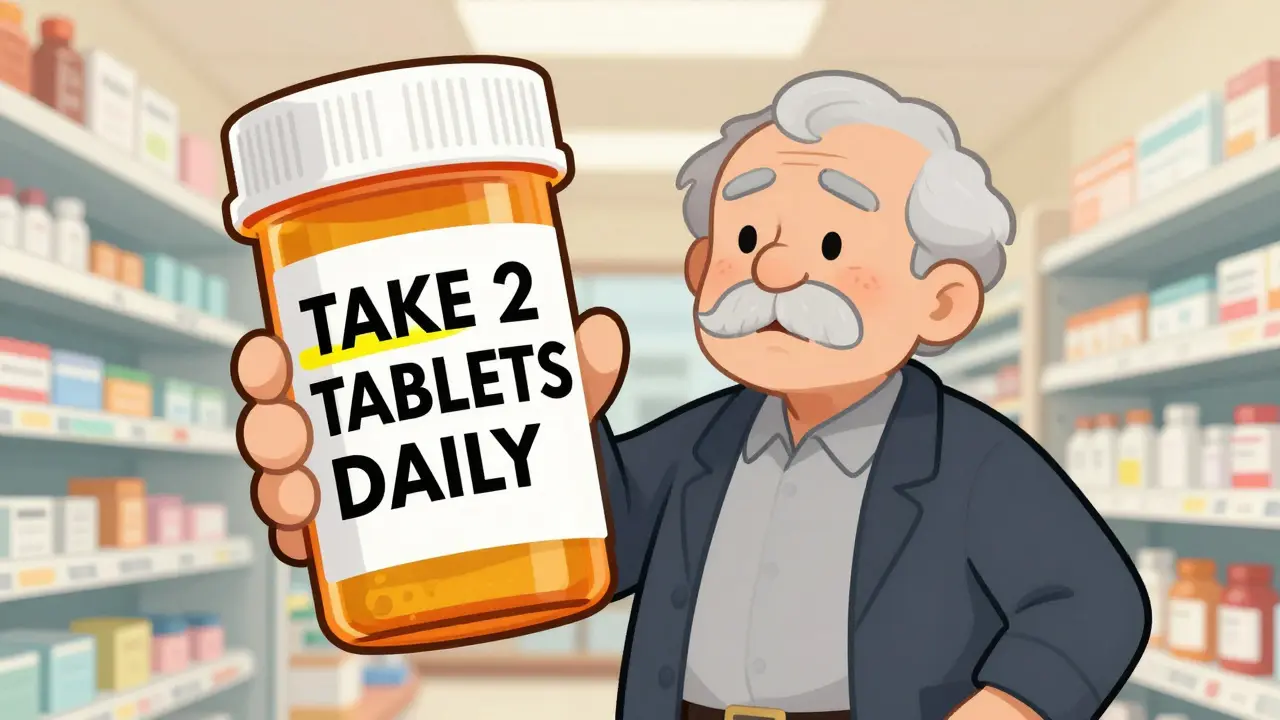
Imagine opening your medicine cabinet and not being able to read what’s inside. Not just blurry text-completely unreadable. That’s the daily reality for millions of people with low vision. Every pill bottle, every instruction, every expiration date becomes a gamble. Taking the wrong dose, missing a refill, or swallowing the wrong medication isn’t just inconvenient-it’s dangerous. But it doesn’t have to be this way.
Why Accessible Prescription Labels Matter
In the U.S., over 12 million people live with vision impairment, and nearly 8.2 million of them are over 65. The CDC found that 20% of adults aged 45 and older struggle to read standard prescription labels. That’s one in five people who could accidentally take too much, too little, or the wrong drug entirely. The consequences? Hospital visits, falls, organ damage, even death. The FDA’s 2012 Safety and Innovation Act made it clear: pharmacies must provide accessible labeling. This wasn’t just a recommendation-it was a legal requirement under the Americans with Disabilities Act. Failure to comply can result in fines, lawsuits, and loss of public trust. But more than that, it’s about dignity. Being able to read your own meds means you don’t have to rely on someone else to tell you what’s in your hand.What Counts as a Large Print Label?
Not all big text is created equal. The American Foundation for the Blind (AFB) says the minimum readable size is 18-point font. Standard pharmacy labels often use 8- to 10-point type. That’s like trying to read a newspaper through a straw. The right large print label uses:- 18-24 point font-no smaller
- Sans-serif fonts like Arial, Verdana, or APHont™ (a free font designed for low vision)
- High contrast-black text on white background, no gray or colored backgrounds
- No glare-matte finish, not glossy
- Left-aligned text-easier to follow line by line
- Lowercase letters with uppercase numbers in instructions (e.g., "take 2 TABLETS daily")
- Yellow highlights on critical info like dosage or warnings
Other Accessible Options Beyond Big Text
Large print isn’t the only solution. Different people need different tools. ScripTalk is an RFID-based system. The label has a small, invisible chip. You hold a handheld reader (or use a smartphone app) over the bottle, and it speaks the label aloud: "Amoxicillin 500mg, take one capsule three times a day for 10 days, expiration 03/2026." It works even if you can’t see the label at all. CVS, Walgreens, and other chains have rolled this out to thousands of locations. QR code labels like UK HealthCare’s ScriptView let you scan the label with your phone. It opens an audio file or webpage with the full instructions. Some even let you choose language or playback speed. Braille is available-but only about 10% of people with low vision read it. It’s useful for those who’ve been blind since childhood or learned Braille early. But for most, it’s not practical as a standalone solution. And then there’s AI-assisted reading. Apps like Be My Eyes connect you with volunteers via live video. You point your phone at the label, and someone on the other end reads it to you in real time. Over 1.2 million labels have been read this way since 2022.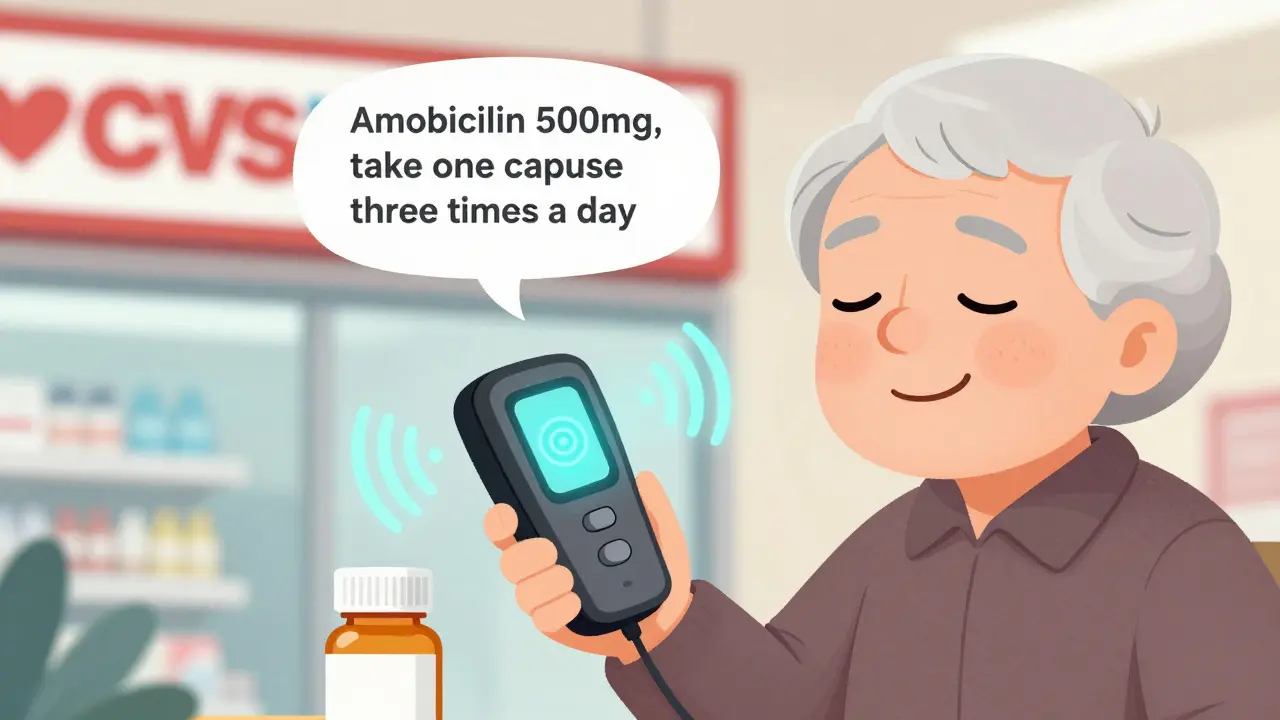
What Pharmacies Offer Today (2026)
Most major chains have made accessible labels standard. Here’s what you can expect:- CVS: Offers large print, ScripTalk, and multilingual labels. Over 98% of locations have at least one option. ScripTalk is free and available at all 9,900 U.S. locations by late 2024.
- Walgreens: Large print and ScripTalk. Staff training is mandatory. Most stores keep duplicate labels in stock.
- Walmart: Large print labels available at checkout. QR code audio labels being tested in pilot stores.
- UK HealthCare: ScriptAbility offers free large print, audio, and translated labels. Their system reduced medication errors by 78% in a 2021 study.
- Independent pharmacies: Only 52% offer any accessible option. Many still require you to ask-and even then, staff may not know how to help.
How to Get Accessible Labels
You don’t have to wait for your pharmacy to surprise you. Here’s how to make sure you get what you need:- Ask directly. Don’t say, "Do you have big print?" Say: "I need a large print label in 18-point Arial, black on white, with no glare. Can you print a duplicate label for me?"
- Request ScripTalk. Ask: "Do you offer ScripTalk? If so, can I get the reader or app?"
- Use QR code labels. Ask if they have ScriptView or similar systems. Most apps are free and work on any smartphone.
- Bring your own. If your pharmacy doesn’t offer it, ask if they’ll let you use a pre-printed large print label from AFB or APH.org. Many will.
- Set it as default. Once you get it, ask them to note it in your file: "Patient requires accessible labeling-always."
Real Stories, Real Impact
One Reddit user, "VisionLiberation," posted in March 2023: "Since my pharmacy started offering 18-point labels, I stopped taking the wrong pills twice a week. It’s literally life-changing." A 78-year-old diabetic in Kentucky switched to ScriptView labels with audio QR codes. Within six months, her hypoglycemic episodes dropped by 75%. She told her doctor: "I finally feel like I’m in control." The University of Kentucky’s five-year study showed a 38% drop in emergency room visits among low-vision patients using accessible labels. That’s not just safety-it’s savings. Fewer hospital trips mean lower costs for families and the system.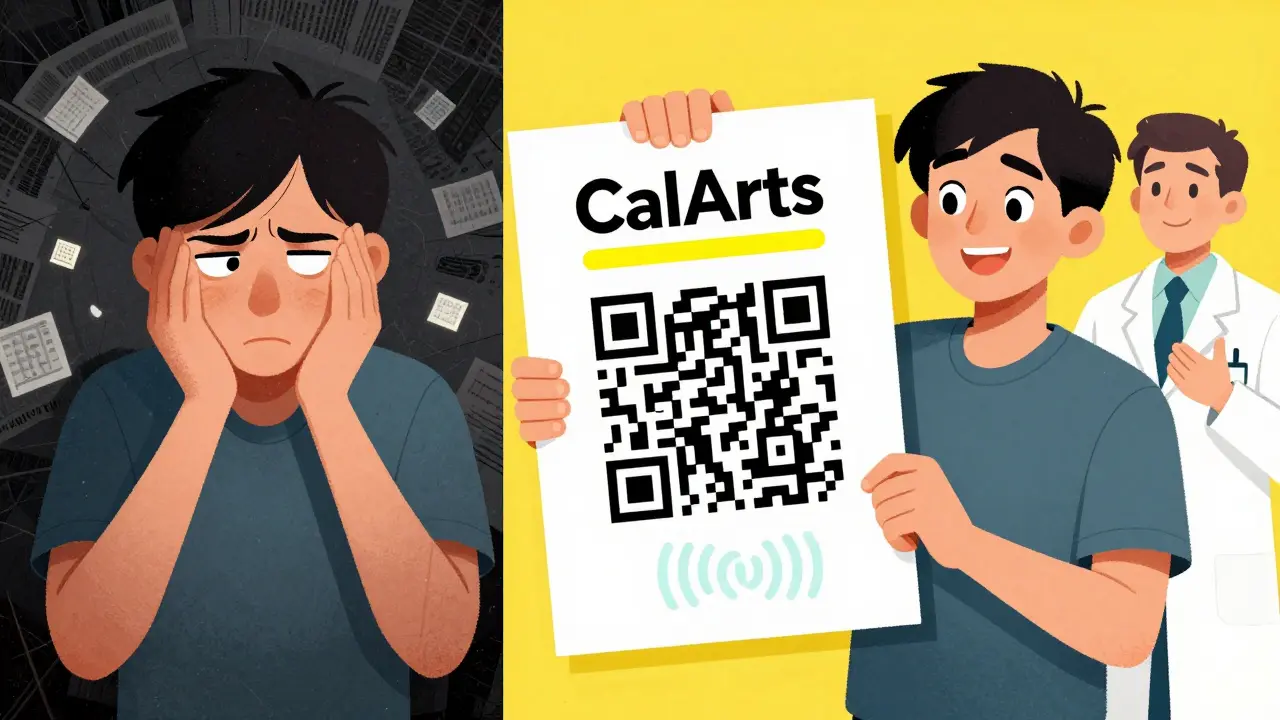
What to Do If Your Pharmacy Says No
If your pharmacy refuses or says they "don’t have it," here’s what to do:- Ask to speak to the pharmacist-in-charge. Front desk staff often don’t know the policy.
- Print a copy of the FDA’s 2012 mandate or the AFB’s guidelines. Hand it to them.
- Call your state board of pharmacy. They can intervene.
- File a complaint with the U.S. Department of Justice. Over 17 formal complaints were filed in 2022 alone, and three resulted in $450,000 in settlements.
Future of Accessible Labels
The market for accessible healthcare labels is growing fast. It was worth $3.2 billion in 2022 and is projected to hit $5.7 billion by 2027. Why? Because the need is growing-and the technology is getting smarter. AI-powered label readers are becoming mainstream. Voice assistants like Alexa and Google Home may soon be able to read your prescription labels aloud with a simple command. Some hospitals are testing smart pill bottles that auto-remind you when to take your meds and speak the name and dose. By 2026, the American Pharmacists Association predicts 100% of U.S. pharmacies will offer at least large print labels. The question isn’t whether they’ll do it-it’s whether you’ll know how to ask for it.Frequently Asked Questions
Are large print prescription labels free?
Yes. Under the FDA and ADA, pharmacies cannot charge extra for accessible labels. Large print, ScripTalk, QR code audio, and Braille-all must be provided at no cost. If a pharmacy tries to charge you, ask to speak to the pharmacist-in-charge or contact your state board of pharmacy.
Can I get accessible labels for over-the-counter meds?
Not officially. The FDA mandate only covers prescription drugs. But some pharmacies will make large print labels for OTC meds if you ask-especially if you’re a regular customer. It’s worth requesting.
What if I don’t have a smartphone? Can I still use accessible labels?
Yes. Large print labels work without any tech. ScripTalk offers handheld readers that don’t need a phone-many pharmacies lend them for free. You can also ask your pharmacy to print a duplicate label with all the info clearly written out. No tech required.
How do I know if my pharmacy is compliant?
Look for the ScripTalk logo on bottles or ask if they offer large print, audio, or QR code labels. Major chains like CVS and Walgreens are nearly 100% compliant. If you’re unsure, call ahead and ask: "Do you provide accessible prescription labels as required by the FDA?" If they hesitate, they may not be fully compliant.
Can I use these labels if I have dementia or memory issues too?
Absolutely. Accessible labels help anyone who struggles with reading or remembering instructions-whether from low vision, dementia, aging, or cognitive challenges. Audio labels and QR codes are especially helpful because they provide verbal reminders. Many caregivers use these systems to support loved ones with memory loss.

15 Comments
My grandma uses large print labels now and she finally stopped mixing up her blood pressure meds. It’s simple, but it saved her life.
Thank you for writing this.
Let’s be real-this isn’t about accessibility. It’s about the pharmaceutical-industrial complex realizing that disabled people have purchasing power now. They didn’t care until we started suing them. Now it’s ‘compliance’-but it’s still performance. The real win? When they stop treating us like charity cases and start designing for us from day one. Not after the fact. Not because the law forced them. Because we deserve it. Period.
They’re pushing this because they want to replace American pharmacists with AI. You think ScripTalk is for the blind? No. It’s so Big Pharma can cut staff and automate everything. Next thing you know, your meds are shipped from China with no human ever touching them. Wake up. This isn’t progress-it’s erosion.
Did you know the FDA’s 2012 mandate was pushed by a secret lobbying group funded by Google? They want you to scan QR codes so they can track every pill you take. Your medication history is now a data asset. You’re not getting help-you’re being monitored. And they call it ‘accessible’? That’s not accessibility. That’s surveillance with a smiley face.
It’s absurd that we still have to beg for basic human dignity. The ADA isn’t a suggestion-it’s the law. And yet, pharmacists act like they’re doing us a favor by printing a label in 18-point font. The fact that this even needs to be explained in 2026 is a national disgrace. We are not asking for luxury. We are demanding the minimum standard of civil rights. And if you don’t get it, you’re complicit.
Let’s not romanticize this. Large print labels? Sure. But what about the 30% of low-vision users who also have cognitive decline? The labels don’t help if you forget what the pills are for. And QR codes? Great-until your phone dies. Or the app crashes. Or the Wi-Fi’s down. This whole system is brittle. We’re treating symptoms, not designing a real solution. We need integrated systems-not patchwork hacks.
They say ‘free’ labels-but what about the hidden costs? The time you waste calling pharmacies. The staff who don’t know the policy. The fact that independent pharmacies can’t afford ScripTalk readers. This isn’t equity. It’s a two-tier system: big chains get tech, small ones get excuses. And the people who need it most? They’re stuck in rural towns where the pharmacist has never even heard of APHont™. This is systemic neglect dressed up as progress.
I’ve been using the Be My Eyes app for a year now. It’s not perfect-sometimes the volunteer takes 3 minutes to answer, and once they misread ‘Lisinopril’ as ‘Lisinopril-HCTZ’. But it’s better than crying in the pharmacy aisle. Honestly? I just wish more people knew about it. It’s free. It’s real. And the volunteers? They’re angels. One guy even called me back the next day to make sure I got my meds right. That’s human connection. That’s what matters.
This is the kind of post that reminds me why I still believe in progress. We’ve come so far from the days when people with low vision had to rely on family members to read their prescriptions. Now we have AI, audio, QR codes, and legal backing. It’s not perfect-but it’s real. And if you’re reading this and you’ve never asked for a large print label? Do it today. Don’t wait. You’re not being difficult-you’re being brave. And you’re helping everyone who comes after you.
If you’re not asking for accessible labels, you’re part of the problem. Stop being polite. Stop saying ‘please’. Walk into the pharmacy and say: ‘I need a 18-point Arial label. Print it now. I’m not leaving until I get it.’ That’s how change happens. Not with petitions. Not with kindness. With demand. You have rights. Use them. Or stay silent and keep dying.
As someone from India, I’ve seen how this works in places where healthcare access is uneven. Here, the tech is advanced. But in rural India, people still use handwritten notes taped to pill bottles. What we need isn’t just better labels-it’s global equity. The same tech that helps someone in Ohio should be available to someone in Bihar. This isn’t a U.S. problem. It’s a human problem. And we can solve it-if we choose to share, not hoard.
It is, indeed, a matter of profound moral and legal significance that the American pharmaceutical infrastructure has, over the course of the past decade, been compelled-through legislative mandate and judicial precedent-to provide equitable access to prescription information for persons with visual impairments. The American Foundation for the Blind’s guidelines, as cited herein, are not merely recommendations; they constitute a codified standard of care, aligned with the Americans with Disabilities Act, and their implementation represents a triumph of civil rights over bureaucratic inertia. It is incumbent upon all citizens, particularly those who are able-bodied, to advocate for the universal adoption of these standards-not as a privilege, but as a non-negotiable component of healthcare justice.
Let’s cut through the noise. 8.2 million seniors can’t read labels? So what? The real problem is that people are taking meds they don’t need. Overprescribing is the epidemic. Why not fix that instead of making bigger labels? And who’s paying for all this? You think CVS doesn’t pass the cost onto insurance premiums? This isn’t charity-it’s a cost shift. And don’t get me started on QR codes. You think grandma’s gonna scan a code? She’s still calling her son to read the bottle. This whole thing is a tech fantasy wrapped in virtue signaling.
They’re not doing this for us. They’re doing it because they’re scared. Scared of lawsuits. Scared of bad press. Scared of the DOJ. The moment they think we’ll stop complaining? The big labels disappear. The QR codes stop working. The ScripTalk readers go missing. This isn’t progress. It’s fear-driven compliance. And if you think it’ll last? You’re naive. We have to keep screaming. Always.
In my village in Punjab, my aunt reads her pills by holding them up to the sunlight. She squints. She guesses. She trusts. I sent her a free APHont™ label printed on cardstock. She taped it to her fridge. Now she doesn’t need anyone. That’s all it took. No app. No chip. No smartphone. Just a little bit of care. This isn’t about technology. It’s about remembering that dignity doesn’t cost much-but forgetting it costs everything.