

Many people think therapeutic interchange means swapping one type of drug for another-like switching from a blood pressure pill to a diabetes pill. That’s not it. Not even close. Therapeutic interchange is when a pharmacist, with approval, swaps a prescribed medication for another drug in the same class that works the same way but costs less. It’s not about changing the treatment goal. It’s about getting the same result without breaking the bank.
What therapeutic interchange actually is
Therapeutic interchange happens inside hospitals, nursing homes, and other institutional settings where there’s a formal list of approved medications called a formulary. This list is built by a team of doctors, pharmacists, and nurses who review which drugs work best for specific conditions. If a doctor prescribes a brand-name statin for cholesterol, and there’s another statin on the formulary that’s just as effective but cheaper, the pharmacist can switch it-without calling the doctor first, if the rules allow it.
It’s not generic substitution. Generic substitution is when you swap a brand-name drug for its exact chemical copy-like switching from Lipitor to atorvastatin. Therapeutic interchange is different. You’re swapping one drug for another that’s chemically different but does the same job. For example, switching from lisinopril to losartan-both are blood pressure meds, both lower angiotensin, but one blocks the enzyme, the other blocks the receptor. They’re not identical, but they’re close enough in effect to be swapped under the right conditions.
This isn’t new. Over 80% of U.S. hospitals have had therapeutic interchange programs since 2002. The goal? Reduce costs without hurting outcomes. Skilled nursing facilities report saving tens of thousands of dollars a month just by sticking to their formulary. That money goes back into patient care-more staff, better meals, better monitoring.
Why it’s not done across different classes
Here’s where people get confused. You can’t swap a beta-blocker for a diuretic and call it therapeutic interchange. That’s not substitution-it’s a new treatment plan. Therapeutic interchange only works when the drugs are in the same class and have been proven to have substantially equivalent effects. The American College of Clinical Pharmacy is clear: it’s for drugs that are therapeutically comparable, not just any alternative.
Imagine a patient on metformin for type 2 diabetes. Their doctor adds a sulfonylurea because their blood sugar isn’t controlled. If the pharmacy wants to switch that sulfonylurea to a different one-say, glipizide instead of glyburide-that’s therapeutic interchange. Both are sulfonylureas. Both stimulate insulin release. Both have similar side effect profiles. The outcome is the same. But if the pharmacy tried to swap the sulfonylurea for a GLP-1 agonist like semaglutide? That’s not interchange. That’s a clinical decision. That requires a new prescription, a new conversation, a new plan.
Doing it wrong can be dangerous. If you swap a drug from one class to another without understanding the patient’s full history, you risk under-treating, over-treating, or causing unexpected side effects. That’s why these swaps only happen when there’s a strong evidence base, a formal process, and a team reviewing it.
Who decides-and how
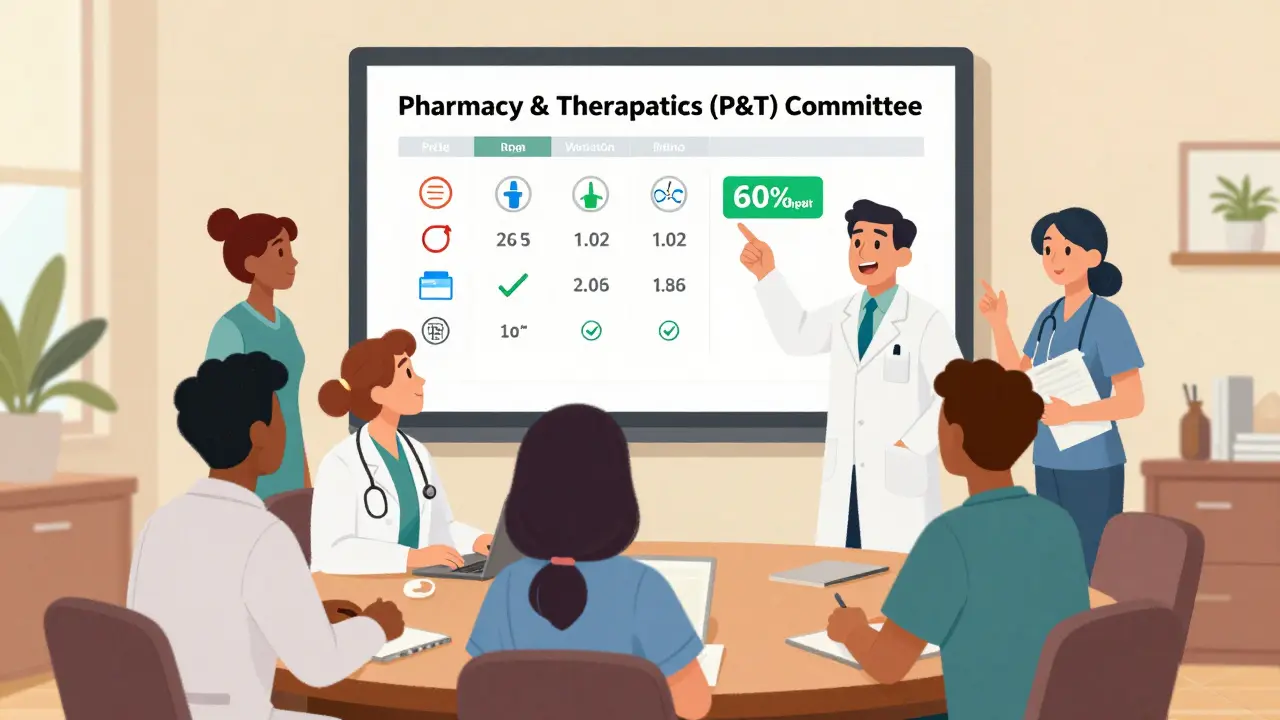
It’s not the pharmacist acting alone. It’s not the pharmacy benefit manager pushing for cheaper drugs. It’s a Pharmacy and Therapeutics (P&T) Committee. This group includes pharmacists, physicians, nurses, and sometimes patients or family reps. They review clinical data, cost data, and real-world outcomes. They decide which drugs make the formulary and which ones can be swapped.
For example, a P&T Committee might find that three different ACE inhibitors work just as well for heart failure, but one costs 60% less. They’ll add that one to the preferred list. Then, if a doctor writes a prescription for the more expensive one, the pharmacist can swap it automatically-unless the doctor has marked it as “do not substitute.”
But here’s the catch: even in hospitals, the rules vary. Some states allow “global” therapeutic interchange, meaning a prescriber signs a blanket agreement once, and the pharmacy can swap anytime. Other states require a new signature every time. In some places, the pharmacist must call the prescriber before making the change. In others, they can do it on the spot. It all depends on local law.
Why community pharmacies rarely do it
If you’ve ever picked up a prescription at your local pharmacy, you’ve probably never seen therapeutic interchange happen. That’s because community pharmacies rarely have the infrastructure to support it. No formulary team. No P&T Committee. No institutional backing. Most community pharmacists don’t have the time or legal authority to swap drugs without checking with the prescriber first.
Instead, what you see in community settings is generic substitution-or nothing at all. If your doctor prescribes a brand-name drug and there’s a generic version, the pharmacist can swap it unless you say no. But if your doctor prescribes a brand-name beta-blocker and the pharmacy wants to switch it to a different beta-blocker? They’ll call the doctor. And the doctor might say no. Why? Because they don’t know the pharmacy’s formulary. They didn’t approve the swap. They didn’t even know it was possible.
That’s why therapeutic interchange thrives in places where the system is centralized: hospitals, VA clinics, long-term care facilities. Where there’s one team making decisions, one formulary, and one way of doing things.
Benefits and risks
The benefits are real. Lower costs. Fewer medication errors (because fewer drugs on the formulary means less confusion). More consistent care. When everyone in a nursing home is on the same two or three anticoagulants, it’s easier to monitor, easier to train staff, easier to catch problems.
But the risks? They’re real too. If a patient has had a bad reaction to one drug in a class, swapping to another in the same class might not be safe. If someone’s been on a specific statin for years and it’s working fine, why change it? Sometimes, the smallest change-like switching from atorvastatin to rosuvastatin-can cause muscle pain or liver enzyme changes, even if the drugs are “equivalent.”
That’s why the guidelines say: therapeutic interchange should only happen when the new drug is expected to provide substantially similar benefit. And it must include input from the patient. If a patient says, “I’ve been on this pill for ten years and it’s the only one that doesn’t make me dizzy,” the pharmacist should listen. The formulary isn’t a rulebook. It’s a tool. And tools should serve people, not the other way around.

What prescribers need to know
Doctors and nurse practitioners are often blindsided by therapeutic interchange. They think they’re prescribing one drug, and the patient comes back with a different pill. That’s frustrating. And it can break trust.
The solution? Communication. If your facility uses therapeutic interchange, make sure you know the formulary. Ask your pharmacy team for a copy. Know which drugs are interchangeable. Mark prescriptions as “do not substitute” if you’re unsure. If you’re comfortable with swaps, sign a global authorization form so pharmacists can act without calling you every time.
It’s not about control. It’s about collaboration. The pharmacist isn’t trying to override you. They’re trying to help you deliver better, cheaper care. But they need your input to do it right.
Where it’s headed
Therapeutic interchange isn’t going away. With drug prices still rising-8% increases are common-it’s one of the few tools providers have to control costs without cutting care. The future is in smarter formularies: ones that use real-time data on patient outcomes, not just cost. Some hospitals are already linking formulary decisions to electronic health records, so if a patient has a history of kidney issues, the system flags that certain drugs aren’t safe-even if they’re on the preferred list.
And more states are starting to standardize their laws. Right now, you’ve got 50 different sets of rules. That’s messy. It makes it hard for pharmacies to operate across state lines. Standardization will help.
But the core won’t change. Therapeutic interchange stays within the same class. It’s not a loophole to swap different types of drugs. It’s a smart, evidence-based way to make sure patients get the right treatment at the right price. And when done right, it helps everyone.
Can a pharmacist switch my medication to a different class without asking?
No. Therapeutic interchange only allows swaps within the same drug class-like switching one beta-blocker for another. Swapping between classes, such as changing a blood pressure medication to a cholesterol drug, is not therapeutic interchange. That would be a new prescription and requires the prescriber’s approval. Pharmacists cannot legally or ethically make that change without consulting the doctor.
Why do hospitals use therapeutic interchange but my local pharmacy doesn’t?
Hospitals have formal Pharmacy and Therapeutics Committees that create and manage a standardized formulary. This allows pharmacists to make pre-approved substitutions. Community pharmacies don’t have that structure. They rely on individual prescriptions and state laws that usually require them to contact the prescriber before changing any medication. Without a centralized formulary and prescriber agreements, therapeutic interchange isn’t practical in retail settings.
Does therapeutic interchange affect how well my medication works?
When done correctly, no. Therapeutic interchange only happens between drugs proven to have substantially equivalent clinical outcomes. For example, switching from one ACE inhibitor to another shouldn’t change your blood pressure control. But if you’ve had side effects with one drug in a class, the same side effect might occur with another. That’s why patient input matters. Always tell your provider or pharmacist if you’ve had issues with a medication before.
How do I know if my medication was changed through therapeutic interchange?
Check your prescription label. The name of the drug will be different. You can also ask your pharmacist directly: “Was this changed under a therapeutic interchange?” If it happened in a hospital or nursing home, they should have a formulary document you can review. In long-term care, you might even get a letter from the prescriber explaining the change. If you’re unsure, always ask.
Can I refuse a therapeutic interchange?
Yes. You have the right to refuse any medication change, even if it’s part of a hospital’s formulary policy. If you’re uncomfortable with the switch, tell your pharmacist or provider. They’ll either honor your request or explain why the swap is considered safe. Your preference matters-especially if you’ve had a good response to your current medication.
What to do next
If you’re a patient: Know your meds. If your pill looks different, ask why. Don’t assume it’s just a generic. Ask if it’s a therapeutic interchange. If you’re on a stable regimen and it’s working, say so.
If you’re a provider: Get familiar with your facility’s formulary. Know which swaps are allowed. Sign global interchange agreements if they make sense. Mark prescriptions clearly if you don’t want substitutions.
If you’re a pharmacist: Build relationships with prescribers. Educate them on the benefits. Document every swap. Use the formulary as a tool-not a rule.
Therapeutic interchange isn’t about cutting corners. It’s about cutting waste. Done right, it’s one of the quietest, most effective ways to make healthcare more sustainable without sacrificing quality.



8 Comments
OMG this is such a game-changer 😍 I had no idea pharmacists could do this without calling the doc! My grandma’s nursing home switched her blood pressure med last year and she didn’t even notice-just got the same results but the bill was way lower. More of this please! 🙌
Therapeutic interchange is a clinically sound cost-containment strategy rooted in evidence-based formulary management. It is not generic substitution, nor is it a loophole for cost-cutting at the expense of therapeutic integrity. The distinction between pharmacologically equivalent agents within a class-such as ACE inhibitors versus ARBs-is critical, and must be supported by robust pharmacokinetic and pharmacodynamic data. The P&T committee model ensures accountability, and its institutional adoption reflects best practice in health systems.
so like… if i’ve been on lisinopril for 12 years and my pill suddenly looks different i should just ask if it’s a swap? sounds simple but no one ever tells you this stuff. also why do hospitals get to do cool stuff and my CVS doesn’t? 🤷♀️
I love that this is happening in hospitals-it’s smart, it’s practical, and it helps people stay on their meds because they can actually afford them. I’ve seen friends stop taking their statins because of the price. This kind of swap keeps them on track without the guilt. We need more systems like this, not less. Keep it simple, keep it safe, keep it human.
Actually most of this is just pharmacy cost control disguised as clinical efficiency. You think switching from atorvastatin to rosuvastatin is safe? I’ve seen patients get rhabdo from that swap. And no one tracks outcomes after the switch. Formularies are controlled by PBMs not doctors. You think the P&T committee cares about your kidney function? Nah they care about the rebate. This is corporate medicine dressed up in white coats.
Just to clarify: therapeutic interchange ≠ generic substitution. The key is therapeutic equivalence per ACPC guidelines-same class, same MOA, comparable PK/PD profiles. In practice, this means you can swap within ACEi, ARB, or SSRI classes, but NOT across classes like beta-blocker → diuretic. Also, EHR-integrated formularies with clinical decision support are the future-think: if patient has CrCl <30, auto-flag all renally cleared agents. That’s where we’re headed.
This is exactly the kind of quiet innovation that makes healthcare better. No fanfare, no headlines-just pharmacists and doctors working together to keep patients healthy and costs manageable. If your doctor doesn’t know about your facility’s formulary, ask for a copy. It’s not about trust-it’s about teamwork. And if you’ve had a bad reaction to a drug before? Speak up. Always.
My cousin’s in a VA hospital and they do this all the time. She was on a pricey brand-name anticoagulant, got switched to a cheaper one in the same class, and her INR stayed perfect. She didn’t even notice until she saw the receipt. That’s the goal-same result, less stress. But yeah, community pharmacies? They’re stuck in the 90s. No formulary, no support, just ‘call the doctor’ every time. We need to fix that.