

Metformin Side Effect Predictor
How This Tool Works
Based on clinical studies from the article, this calculator estimates potential reduction in gastrointestinal side effects when switching between metformin formulations. Studies show extended-release (XR) reduces GI side effects by approximately 15.3% overall compared to immediate-release (IR).
Your Personalized Result
When you’re first prescribed metformin for type 2 diabetes, most doctors don’t warn you about the stomach issues. But if you’ve taken it, you know what they’re talking about-diarrhea, nausea, bloating, cramps. It’s not just annoying; it’s enough to make people quit the drug entirely. That’s why so many patients and doctors are asking: metformin extended-release vs immediate-release-does one really cause fewer stomach problems?
Why Metformin Upsets Your Stomach
Metformin works by lowering blood sugar in the liver and helping your body use insulin better. But it doesn’t just act where it’s supposed to. It also interacts with cells in your gut, especially when it hits them all at once. That’s the problem with immediate-release (IR) metformin. It’s designed to dissolve fast, so your body absorbs it quickly-peak levels hit within 3 hours. That sudden surge can irritate the lining of your stomach and intestines, triggering nausea, loose stools, or gas. The numbers don’t lie. About 20-30% of people on metformin IR report GI side effects severe enough to stop taking it. In one study, 28.6% of patients on IR had diarrhea. For someone trying to manage diabetes, that’s a brutal trade-off: lower blood sugar, but constant trips to the bathroom.How Extended-Release Works Differently
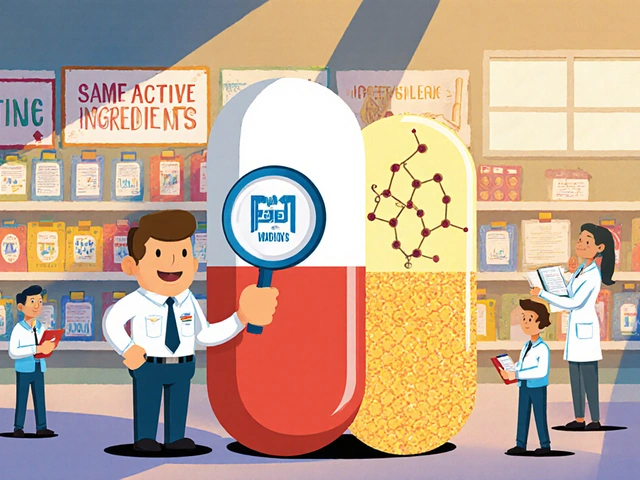
Extended-release (XR) metformin was created to fix this. Instead of dumping the full dose into your system all at once, it slowly releases the medication over 8-12 hours. The most common version uses a gel-based system called GelShield, which lets the drug leak out gradually as it moves through your upper intestine-the main area where metformin gets absorbed. This means peak levels come later (around 7-8 hours after taking it) and are slightly lower than with IR. The total amount of drug your body gets over 24 hours is about the same. But the key difference? It’s spread out. No big spikes. Less irritation.The Evidence: Does XR Really Help?
Multiple studies show XR reduces GI side effects-but not for everyone. A 2004 study by Dr. Lawrence Blonde tracked patients who switched from IR to XR. The results? A 32.7% drop in GI side effects. Diarrhea dropped from nearly 29% to under 18%. That’s not small. For many, it meant they could finally stick with the medication. A 2021 meta-analysis of 2,347 patients across seven trials confirmed this trend. Overall, XR cut GI side effects by 15.3% compared to IR. That’s a clear advantage. But here’s the catch: the quality of those studies wasn’t perfect. Some were small. Some didn’t control for dosing schedules. So while the trend is strong, it’s not a miracle cure. One surprising finding? Nausea was slightly more common with XR (4.6%) than IR (2.8%). Why? Maybe because the drug lingers longer in the stomach before being absorbed. For some, this means feeling queasy for hours instead of a quick bout of diarrhea.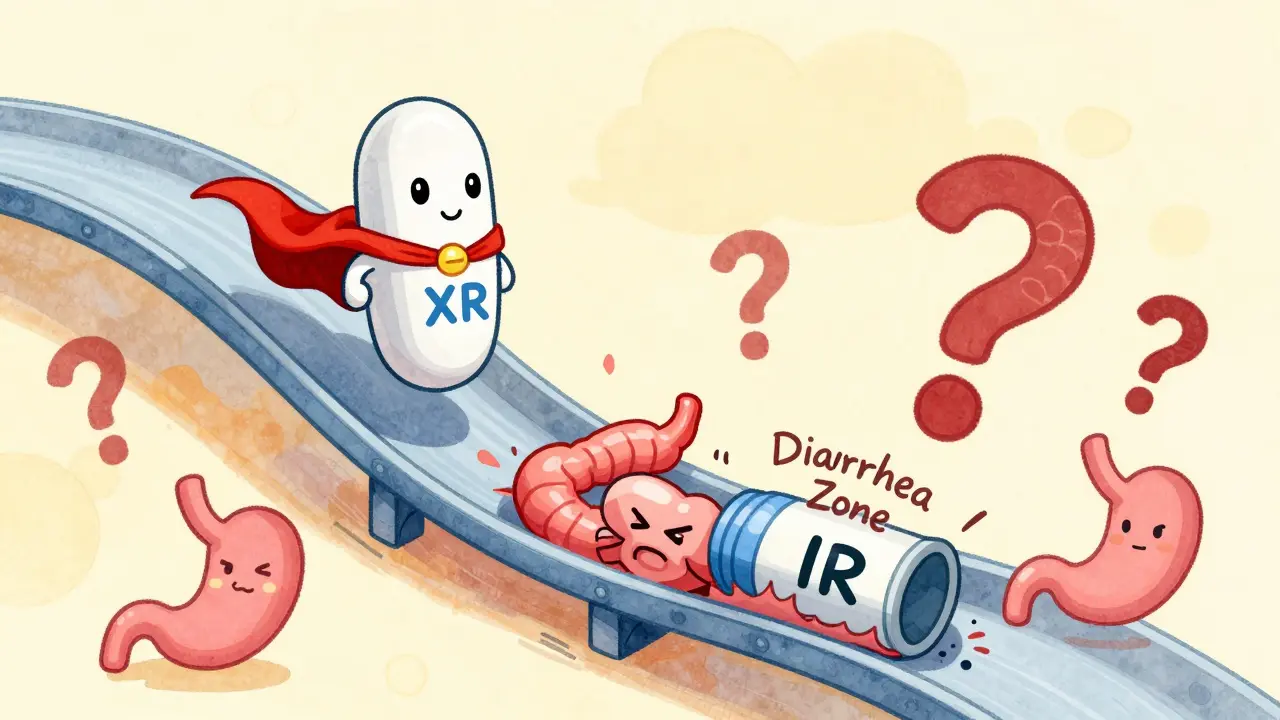
What Real Patients Say
Real-world experiences back up the data-and add nuance. On TuDiabetes, 68% of users who switched from IR to XR reported noticeable improvement. Many mentioned diarrhea dropping from daily to once a month. One person wrote: “I went from 5-6 bad days a week to maybe 1-2 a month. Life-changing.” But not everyone had luck. On Reddit, another user said: “I switched to XR thinking it would help. Instead, I got new nausea I never had with IR. Went back to splitting my IR dose-and it’s better.” Drugs.com ratings reflect this split. Metformin IR has a 5.8/10 average score, with 33% of reviews citing GI issues. XR scores 6.9/10, with only 21% complaining. That’s better, but still not perfect.Who Benefits Most from XR?
XR isn’t for everyone. But it’s a game-changer for certain people:- Those who had to stop IR because of diarrhea or vomiting
- People who take it once daily and want to avoid midday nausea
- Anyone who’s struggled with adherence due to side effects
Dosing Tips to Reduce Side Effects
No matter which form you take, how you start matters more than you think. Start low. Go slow. The American Diabetes Association recommends beginning with 500 mg once daily with your evening meal. Wait a week, then bump up by 500 mg every 7 days until you reach your target dose. This simple trick cuts initial GI side effects by 42%, according to a 2024 review. Always take metformin with food. Even a small snack helps buffer the drug’s effect on your gut. Skip the empty stomach. It’s a recipe for discomfort. If you’re on IR and still struggling, ask about splitting the dose. Two 500 mg pills-one with breakfast, one with dinner-often works better than one 1000 mg pill. It mimics the slow release of XR without the higher cost.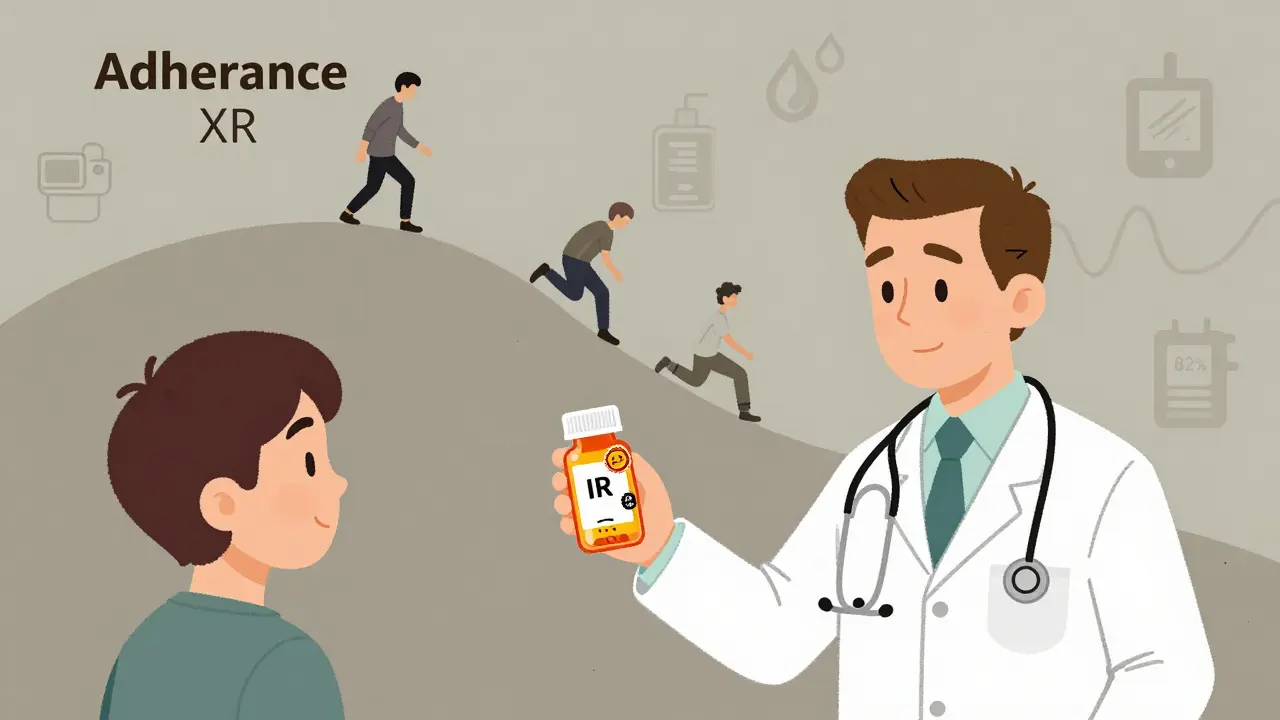
Cost and Accessibility
Here’s the downside: XR costs more. Generic metformin IR runs about $8-$10 for a 30-day supply. Generic XR? $10-$15. That 25-35% price gap used to be a big barrier. But since 2020, more generic XR brands have hit the market. The gap is shrinking. Insurance often covers both. But if you’re paying out of pocket, the cost difference matters. Still, if you’ve lost workdays or skipped meals because of side effects, the extra cost might be worth it. And here’s a hidden benefit: better adherence. A 2022 study of nearly 19,000 patients found that those on XR stayed on their medication 18.3% longer than those on IR. That’s over two extra months of treatment per year. Better control. Fewer complications. That’s value.The Future: What’s Next?
A new XR formulation, Metformax XR, got FDA approval in 2023. It uses pH-dependent release technology-meaning it only releases the drug in the right part of the gut. Early data suggests it cuts GI side effects another 12-15% compared to older XR versions. It’s not widely available yet, but it’s a sign that drugmakers are still trying to make metformin easier to take. The MET-XR trial, tracking 1,200 patients over two years, will publish results in mid-2024. That study could give us the clearest picture yet on long-term tolerability.Bottom Line: Choose Based on Your Body
There’s no single “best” metformin. It’s about what works for you.- If you’re tolerating IR fine-no nausea, no diarrhea, you’re taking it as prescribed-stick with it. No need to switch.
- If you’ve quit metformin because of stomach issues, XR is your best next step. Give it a real try-start low, go slow, take it with food.
- If you’re on XR and still having nausea, talk to your doctor. Maybe you need to switch back to IR and split the dose.
Is metformin extended-release better for your stomach than immediate-release?
Yes, for most people who experience gastrointestinal side effects like diarrhea or nausea with immediate-release metformin. Studies show extended-release (XR) reduces overall GI side effects by about 15%, with diarrhea dropping by nearly 40% in patients who switch. However, some people report new or worse nausea with XR, so it’s not a universal fix. The key is gradual dosing and taking it with food, no matter the formulation.
Can you switch from metformin IR to XR safely?
Yes, switching is safe and commonly done. Your doctor will match the total daily dose-for example, 1000 mg of IR twice daily becomes 2000 mg of XR once daily. But don’t just swap doses without guidance. Start at the lowest XR dose (500 mg) and increase slowly to reduce side effects. Always take it with food. Many patients report significant improvement in GI symptoms within 1-2 weeks.
Does metformin XR cause less diarrhea than IR?
Yes. Diarrhea is the most common GI side effect of metformin, affecting up to 29% of people on IR. Studies show that switching to XR reduces diarrhea rates to around 17-18%. This is because XR releases the drug slowly, avoiding the sudden spike in concentration that irritates the gut. For many, this means fewer bathroom trips and better adherence to treatment.
Is metformin XR more expensive than IR?
Yes, but the gap is narrowing. Generic metformin IR typically costs $8-$10 for a 30-day supply. Generic XR costs $10-$15. The higher price is due to the specialized delivery system. However, since 2020, more generic XR brands have entered the market, lowering prices. If you’re paying out of pocket, check pharmacy discount programs. For many, the cost is offset by fewer doctor visits and better blood sugar control from improved adherence.
Can you take metformin XR once a day?
Yes, that’s the main advantage. Metformin XR is designed to be taken once daily, usually with the evening meal. This helps stabilize blood sugar overnight and reduces morning highs. In contrast, immediate-release metformin usually requires two or three doses per day to maintain effectiveness. Taking XR once daily improves convenience and adherence, especially for people with busy schedules.
What’s the best way to start metformin to avoid side effects?
Start with 500 mg once daily, taken with your evening meal. Wait one week, then increase by 500 mg each week until you reach your target dose. This slow titration reduces initial GI side effects by 42%. Don’t rush it. Even if you feel fine, waiting a week between doses gives your gut time to adjust. Always take it with food-never on an empty stomach. This simple approach works for both IR and XR formulations.


13 Comments
I switched to XR last year and my diarrhea went from daily to maybe once a month 🙌 I was ready to quit metformin entirely-now I actually feel like I can eat dinner without panic. Life-changing.
i switched to xr too but now i get this constant nausea like all day?? i thought xr was supposed to help with that?? maybe im just cursed idk
It's fascinating how the same molecule, delivered differently, can alter the human experience so profoundly. The gut is not merely a pipe-it's a sentient ecosystem. Perhaps the issue isn't the drug, but our insistence on forcing biology into industrial timelines.
If you can't handle metformin you're not serious about your health. Stop making excuses and start taking it right. End of story.
I’ve been on XR for 2 years now. Started at 500mg with dinner, bumped up slowly. No more midnight bathroom runs. Honestly, the biggest win was being able to travel without planning my whole day around the nearest toilet 😅
So you’re telling me people can’t handle a $10 pill? Maybe you should’ve just eaten less sugar instead of medicating your poor choices. This isn’t a pity party.
The pharmacokinetic profile of XR essentially modulates the pharmacodynamic insult to the GI mucosa by attenuating the Cmax, thereby reducing the local concentration-dependent irritation. In layman’s terms? Less boom, more whisper.
To anyone struggling: don’t give up. I was on IR for 6 months, nearly quit. Switched to XR, started at 500mg, waited 10 days before increasing. Took it with yogurt and a banana. Now I’m stable. You got this. 💪
The fact that people need a ‘slow-release’ version of a 60-year-old drug says more about modern medicine’s obsession with comfort than efficacy. Maybe we’ve forgotten how to suffer.
I’ve been on both. IR gave me diarrhea so bad I missed work. XR gave me nausea so persistent I started questioning my life choices. I ended up splitting my IR dose and it’s perfect now. But here’s the thing-I’ve been on metformin for 14 years, and I’ve seen people quit over this. It’s not just a pill. It’s a psychological battle. And the real issue? No one talks about how lonely it feels to be the only one in your family who has to think about this every single day.
Oh wow so XR is better? I thought the whole point of medicine was to fix you not make you pay more for a slower version of the same thing
You people act like this is a miracle drug. I took XR for two weeks and my stomach felt like a warzone. I went back to IR. At least with IR, the suffering is over fast. XR just drags it out. You’re not healing. You’re just delaying the inevitable.
XR is just a scam. My doctor pushed it because they get kickbacks. I switched back to IR split dose. Cheaper. Better. Done.