
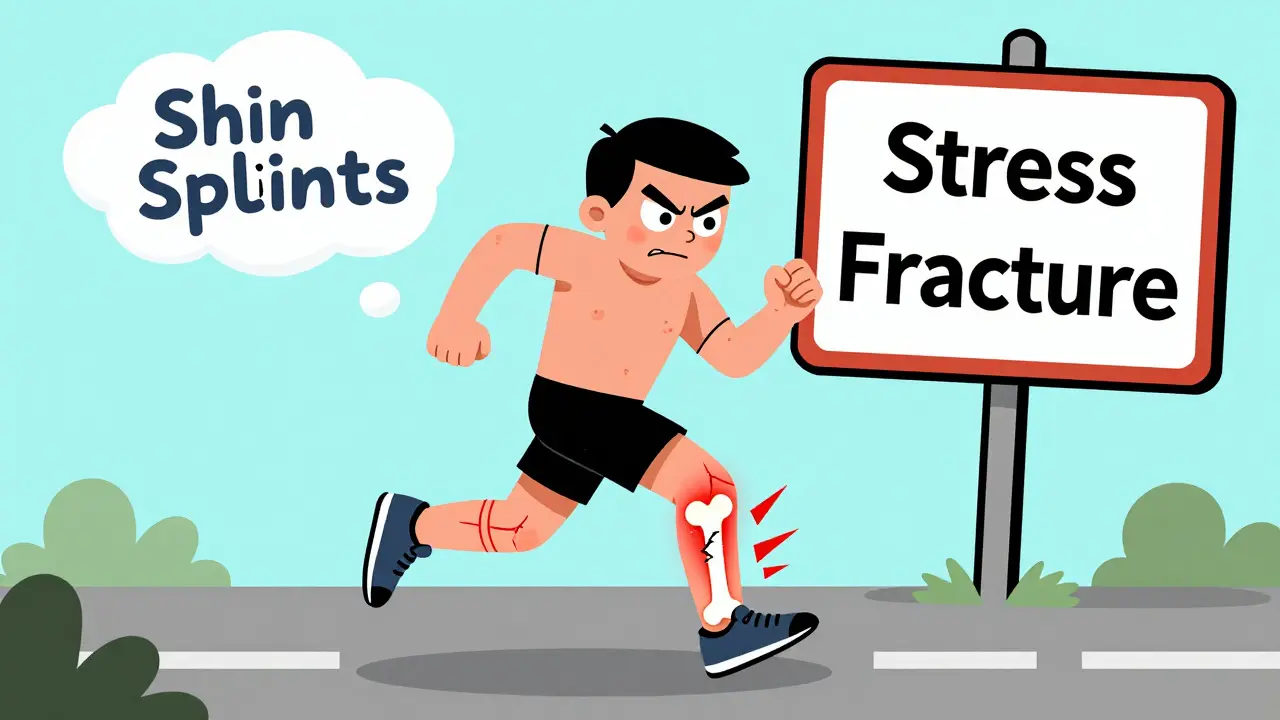
Running hurts - not the good kind of hurt, but the sharp, persistent ache in your shins that makes every step feel like walking on broken glass. If you’ve been there, you know the frustration: you just want to get back out there, but one wrong move and the pain comes roaring back. Shin splints and stress fractures might sound similar, but they’re not the same. And if you treat them like they are, you’re setting yourself up for a long, painful setback.
What’s the Difference Between Shin Splints and Stress Fractures?
Shin splints, or medial tibial stress syndrome (MTSS), are a soft tissue problem. Think of it as inflammation along the inner edge of your shinbone, where muscles attach. It’s common in new runners, people who suddenly increase mileage, or those running on hard surfaces. The pain is usually diffuse - spread out over a few inches - and often feels better after warming up, though it can flare up again after running.
Stress fractures are different. These are tiny cracks in the bone itself, most often in the tibia or fibula. They don’t just hurt - they scream. The pain is sharp, localized, and gets worse with activity. You might even feel it when you press on the spot. Unlike shin splints, stress fractures don’t improve with a warm-up. If you keep running, the crack can widen. In severe cases, it becomes a full break.
Here’s the kicker: up to 21% of female runners develop stress fractures, compared to 8% of men. Why? It’s often tied to energy availability - not enough calories, low iron, or hormonal imbalances. The International Olympic Committee now calls this condition Relative Energy Deficiency in Sport (RED-S), and it’s behind nearly a third of recurring stress fractures in women.
Why the 10% Rule Doesn’t Work Anymore
You’ve heard it a hundred times: “Don’t increase your mileage by more than 10% per week.” It sounds smart. But here’s the truth - that rule fails 68% of the time for runners recovering from stress fractures. Why? Because bones don’t heal on a calendar. They heal on load.
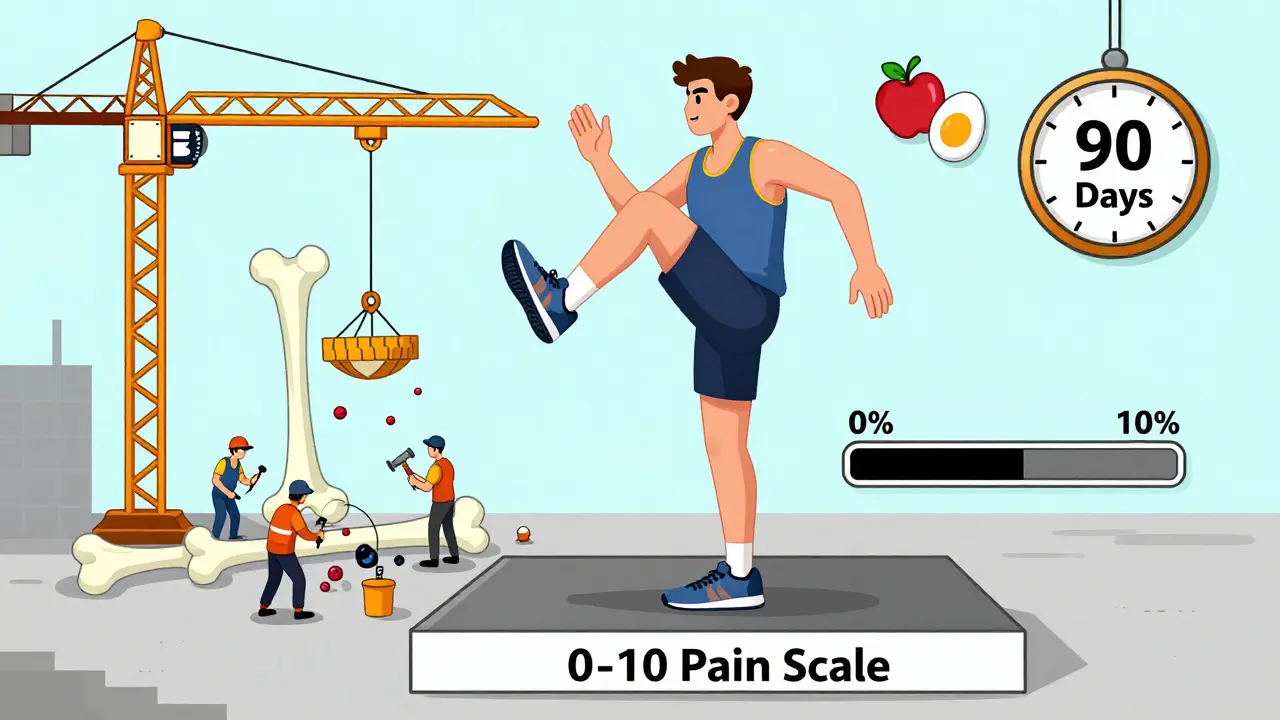
Bone remodeling takes 90 to 120 days. That’s the cycle your body needs to rebuild and strengthen. Rushing it doesn’t make you faster - it just makes you injured again. Studies show that runners who push too soon have a 19-32% chance of re-injury. That’s not a risk. That’s a guarantee.
Instead of counting miles, start counting pain. Use a 0-10 scale. If your pain hits above 2/10 during or after activity, you’re pushing too hard. No exceptions. No “just one more run.”
The Four-Phase Return-to-Run Protocol
Successful recovery isn’t about waiting for pain to disappear. It’s about rebuilding strength, control, and resilience - step by step. Here’s what works, based on the latest evidence from physical therapy clinics and sports medicine journals.
Phase 1: Pain-Free Walking (3-10 Days)
Stop running. Not “cut back.” Not “take a few days off.” Stop. If you can’t walk without pain, you’re not ready to start rehab. This phase is about letting the bone calm down. No impact. No jumping. No cycling if it causes discomfort.
Use crutches if needed. Yes, really. If you’re limping, you’re stressing the bone. Rest isn’t lazy - it’s strategic. This phase lasts until you can walk for 7 full days without any pain. No shortcuts.
Phase 2: Gentle Loading (Start After 7 Pain-Free Days)
Now you start rebuilding. Not with running - with strength. Daily heel raises are your new best friend.
- Double-leg heel raises: 3 sets of 15-20 reps, twice a day
- Do them slowly. 3 seconds up, 3 seconds down
- Keep your knees straight, hips square
Do these even if you feel fine. Bone needs stimulus to heal. But only if it’s controlled. If your pain goes above 2/10 during or after, stop and rest another 3 days.
Phase 3: Full Range Strength (Weeks 2-4)
Once you can do 3 sets of 20 double-leg heel raises without pain, move to step-ups. Stand on a low step or book, let your heel drop below the step, then rise up on one foot.
- 3 sets of 10-15 reps per leg
- Focus on control, not speed
- Add weight only if you can do it pain-free
Don’t skip glutes. Weak hips mean your shins take the extra load. Do clamshells, side leg raises, and single-leg bridges 3 times a week. Studies show 57% of runners who skipped hip work re-injured themselves within 3 months.
Phase 4: Explosive Strength and Run-Walk Progression (Weeks 5-12)
Now you’re ready to reintroduce running - slowly. This isn’t a race. It’s a science.
For low-risk stress fractures (back of the shin), use this schedule:
- Weeks 1-2: 1 minute running, 4 minutes walking. Total 20 minutes. 2-3 times a week.
- Week 3: 1:3 ratio. 25 minutes total.
- Week 4: 1:2 ratio. 30 minutes total.
- Week 5: 1:1 ratio. 35 minutes total.
- Week 6: 3:1 ratio. 40 minutes total.
For high-risk sites - front of the shin, femur, or navicular bone - double the time. 8-12 weeks minimum. No exceptions.
After each run, check your pain. If it’s above 2/10, go back a step. If it’s zero, stay where you are for another week. This isn’t about speed. It’s about safety.
What to Do When You’re Not Running
Cardio doesn’t vanish just because you can’t run. You need to keep your heart strong - or you’ll lose motivation, muscle, and stamina.
- Pool running: Mimics running motion with zero impact
- Cycling: Low resistance, high cadence - avoid hills if they hurt
- Elliptical: Keep resistance low, focus on form
- Anti-gravity treadmills (AlterG): If available, use them. They cut body weight by 40-60%, reducing stress while keeping running mechanics intact. Studies show they cut recovery time by 27 days.
Do cross-training 3-4 times a week. 30-40 minutes each session. Keep your heart rate up, but keep your shins quiet.
Why So Many Runners Fail
It’s not lack of willpower. It’s lack of structure.
On Reddit’s r/running, runners who followed a structured plan had a 63% success rate. Those who guessed? Only 29%. The most common mistake? Jumping to 1:1 running too fast. One user wrote: “I jumped to 1:1 after two pain-free days. Three weeks later, I was back in the clinic.”
Another big failure point: skipping strength work. You can’t run your way out of a stress fracture. You have to rebuild the foundation.
And don’t ignore nutrition. If you’re not eating enough - especially if you’re a woman - your bones won’t heal. Low iron, low vitamin D, low estrogen - they all slow healing. The American College of Sports Medicine now recommends a DXA scan for anyone with recurring stress fractures. One in four has low bone density.

What’s New in 2026
Recovery isn’t static. New tools are making it smarter.
Wearable tech like the WHOOP strap now tracks bone strain - not just heart rate. Its algorithm detects abnormal loading patterns with 89% accuracy. If your bone stress spikes, it warns you before you get hurt.
Blood tests are becoming part of rehab. Biomarkers like PINP and CTX tell doctors exactly how fast your bone is healing - not guesswork from MRI scans. A 2024 study showed these markers matched MRI results 94% of the time.
Apps like RunRx use AI to predict recovery time based on your training history, biomechanics, and blood data. In beta testing, it’s accurate 86% of the time. That’s not magic - it’s science.
And insurance? In the U.S., 87% of plans now cover 12 physical therapy visits for stress fractures - up from 63% in 2021. If you’re in the UK, NHS physio is available, but wait times can be long. Private clinics with running specialists are worth the investment.
When to See a Specialist
If you’ve had two or more stress fractures, see a sports medicine doctor. You need a full check: blood work, bone density scan, hormone levels, and gait analysis.
Dr. Irene Davis from Spaulding National Running Center says: “Bone adapts to load, but only when energy availability is sufficient.” Translation: you can’t train your way out of a nutritional deficit.
And if you’re still hurting after 12 weeks - even with perfect rehab - it’s not just a bone issue. It could be nerve compression, compartment syndrome, or a hidden endocrine disorder. Don’t wait. Get checked.
Final Advice: Patience Is Your Best Gear
You didn’t get injured overnight. You won’t heal overnight. The fastest recovery isn’t the one with the shortest timeline - it’s the one with the lowest chance of coming back.
Stick to the plan. Track your pain. Do the exercises. Eat enough. Rest when needed. Your future self - the one running pain-free in 12 weeks - will thank you.
And if you’re tempted to skip a step? Ask yourself: Do you want to run next month - or next year?
Can I keep running if my shin splints only hurt a little?
No. Even mild pain is your body’s warning sign. Continuing to run with shin splints can turn a soft tissue issue into a stress fracture. The pain threshold should be zero during activity. If you feel discomfort, stop and reassess.
How long does a stress fracture take to heal?
Low-risk stress fractures (like those on the back of the shin) usually take 6-8 weeks to heal with proper rest and rehab. High-risk sites - such as the front of the shin, femur, or foot bones - can take 8-12 weeks or longer. Healing depends on nutrition, age, and how strictly you follow the rehab plan.
Should I use orthotics or heel lifts for shin splints?
Heel lifts may reduce tibial strain by only 12-15%. Gait retraining - changing how you land and move - reduces strain by up to 38%. Orthotics can help if you have flat feet or overpronation, but they’re not a fix. Strengthening your calves, hips, and core is far more effective long-term.
Can I do yoga or Pilates while recovering?
Yes - as long as you avoid poses that put pressure on your shins. Gentle yoga and Pilates help with mobility and core strength, which support running form. Avoid deep lunges, toe touches, or any movement that causes pain. Focus on hip stability and controlled breathing.
Why do women get stress fractures more often than men?
Women are more likely to have Relative Energy Deficiency in Sport (RED-S), where calorie intake doesn’t match energy output. This disrupts hormones, lowers bone density, and slows healing. Low iron, vitamin D deficiency, and irregular periods are red flags. Screening for RED-S is now standard for female athletes with recurring injuries.
How do I know when I’m ready to run again?
You’re ready when: you’ve walked pain-free for 7+ days, you can do 3 sets of 20 double-leg heel raises without pain, and your hip and core strength is back. Then, start the run-walk protocol slowly. If pain hits above 2/10 at any point, stop and wait another week.
Will I ever run the same again after a stress fracture?
Yes - if you rebuild properly. Many runners come back stronger because they’ve learned to listen to their bodies. The key is consistency in rehab, not just in running. Those who stick to strength work, nutrition, and gradual progression often run longer and injury-free for years.



9 Comments
So basically, if you're a woman who runs and doesn't eat enough, your bones are just like, 'lol, see ya later' 😅
I've seen too many runners ignore this. They think 'pain is weakness leaving the body'-no, pain is your skeleton screaming for mercy. Stop. Now. You're not a hero. You're just stupid.
This is gold. 💪 Seriously, if you're reading this and still trying to run through pain-you're not training, you're gambling with your future. I've coached runners back from stress fractures, and the ones who stuck to the plan? They came back stronger, smarter, and faster. Patience isn't passive-it's power.
I mean, if you're not doing daily heel raises and your hips aren't firing like a rocket, you're just wasting everyone's time. And if you're on a plant-based diet? Good luck. Your bones know.
I had this for 3 years and no one told me this! I just kept running and now I can't even walk without crying. Why didn't anyone help me?
I appreciate how this breaks it down without judgment. Too many people treat recovery like a checklist. But bones don't care about your race schedule. They care about rest, food, and consistency. This is the kind of advice that actually saves people.
This is the kind of post that makes me proud to be part of this community. 🌍❤️ Whether you're from India, the US, or anywhere else-your body speaks the same language. Listen to it. Eat. Rest. Strengthen. Repeat. You got this.
The notion that '10% rule' is outdated? Absolutely correct. And yet, I still see coaches-yes, coaches-recommending it. This is not merely anecdotal; it's empirically invalid. Furthermore, the assertion that RED-S underlies 33% of recurrent stress fractures is not only statistically significant-it is ethically imperative that medical professionals screen for it. Period.
heel raises > everything. just do them. no excuses.