
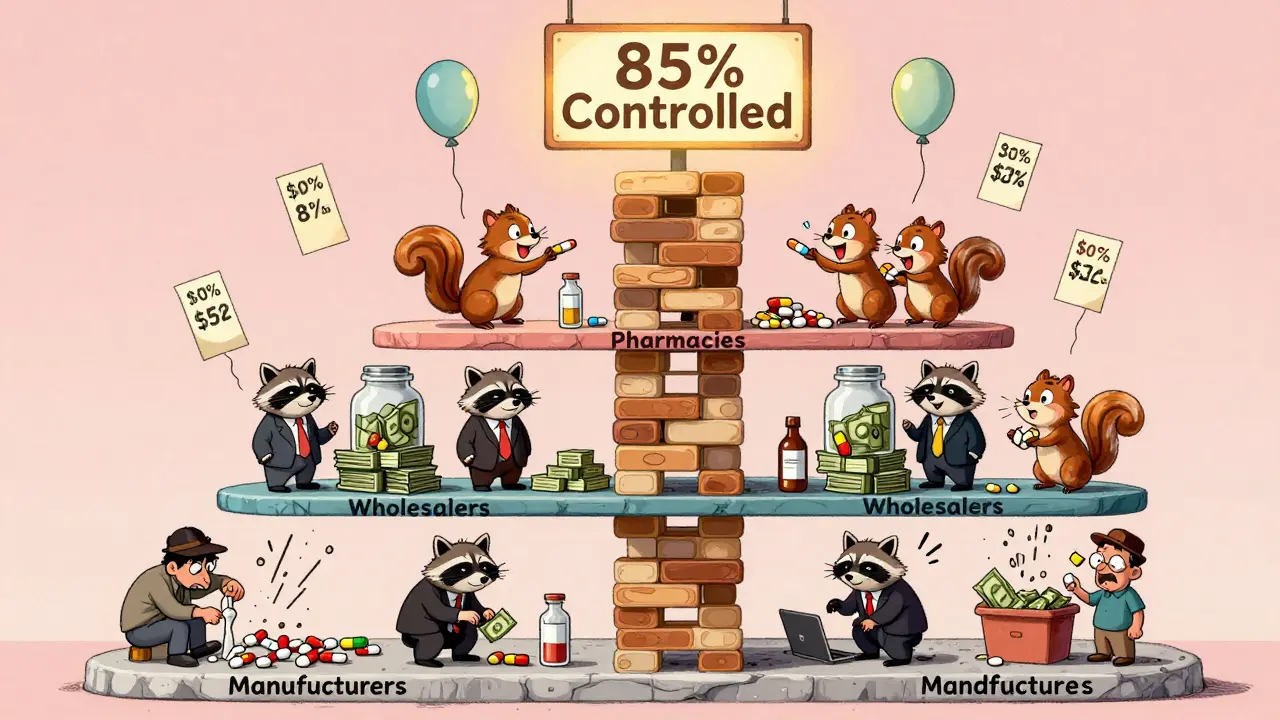
When you pick up a prescription for generic lisinopril or metformin, you probably don’t think about who moved it from the factory to your pharmacy. But behind that $4 bottle of pills is a complex, high-stakes economic system that shapes exactly how much you pay-and who makes the money. The wholesale distribution of generic drugs isn’t just logistics. It’s a profit engine with rules that favor a handful of giants, reward volume over value, and often leave manufacturers with razor-thin margins while others cash in.
The Three-Tier System That Controls Your Medicine
The U.S. generic drug supply chain runs on a three-tier structure: manufacturers make the pills, wholesalers move them, and pharmacies sell them. This system wasn’t always this way. Before the Prescription Drug Marketing Act of 1987, drug distribution was messy and unsafe. Today, it’s tightly controlled-and dominated. Just three companies-AmerisourceBergen, Cardinal Health, and McKesson-control about 85% of the entire U.S. pharmaceutical wholesale market. That’s not competition. That’s a cartel with a legal shield. These wholesalers don’t just ship boxes. They set prices. They decide which manufacturers get shelf space. They influence which drugs are available and which go out of stock. And they make more money on generic drugs than on branded ones-even though generics make up a smaller slice of total revenue.Why Wholesalers Make More on Generic Drugs
Here’s the twist: manufacturers earn less profit on generics than on branded drugs. For branded drugs, manufacturers take home about 76% gross margin. For generics? It drops to 49.8%. But here’s where it gets strange: wholesalers make eleven times more profit per unit on generic drugs than on branded ones. In 2009, generics generated $1.7 billion more in gross profits for the Big Three than brand-name drugs-even though they only accounted for 9% of wholesale revenue. Why? Because generic drug makers are desperate to win contracts. With dozens of companies making the same generic pill, they slash prices to get into the system. Wholesalers, sitting on top of this pile of cheap inventory, get to pick and choose. They buy in bulk at rock-bottom prices, then sell to pharmacies at a markup that still leaves them with massive profit margins. Meanwhile, pharmacies make nearly twelve times more on generics than on branded drugs. The real winners? The middlemen.How Pricing Actually Works (It’s Not What You Think)
Wholesalers don’t just slap on a 20% markup and call it a day. They use four pricing strategies, and tiered volume discounts are the most powerful.- Cost-plus pricing: Add a fixed percentage to production cost. Simple, but ignores demand.
- Market-based pricing: Match what competitors charge. Safe, but cuts into margins.
- Value-based pricing: Charge based on perceived benefit. Rare in generics.
- Tiered pricing: The real game-changer.
Profit Margins: Who Gets What?
Here’s a breakdown of who pockets what on a typical generic drug:| Role | Gross Margin (Generic) | Gross Margin (Branded) | Profit Ratio (Generic vs. Branded) |
|---|---|---|---|
| Manufacturer | 49.8% | 76.3% | ~0.65x |
| Wholesaler | ~20-30% | ~2-5% | ~11x |
| Pharmacy | 42.7% | ~3.5% | ~12x |
| PBM (Pharmacy Benefit Manager) | High (exact varies) | Lower | ~4x |
What Happens When Drugs Go Short?
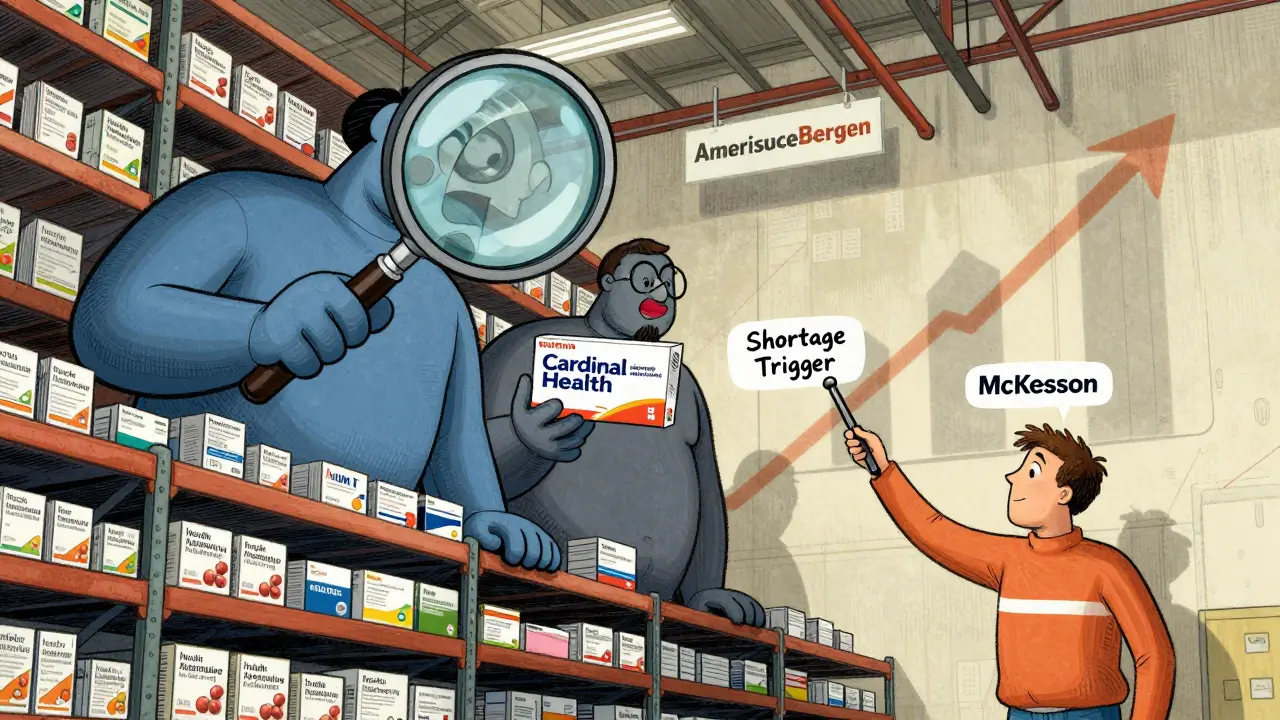
In 2020, the pandemic caused panic buying. Prices spiked. In 2021 and 2022, the market corrected-prices fell again. But in 2023, something new happened: shortages. Not just a few pills missing. Entire classes of generics vanished. Antibiotics. Blood pressure meds. Insulin alternatives. When a generic drug disappears from the market, the few remaining suppliers gain total control. Prices jump. Wholesalers raise their prices. Pharmacies pass it on. Patients pay more. And guess who benefits? The wholesalers who still have stock. The ones who bought ahead. The ones who played the long game. This isn’t an accident. It’s systemic. The same companies that control 85% of distribution also control how inventory is allocated. When a shortage hits, they decide who gets what-and at what price. The Commonwealth Fund calls this “leveraging list price increases.” In plain terms: they use scarcity to inflate profits.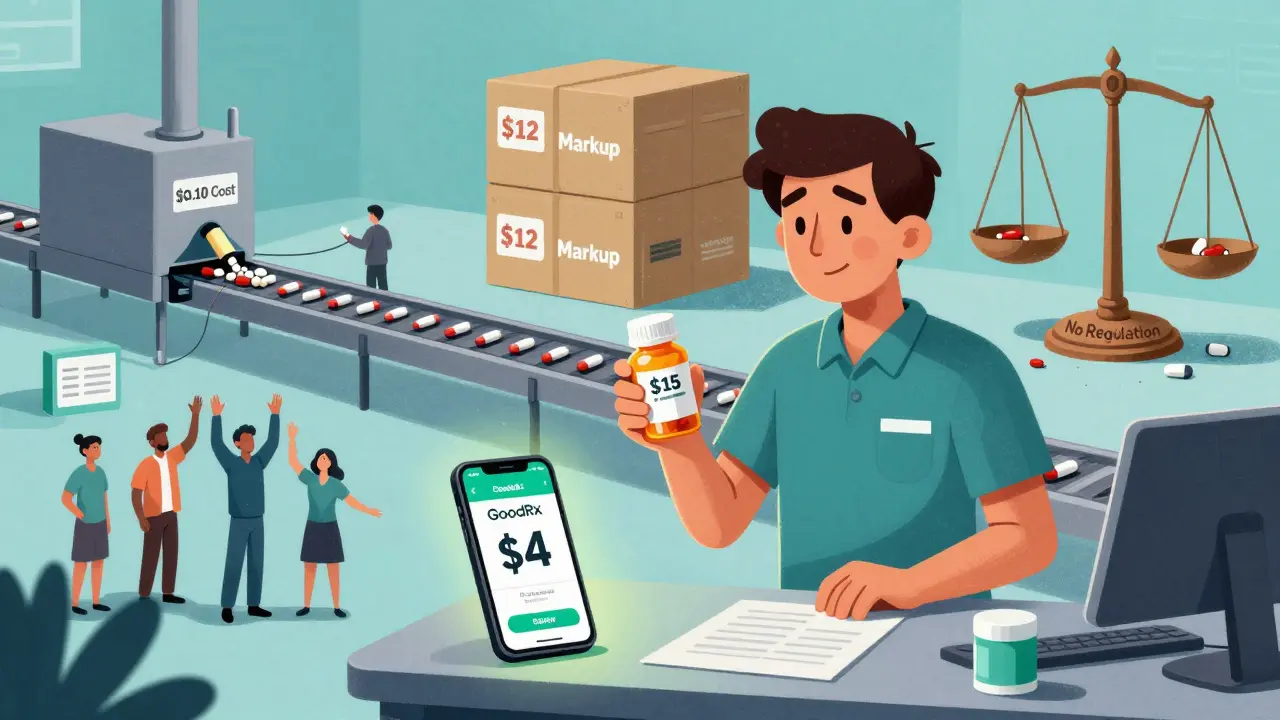
The Hidden Cost of Volume
Wholesalers love volume because it moves inventory fast. But volume also means huge amounts of cash tied up in stock. A single warehouse might hold millions of dollars in pills that haven’t been sold yet. That’s why their net margins are so thin-just 0.5%. They make money on turnover, not per-unit profit. This creates pressure. Wholesalers need to sell fast. So they push pharmacies to buy more. They offer deep discounts for bulk orders. They bundle drugs together. They even delay shipments to create artificial shortages, then sell at premium prices. It’s a game of supply chain chess. And most pharmacies? They’re pawns.Who’s Watching? And Should They Be?
No one is really regulating this. The FDA tracks safety. The FTC watches for mergers. But no agency audits wholesale pricing. No one asks why a $0.10 pill ends up costing $15 at the pharmacy. The USC Schaeffer Center said it plainly in 2006: “Greater scrutiny of pricing policies… and more competition… is warranted.” Ten years later, not much changed. The Big Three still own the market. Generic prices still swing wildly. Shortages still happen. And patients still pay the price. The National Retail Federation says wholesale pricing should reflect production cost + shipping + profit. That sounds fair. But in reality, profit is determined by power-not cost.What Could Change?
There are three paths forward:- More competition: Break up the Big Three. Let smaller wholesalers compete. But that’s unlikely-consolidation is still the trend.
- Transparency laws: Require wholesalers to disclose pricing formulas. Some states are trying this. It’s a start.
- Direct sourcing: Pharmacies and hospitals bypass wholesalers entirely. A few are doing it. But it’s risky. Logistics are hard. Inventory is expensive.
Why are generic drugs cheaper at some pharmacies than others?
It’s not about the drug-it’s about who’s buying it. Pharmacies that buy in bulk directly from wholesalers get better prices. Those that buy smaller quantities pay more. Some pharmacies also negotiate special deals with specific wholesalers. And some use mail-order or bulk purchasing groups to cut costs. The same generic pill can cost $4 at one store and $12 at another, even next door.
Do wholesalers cause drug shortages?
They don’t cause them directly, but they can worsen them. When a manufacturer runs low, wholesalers decide who gets the remaining stock. They often prioritize customers who buy the most volume or pay the highest prices. This creates artificial scarcity. Some critics argue wholesalers delay shipments to create urgency and drive up prices. While hard to prove, the pattern is consistent: shortages hit when profits are highest.
Why don’t manufacturers just sell directly to pharmacies?
They can-but it’s risky. Wholesalers handle logistics, storage, billing, and delivery across thousands of locations. A small manufacturer can’t afford to build that infrastructure. Plus, wholesalers have long-term contracts with major pharmacy chains. Breaking in is nearly impossible without paying hefty fees or giving up control. It’s easier to accept low margins than to fight the system.
Is it legal for wholesalers to raise prices during shortages?
Yes. There are no federal price controls on generic drugs. States can set limits, but most don’t. As long as the price isn’t fraudulent or collusive, it’s legal-even if it feels unfair. The system is designed to let market forces rule-even when those forces create hardship.
Can patients do anything about high generic drug prices?
Yes. Use pharmacy discount cards like GoodRx-they often show prices from multiple suppliers. Compare prices between local pharmacies and mail-order services. Ask your pharmacist if a different generic brand is available. And if you’re on a fixed income, ask about patient assistance programs. You’re not powerless-you just need to look beyond the label.
The next time you pay $5 for a generic pill, remember: you’re not just paying for the medicine. You’re paying for a system built to profit from volume, scarcity, and silence.

10 Comments
So let me get this straight - the people who make the actual medicine make next to nothing, but the guys who just warehouse and ship it get 11x the profit? And we call this a free market? 🤡
Next they’ll tell me the guy who delivers your pizza makes more than the chef. At this point, I’m just waiting for the pill to come with a side of Wall Street bingo.
This isn’t just broken - it’s a textbook case of market capture. When three firms control 85% of distribution, you don’t have competition. You have a regulated monopoly disguised as capitalism. The profit asymmetry between manufacturers and wholesalers isn’t an accident - it’s the design. The system incentivizes volume over access, and scarcity over stability. That’s not economics. That’s predatory structuring.
The fact that no federal agency audits wholesale pricing is a regulatory failure of historic proportions. We regulate the safety of pills, but not the morality of their pricing? We’ve outsourced healthcare ethics to profit algorithms.
I’ve been on metformin for 8 years. Last year, my pharmacy charged me $18 for a 30-day supply. This month? $4. Same pill. Same manufacturer. What changed? I started using GoodRx. Turns out, the ‘market price’ is a lie. It’s a game of musical chairs with inventory, and we’re the ones getting left standing when the music stops.
Wholesalers aren’t middlemen - they’re gatekeepers with a spreadsheet and a conscience vacuum. And pharmacies? They’re just the front desk for a system rigged to extract, not heal.
It’s kind of wild how everyone focuses on the wholesalers, but PBMs are the real ghosts in the machine. They negotiate rebates behind closed doors, then the pharmacy gets paid based on the list price - not the actual cost. So even if the wholesaler charges $0.50, the PBM says ‘$15’ and the insurance pays that. The difference? Pocketed. Nobody talks about that.
Wholesalers are bad, but PBMs are the silent vampires.
Of course this is rigged. The same three companies that move your pills also own the lobbyists who write the laws. They’ve been doing this since the 90s. You think the FDA doesn’t know? They do. They just don’t care. This is how the deep state works - not with spies, but with supply chain contracts.
And don’t even get me started on how they engineer shortages. It’s not ‘market forces.’ It’s deliberate. They let a drug go out of stock, then raise the price 500% when everyone’s panicking. It’s not capitalism. It’s extortion with a warehouse.
Let us be perfectly clear: the entire structure of generic drug distribution is a moral abomination. The manufacturer, who invests in R&D, quality control, regulatory compliance, and raw material sourcing, is reduced to a commodity supplier - paid pennies while intermediaries extract rents that would make a medieval toll collector blush.
The pharmacy, ostensibly a healthcare provider, becomes a retail outlet for profit extraction. The patient, who requires medicine to survive, is treated as a revenue stream. This is not a market failure - it is a civilization failure. The absence of price transparency, the consolidation of power, the normalization of scarcity as a profit lever - these are not business practices. They are crimes against public welfare, enabled by legislative inertia and judicial passivity.
Why are we even talking about this? It’s America. If you can’t afford your meds, you’re just lazy. The government shouldn’t be babysitting drug prices. Let the market work. If you want cheap pills, move to India. Or don’t get sick. Simple.
These ‘wholesalers’? They’re doing the heavy lifting. You think some guy in a warehouse in Ohio wants to be your healthcare hero? No. He just wants to get paid. And if he can make more on a $0.10 pill than the guy who made it - good for him. That’s the American dream. Profit. Not pity.
ok so i just looked up my blood pressure med and it’s $12 at cvs but $3 at walmart?? like what??
also why does my pharmacy always say ‘this one’s on backorder’ right when my script renews?? smh. they’re totally playing us. i swear they wait until i’m out and then ‘magically’ have it again at a higher price. #genericdrugconspiracy
Thank you for writing this. I’ve been a pharmacist for 15 years and I’ve watched this system destroy people. I’ve had patients cry because they had to choose between insulin and groceries. I’ve had to tell people, ‘I can get you this pill for $15 if you wait two weeks’ - because that’s when the wholesaler decides to release the next shipment.
We’re not the villains. We’re the messengers. And we’re exhausted.
Use GoodRx. Ask for cash prices. Talk to your pharmacist. You’re not powerless. 💙
Oh my god I knew it. I KNEW IT. This whole time I thought it was just me being bad at shopping, but no - it’s a SYSTEM. The same way they make you buy 10 packs of toilet paper to get the ‘sale’ price, they do it with pills. You think you’re saving money? No. You’re getting trapped. I bought 90 days of metformin because it was ‘cheaper’ - ended up with half of it expiring because I didn’t need that much. Now I’m paying for storage AND wasted medicine. And the wholesaler? They got their cash upfront. Classic.
And don’t even get me started on how they ‘accidentally’ run out of stock right before your insurance renews. It’s like they have a calendar. ‘Oh, it’s the 15th - time to trigger the shortage.’
This isn’t capitalism. This is a horror movie written by a Wall Street intern with a grudge. And we’re all just background extras in a hospital gown.