
Bisphosphonate & Calcium Timing Calculator
How This Tool Works
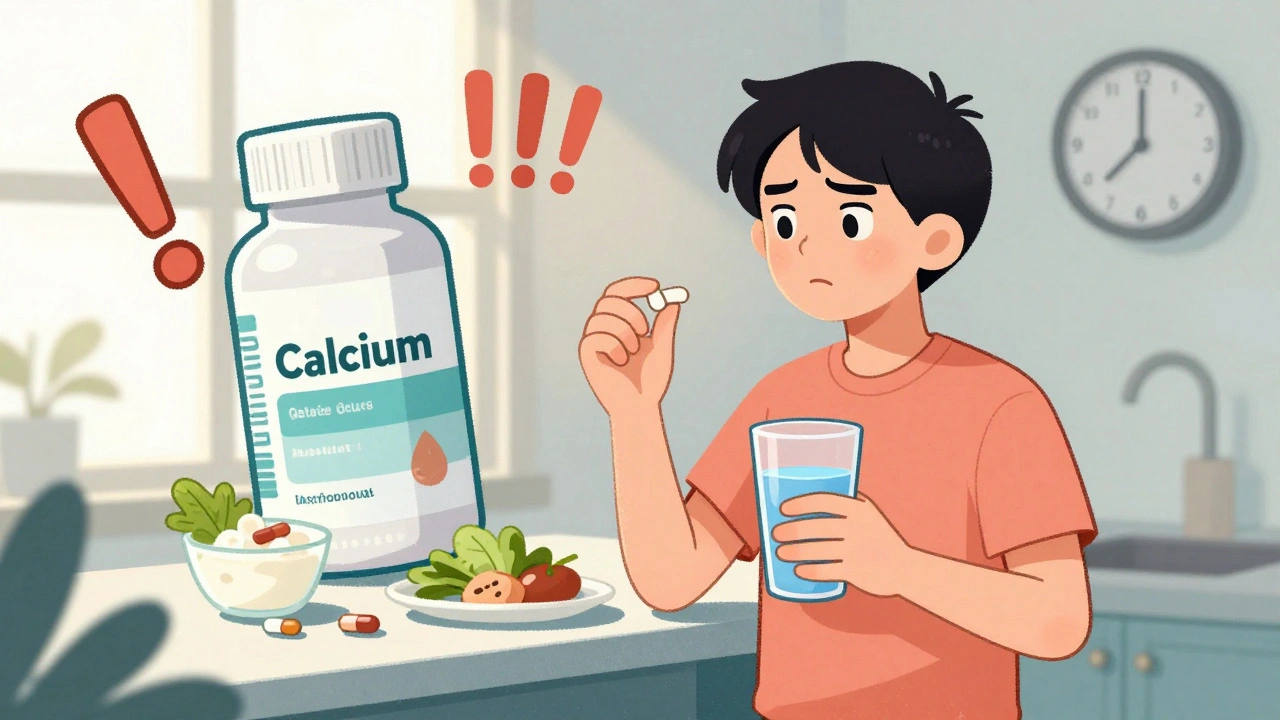
Take bisphosphonate first thing in the morning on an empty stomach with water. Wait 30-60 minutes before eating or taking calcium. This timing is critical because calcium blocks bisphosphonate absorption by up to 90%.
Enter your schedule below to calculate the optimal time to take your bisphosphonate and calcium. This tool helps prevent treatment failure by ensuring proper timing.
Your Medication Schedule
Your Calcium Intake
Your total calcium intake from food and supplements:
0 mg (0% of daily need)
Aim for 500-1,000 mg daily (split into two doses)
Your Timing Schedule
07:00 AM
07:30 AM
Important: If you take calcium before or during your bisphosphonate, you're reducing effectiveness by up to 90%. Always take bisphosphonate first, then wait 30-60 minutes before taking calcium.
How to take your medication:
- Take bisphosphonate first thing in the morning on an empty stomach
- Drink with a full glass of water
- Remain upright for at least 30 minutes
- Wait at least 30-60 minutes before eating or taking calcium
- Take your calcium supplement after the waiting period
Take your bisphosphonate with a full glass of water. Wait at least 30 minutes before eating. Don’t take it with calcium. If you forget, you might as well have skipped the pill entirely.
This isn’t advice from a confused pharmacist. It’s the bare minimum required for bisphosphonates-like alendronate, risedronate, or zoledronic acid-to work at all. And yet, nearly half of people taking them get it wrong.
Osteoporosis isn’t just about weak bones. It’s about a silent, slow erosion of your skeletal structure. One fall, one misstep, and a hip fracture can change your life forever. That’s why doctors prescribe bisphosphonates: they’re the most proven tool we have to stop bone loss before it leads to disaster. But here’s the catch-these powerful drugs can’t do their job if you’re taking calcium the wrong way.
How Bisphosphonates Actually Work
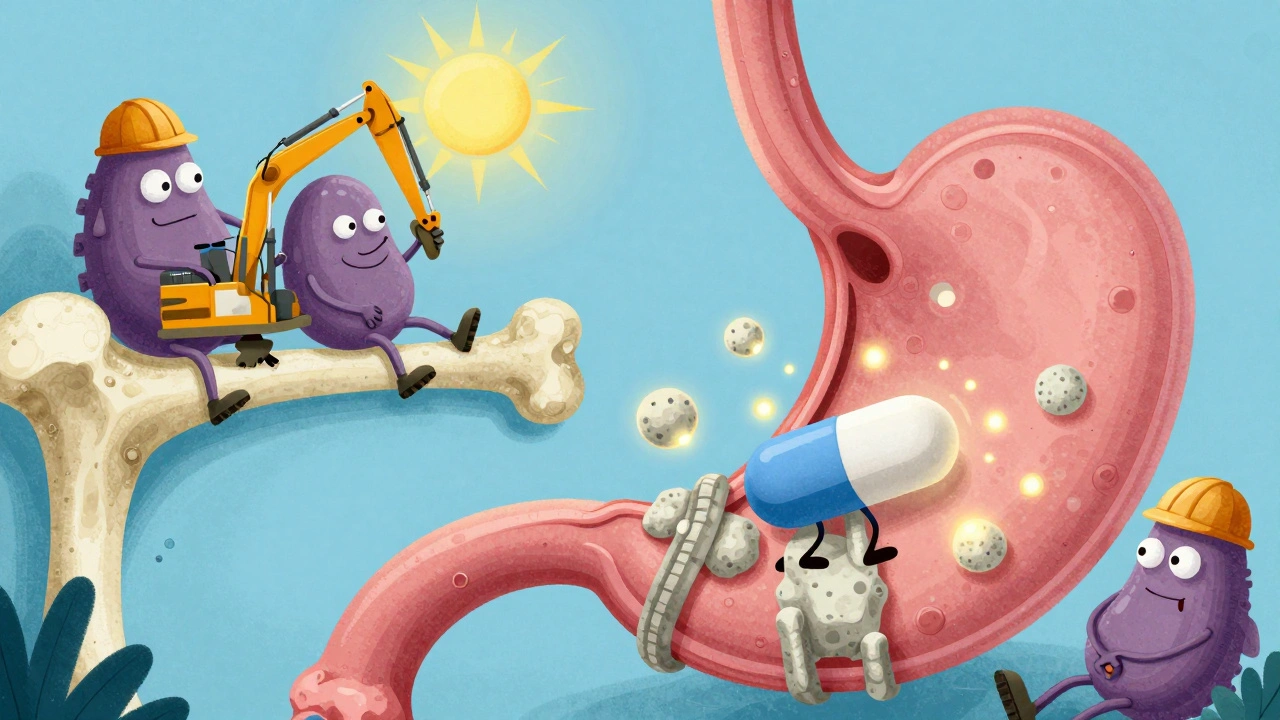
Bisphosphonates aren’t magic. They don’t rebuild bone. They don’t make you stronger overnight. What they do is quiet down the cells that break bone down-osteoclasts. Think of your skeleton like a construction site. Osteoclasts are the demolition crew. Osteoblasts are the builders. In osteoporosis, the demolition crew gets too aggressive. Bisphosphonates step in and shut them down.
These drugs latch onto the mineral part of your bone like magnets. Once there, they interfere with the energy supply of osteoclasts, essentially starving them. Studies show this reduces spine fractures by 40-50% and hip fractures by 20-25%. That’s not small. That’s life-changing.
But here’s the twist: bisphosphonates don’t absorb well. Only about 1% of the pill you swallow actually enters your bloodstream. The rest? It just sits in your gut. And if calcium is nearby? That 1% drops to 0.1%.
Why Calcium Ruins Bisphosphonates (And How to Fix It)
Calcium and bisphosphonates don’t just ignore each other-they fight. In your stomach and intestines, calcium ions bind tightly to bisphosphonates, forming a hard, insoluble clump. It’s like mixing cement with paint. The paint can’t spread. The medicine can’t work.
Studies show this interaction can slash bisphosphonate absorption by up to 90%. That’s not a minor mistake. That’s throwing away your treatment.
The fix? Timing. Absolute, non-negotiable timing.
You must take your bisphosphonate:
- First thing in the morning, on an empty stomach
- With a full glass of plain water (no coffee, juice, or soda)
- At least 30 to 60 minutes before eating, drinking, or taking any other medication-including calcium
After that 30-60 minute window, you’re free to eat. That’s when you take your calcium supplement. Or better yet-get it from food. Yogurt, fortified plant milks, leafy greens, sardines with bones. If you’re taking a supplement, aim for 500-1,000 mg per day, split into two doses if possible. Don’t take it all at once. Your body can’t absorb more than 500 mg at a time.
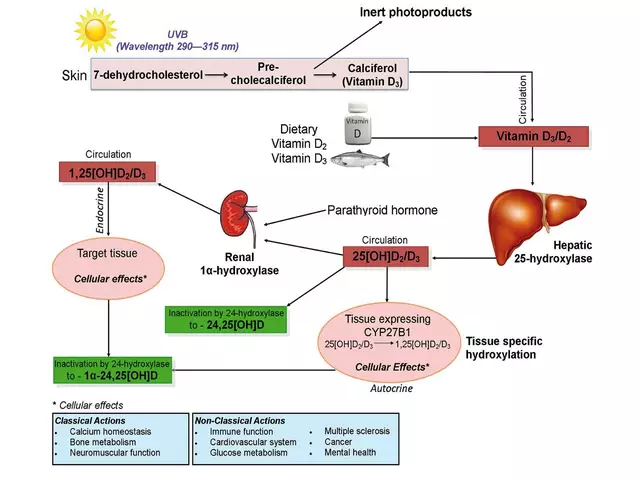
And don’t forget vitamin D. Without it, calcium doesn’t get absorbed. Most experts recommend 800-1,000 IU daily. Many bisphosphonate prescriptions now come bundled with vitamin D. If yours doesn’t, ask your doctor.
The Real Problem: People Just Forget
On paper, this sounds simple. In real life? It’s a nightmare.
A 2022 survey by the National Osteoporosis Foundation found that 58% of people stop taking their bisphosphonate within the first year. Why? The #3 reason? “Too hard to manage with all the timing rules.”
Reddit’s r/Osteoporosis community has over 12,000 members. In a 2023 survey, 67% admitted they initially took calcium right after their bisphosphonate-sometimes even with breakfast. One user wrote: “I thought the calcium would help the medicine work. Turns out, I was making it useless.”
Even doctors struggle with this. A Cleveland Clinic study of 1,200 patients found that 28% experienced mild esophageal irritation-not because the drug was bad, but because they took it lying down or with tea. The pill stuck. It burned. They stopped.
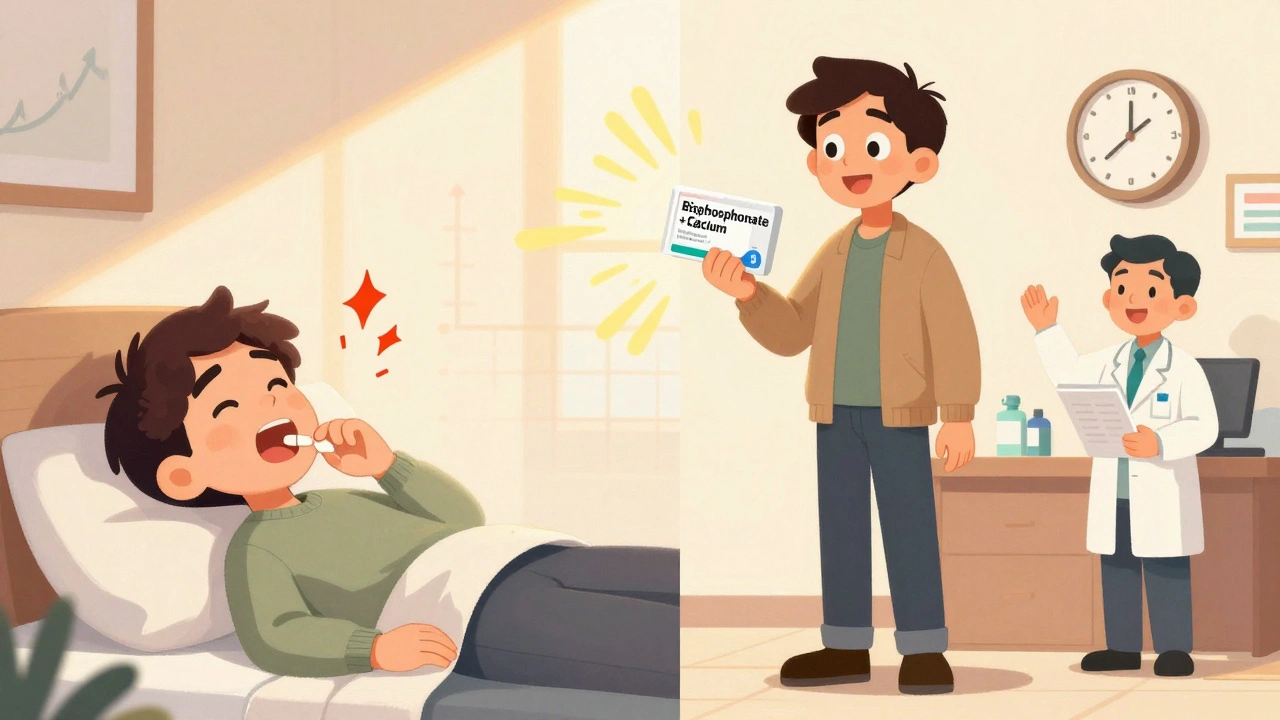
That’s why some companies created combo packs. Actonel with Calcium, for example, packages one risedronate tablet and six calcium tablets together. The packaging has clear labels: “Take this first. Wait 30 minutes. Then take these.” In clinical trials, this improved correct dosing by 28%. Patients rated it 4.2 out of 5. Why? Because it removed the guesswork.
What Happens If You Mess Up?
If you take calcium with your bisphosphonate once? Probably nothing dramatic. But if you do it every day? You’re not getting the benefit. Your bone density won’t improve. Your fracture risk stays high.
And here’s the scary part: you won’t know. There’s no immediate symptom. No stomach ache. No dizziness. Just a slow, silent decline in bone strength. A year later, you fall. A hip fractures. Suddenly, you’re in the hospital. Maybe you never walk the same again.
The risk of a fracture is real. The risk of side effects from bisphosphonates? Much smaller. Osteonecrosis of the jaw (ONJ) happens in fewer than 1 in 10,000 patients. Atypical femur fractures? About 1 in 1,000 to 10,000 over five years. But hip fractures? One in five people die within a year of breaking a hip.
That’s why experts say: the risk of not taking bisphosphonates correctly is far greater than the risk of taking them.
What About Too Much Calcium?
There’s another side to this. While calcium is essential, more isn’t always better.
Some studies suggest that taking more than 1,200 mg of supplemental calcium daily-especially without enough vitamin D-might slightly raise the risk of heart problems. It’s not a guarantee. But it’s a signal to be careful.
Don’t double up. Don’t take calcium from food, a multivitamin, and a separate supplement all at once. Track your intake. Read labels. Most multivitamins have 200-400 mg. Dairy adds another 300 mg per serving. You don’t need to force down 1,200 mg in pills.
The goal isn’t to flood your body. It’s to give your bones what they need-just enough, at the right time.
What Should You Do?
Here’s the simple checklist:
- Morning: Take bisphosphonate with plain water. Stand or sit upright for 30 minutes after. No food. No coffee. No other meds.
- After 30-60 minutes: Eat breakfast. Take your calcium supplement (if needed). Take your vitamin D.
- Evening: If you take a second calcium dose, take it at dinner or bedtime. Again, no bisphosphonate.
- Check your labels: How much elemental calcium is in your supplement? Many pills say “calcium carbonate 1250 mg”-but that’s only 500 mg of actual calcium.
- Ask for combo packs: If your pharmacy offers a pre-sorted bisphosphonate + calcium pack, ask for it. It’s designed to make this easier.
And if you’re confused? Talk to your pharmacist. Not your doctor. Pharmacists are the experts on how pills interact. They see this every day.
It’s Not About Being Perfect. It’s About Being Consistent.
You don’t need to be flawless. Life happens. You forget. You’re in a rush. You eat a snack too early.
But if you do it right 80% of the time? You’re doing better than most.
Bone health isn’t a sprint. It’s a marathon. And bisphosphonates, taken correctly with calcium, are one of the few tools that can actually help you finish it without breaking.
Don’t let a simple timing mistake turn your treatment into a waste. Your bones will thank you.
Can I take calcium and bisphosphonates at the same time?
No. Calcium blocks bisphosphonate absorption. Taking them together reduces the medicine’s effectiveness by up to 90%. Always take bisphosphonates on an empty stomach with water, then wait 30-60 minutes before taking calcium or eating.
What if I forget and take calcium right after my bisphosphonate?
If you realize within 30 minutes, wait two hours and take your bisphosphonate again with plain water. If it’s been longer than 30 minutes, skip that dose and take your next one as scheduled. Don’t double up. Missing one dose occasionally won’t ruin your treatment-but doing it regularly will.
Do I need calcium supplements if I drink milk and eat yogurt?
Maybe not. One cup of milk has about 300 mg of calcium. Two servings of yogurt add another 400-500 mg. If you’re eating those daily, you may already be close to your daily need. Check your total intake. Only supplement if you’re below 500-1,000 mg per day from food and pills combined.
Is it safe to take bisphosphonates long-term?
Yes, for most people. Bisphosphonates are proven safe for up to 10 years. After 3-5 years, your doctor may suggest a “drug holiday”-pausing treatment if your fracture risk is low. This reduces rare risks like atypical femur fractures or osteonecrosis of the jaw. Always get bone density scans and risk assessments before deciding to stop.
Can I take vitamin D with my bisphosphonate?
Yes. Vitamin D doesn’t interfere with bisphosphonate absorption. In fact, it’s essential for calcium to work. You can take vitamin D with your bisphosphonate in the morning. Just make sure it’s not combined with calcium in the same pill unless your doctor says it’s safe.
Why do I need to stay upright after taking bisphosphonate?
Bisphosphonates can irritate the esophagus if they sit there too long. Standing or sitting upright helps the pill move quickly into your stomach. Lying down increases the risk of burning or inflammation. Wait at least 30 minutes before lying down.
Are there alternatives if I can’t follow the timing rules?
Yes. If you can’t manage the strict schedule, talk to your doctor about alternatives like denosumab (Prolia), which is injected twice a year and doesn’t require fasting or timing restrictions. Or consider romosozumab (Evenity), which builds bone rather than just slowing loss. These aren’t for everyone, but they’re options if bisphosphonates aren’t workable.


15 Comments
Just took my alendronate this morning with a big glass of water. Sat upright like a statue for 45 minutes. No coffee, no yogurt, no sneaky calcium pill. Feels weird, but I’d rather be alive than broken.
Oh please. You think this is some holy ritual? I’ve been taking my bisphosphonate with my morning coffee and calcium for 7 years. My bones are fine. Your doctor’s just scared of losing you to a drug company’s marketing department.
Ugh I did the coffee + calcium thing for months and didn’t realize it was useless 😭 I started using a little alarm app now - ‘BISOPHOSPHONATE TIME’ - and it saved my spine. You’re not crazy for struggling. This stuff is designed to be hard.
my pharmacist gave me those combo packs and my life changed. no more guessing. no more guilt. just open the little slot, take the white pill, wait, then take the green ones. it’s dumb simple. why don’t more people ask for these??
It’s wild how something so simple - water, wait, don’t eat - can feel like a full-time job. I used to take my calcium with breakfast like a normal person. Now I’ve got a little whiteboard on my fridge: ‘WATER → WAIT → WAKE UP → WALK OUTSIDE.’ It’s not just medicine. It’s a daily meditation on not becoming a statistic.
Let’s be honest - this whole osteoporosis narrative is manufactured by Big Pharma to sell drugs to elderly women who are terrified of falling. The real cause of bone loss? Chronic inflammation from processed foods and vitamin D deficiency. Not bisphosphonates. Not calcium timing. Your body doesn’t need chemicals. It needs real food and sunlight.
Wait - did you know the FDA approved bisphosphonates after a secret meeting with Pfizer in 2003? And now they’re pushing calcium combo packs? That’s not convenience. That’s control. They want you dependent. You think your bones are weak? Maybe your trust in the system is weaker.
lol i took mine with orange juice once bc i was in a rush. woke up with my throat on fire. went to er. they said ‘you’re lucky you didn’t get esophagitis.’ now i have a plastic cup labeled ‘BISPHOSPHONATE ONLY’ on my counter. no one touches it. not even my cat.
You speak of timing as if it were a moral imperative. But time is a human construct. The body does not care about your clock. The mineral ions bind when they bind - not when you say they should. Your rigid schedule is an illusion of control. True healing comes from surrendering to the rhythm of nature - not pharmaceutical calendars.
They say calcium blocks absorption - but what if that’s the lie? What if they want you to take MORE pills? What if the real danger is the aluminum in the calcium tablets? I read a forum post from a guy in Canada who said his bone density tanked after switching to a brand with ‘tricalcium phosphate.’ Coincidence? I think not.
As a clinical pharmacist with 22 years of experience, I can state with absolute authority that the 90% absorption reduction claim is grossly overstated. The data from the 2018 Cochrane review shows a 22-35% reduction under controlled conditions - not the 90% fear-mongering peddled by lay bloggers. Patients are being misled. This is irresponsible.
my mom did this right for 3 years. no slips. no shortcuts. her last bone scan? better than when she started. 🙏 i cried. she’s 78 and still hikes. you can do this. it’s not perfect, but it’s worth it. you’re not alone 💪
water
wait
no food
no calcium
stand up
do it right or don't bother
you're not special
your bones don't care
The entire premise of this post is rooted in reductionist biomedicine. You treat bone as a static mineral reservoir, ignoring the systemic neuroendocrine-immune interplay that governs remodeling. Bisphosphonates suppress osteoclasts but induce compensatory osteoblast apoptosis. Long-term, this leads to microdamage accumulation. The real solution? Hormonal optimization, resistance training, and circadian alignment. Not pill schedules.
They tell you to take it on an empty stomach. But what if you have gastroparesis? What if you can’t sit upright for 30 minutes because your spine is already crumbling? This advice is for people who still have mobility. For the rest of us? It’s just another way the medical system says ‘you don’t matter enough to adapt.’