
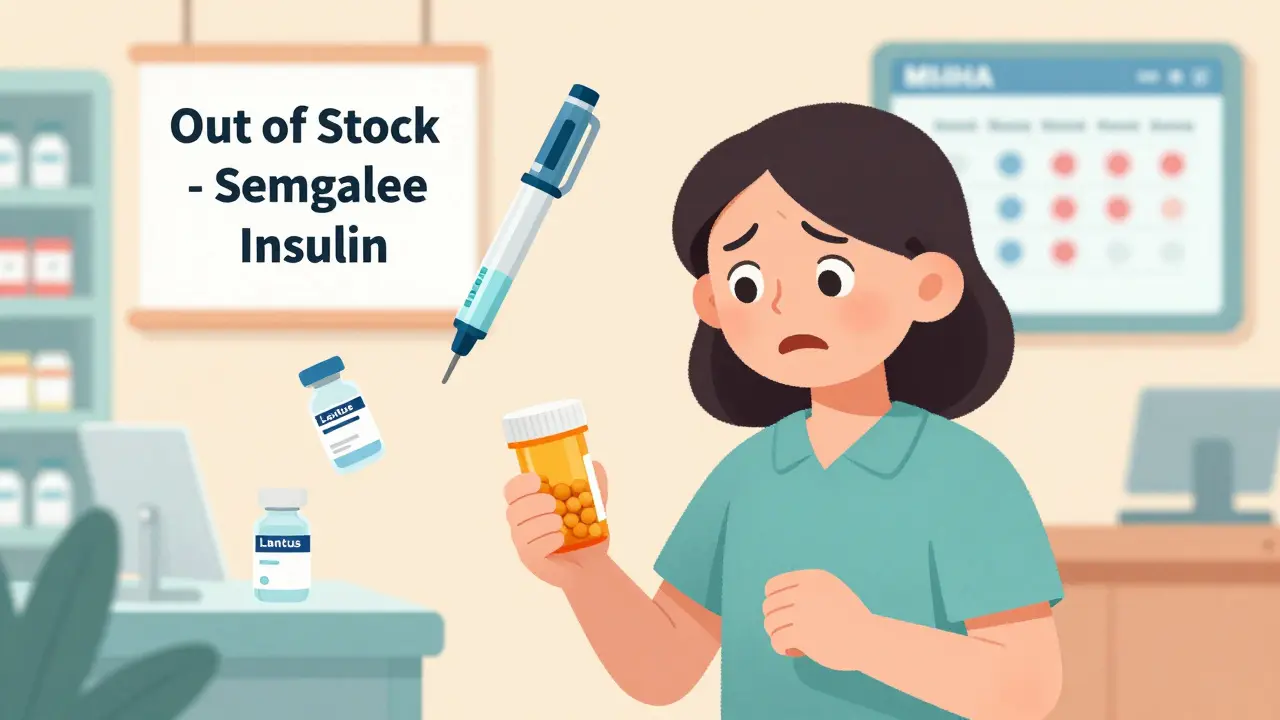
When your prescription runs out and the pharmacy says they don’t have it-again-you’re not alone. Drug shortages are no longer rare events. They’re a regular part of life for millions of people in the UK and beyond. Whether it’s insulin, antibiotics, or even basic painkillers, if your medication disappears from the shelf, you need to know what to do next. Waiting for it to come back isn’t always safe. And guessing on your own can be dangerous. The good news? There are clear, proven steps to take when your drug isn’t available.
Why Are Medications Running Out?
- Manufacturing problems: A single factory making a generic drug can shut down for quality issues, and suddenly, the whole country runs short.
- Supply chain delays: Raw materials from overseas get stuck in shipping or customs.
- Low profit margins: Some drugs cost more to make than they sell for, so companies stop producing them.
- Increased demand: A new study shows a drug works better than expected, and suddenly everyone needs it.
- Regulatory actions: The FDA or MHRA can halt production if safety concerns arise.
Between 2018 and 2023, nearly 2,000 prescription drugs entered shortage in the US alone. In the UK, similar patterns are emerging-especially with injectables, chemotherapy drugs, and insulin. Many shortages last over a year. Some have been going on for two. This isn’t a temporary glitch. It’s a broken system.
What You Can Do Right Now
Don’t panic. Don’t skip doses. Don’t try to stretch your pills. Here’s what actually works:
- Check the FDA or MHRA shortage list. The UK’s Medicines and Healthcare products Regulatory Agency (MHRA) publishes real-time alerts on drug shortages. Go to their website and search for your medication. If it’s listed, they often list approved alternatives.
- Call your pharmacy-then call three more. One pharmacy might be out, but another 10 miles away might have stock. Mail-order pharmacies often have better inventory than local ones. Ask if they can hold a supply if it arrives soon.
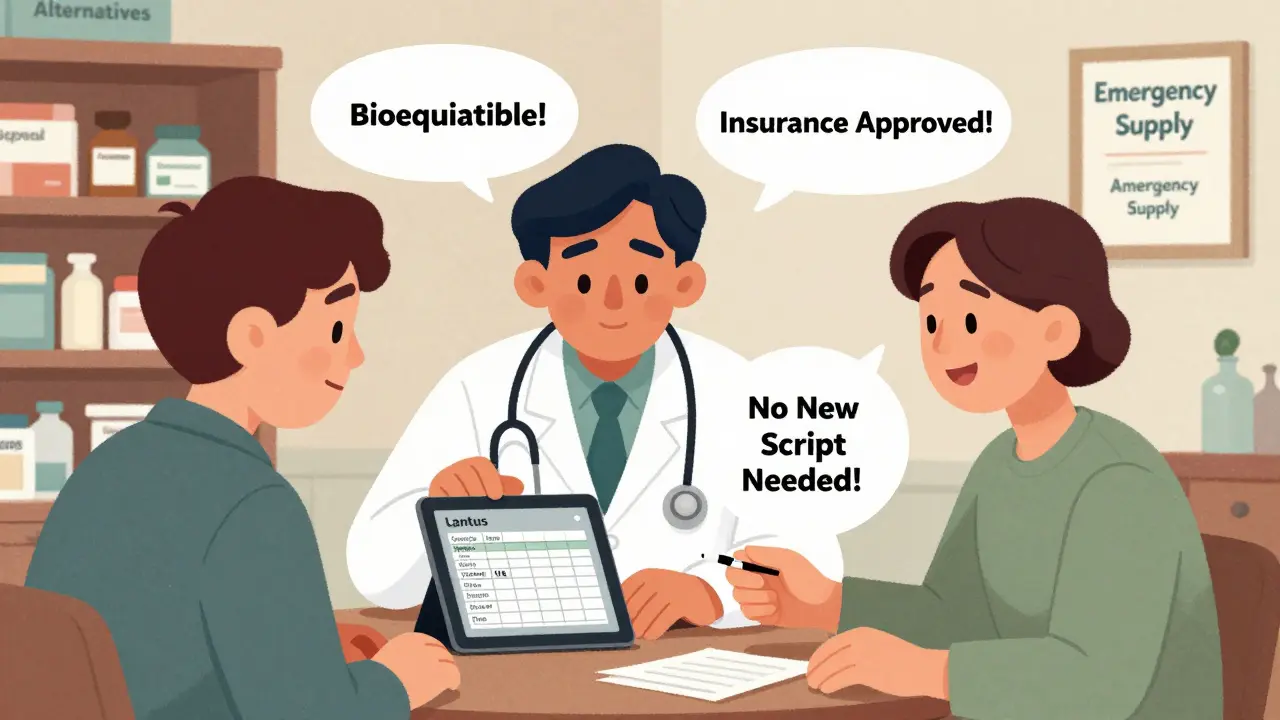
- Ask your doctor about therapeutic alternatives. Not all substitutes are the same. For example, during the Semglee insulin shortage, Lantus was approved as a direct substitute without a new prescription because they’re biosimilar. But Toujeo or Tresiba? Those require a new prescription. Your doctor needs to know which alternatives are safe and covered by your insurance.
- Check your insurance formulary. Your insurer might have changed what they cover during the shortage. Some plans removed prior authorizations for alternatives like Lantus during the insulin shortage. Others switched preferred brands. Call your insurer or log into your account.
- Use your pharmacist. Pharmacists are trained to handle shortages. Over 89% of major pharmacy chains now offer free shortage consultation services. Ask them: “Is there another drug that works the same way? Is it safe for me? Will my insurance pay for it?”
Real Examples: What Worked for Others
People have been through this-and figured it out.
One man in Liverpool, whose child needed Semglee insulin, spent three days calling seven pharmacies. He finally found a stock at a mail-order pharmacy in Manchester. His pharmacist helped him switch to Lantus temporarily, which his insurer covered without extra paperwork.
Another patient on amoxicillin found the drug gone for weeks. His doctor switched him to azithromycin. It worked-but he had to watch for stomach upset and avoid alcohol. He didn’t know this until his pharmacist explained the side effects.
During the GLP-1 weight loss drug shortage (2022-2025), many patients switched to older diabetes medications like metformin or sulfonylureas. Some saw slower results, but their conditions stayed stable. Others used compounded versions, but only under strict medical supervision.
One Reddit user, DiabeticDad87, said: “I almost gave up. Then I called my endocrinologist. She told me to try Lantus. It was easier than I thought.”
What NOT to Do
These mistakes are common-and risky.
- Don’t stop taking your medicine. Stopping blood pressure, insulin, or seizure meds can land you in hospital.
- Don’t use someone else’s prescription. Even if it’s the same name, the dose or formulation might be different.
- Don’t buy from unverified online sellers. Fake drugs are flooding the market during shortages. The MHRA warns against websites that don’t require a prescription.
- Don’t assume all generics are the same. Some are bioequivalent, others aren’t. Your doctor and pharmacist need to confirm.
When Alternatives Aren’t Perfect
Some drugs don’t have easy swaps.
Oncology drugs are the hardest. Between 2023 and 2025, 15 cancer medications faced shortages in the UK and US. Seven were pediatric treatments. For these, doctors often have to delay treatment, reduce doses, or use older, less effective drugs. It’s not ideal-but it’s life-saving when there’s no other choice.
For autoimmune drugs like sarilumab, shortages led to dose reductions in the UK. Some patients went from monthly injections to every other month. Their condition didn’t flare, but they needed closer monitoring.
When no direct alternative exists, your doctor may apply for a special import. In 2025, Hawaii’s Medicaid program started allowing foreign-approved versions of drugs during shortages. The UK hasn’t adopted this yet-but it’s being discussed.
How to Prepare for the Next Shortage
Shortages aren’t going away. Be ready.
- Keep a list of all your medications, doses, and prescribers. Update it every six months.
- Ask your doctor now: “If this drug becomes unavailable, what’s my backup?” Get it in writing.
- Sign up for MHRA drug shortage alerts via email.
- Consider keeping a 30-day emergency supply if your drug is high-risk (insulin, seizure meds, heart meds). Talk to your doctor first.
- Know your pharmacy’s shortage protocol. Do they notify you? Do they offer substitutions?
What’s Being Done to Fix This?
It’s not just up to you.
The MHRA has increased inspections of drug manufacturers by 25% since early 2025. The FDA now visits critical production sites monthly instead of quarterly. That’s cut new shortages by 15%.
In the US, New York is testing a public database that shows which pharmacies have which drugs in stock. The UK is watching closely. Some pharmacists are pushing for expanded authority to switch medications without a doctor’s note-like in New Jersey, where pharmacists can now give emergency insulin for up to 30 days.
Big health systems are using AI tools to predict shortages before they happen. Pilot programs at 47 hospitals cut the time to find alternatives by 28%.
But the root problem remains: too many generic drugs made by too few companies. Eighty-five percent of generics come from just five manufacturers. One factory shuts down-and hundreds of drugs vanish.
Final Thoughts
Drug shortages are stressful, confusing, and sometimes scary. But you’re not powerless. You don’t need to wait for the system to fix itself. You can act. Talk to your doctor. Talk to your pharmacist. Check official sources. Know your options. And never assume the first answer you hear is the only one.
The goal isn’t perfection. It’s safety. And with the right steps, you can keep your treatment on track-even when the supply chain fails.
What should I do if my insulin is on shortage?
First, check the MHRA or FDA drug shortage list to confirm. Then call your pharmacy and ask if Lantus is available-it’s an approved substitute for Semglee and doesn’t require a new prescription. Contact your doctor to confirm the switch is safe for you. Many insurers now cover Lantus without prior authorization during shortages. Never skip doses or switch to another insulin without medical advice.
Can I use a drug from another country during a shortage?
In the UK, importing drugs from abroad is tightly controlled. Only under special circumstances-like when no UK-approved alternative exists-can a doctor apply for a personal import under MHRA guidelines. This usually requires a letter explaining why no licensed option is available. Do not buy foreign drugs from online sellers; many are counterfeit. Only use this route under direct medical supervision.
Are generic drugs always interchangeable?
No. While many generics are bioequivalent, some aren’t. For example, certain antibiotics or psychiatric drugs have narrow therapeutic windows-small differences in absorption can cause side effects or treatment failure. Always ask your pharmacist or doctor: “Is this generic approved as an interchangeable substitute?” Don’t assume “same name = same effect.”
How long do drug shortages usually last?
About 75% of drug shortages last over a year. More than half last two years or longer. Some, like certain chemotherapy drugs, have been in shortage for over five years. Don’t expect a quick fix. Plan for long-term alternatives. Check the MHRA website monthly for updates on resolution timelines.
Can my pharmacist give me a different drug without a new prescription?
In the UK, pharmacists can only substitute drugs if they’re officially designated as interchangeable by the MHRA and your prescriber has not marked the prescription as “dispense as written.” For example, Semglee and Lantus are interchangeable, so a pharmacist can switch them without a new script. But for most drugs, a new prescription is required. Always ask your pharmacist what options they can offer.
Where can I find real-time updates on drug shortages in the UK?
The Medicines and Healthcare products Regulatory Agency (MHRA) publishes official shortage alerts on their website. You can also sign up for email notifications. The British National Formulary (BNF) and the NHS Supply Chain portal also track critical shortages. Avoid relying on social media or pharmacy apps-they’re often outdated.




8 Comments
I’ve been through this with my daughter’s insulin. Called seven pharmacies over three days. Found Lantus at a mail-order in Manchester. Pharmacist handled the switch with zero hassle. Insurance covered it too. Just don’t panic. There’s always a way.
But seriously, check the MHRA site first. So many people waste hours calling random pharmacies when the official list has the answers right there.
YOOOOO this is wild bro. I swear the pharma giants are in cahoots with the government. Why do you think all the cheap generics vanish but the $500 ones are always in stock? Someone’s got a spreadsheet somewhere with ‘profitability’ written in blood.
Also, did you know the FDA’s ‘quality checks’ are basically just a guy with a clipboard and a coffee? No wonder stuff keeps failing.
My pharmacist told me about the free shortage consultations. I didn’t even know that was a thing. Just walked in, asked if they had my med, and they pulled up the MHRA list, checked my insurance, and suggested two alternatives. Took five minutes.
Turns out pharmacists are the real MVPs. We should all thank them more.
Here’s what they don’t tell you: the whole shortage crisis is engineered. The same five companies that make 85% of generics? They’re all owned by three private equity firms. They shut down production on purpose to jack up prices. Then they ‘reintroduce’ the drug as a ‘new formulation’ at triple the cost.
I’ve got documents. I’ve got emails. I’ve got whistleblower reports. The MHRA knows. The FDA knows. But they won’t act because they’re paid off. You think your insulin shortage is bad? Wait till they switch your blood pressure med to a ‘premium’ version with a 1000% markup.
You’re all missing the point. The real failure isn’t the shortage-it’s the systemic abandonment of clinical judgment. Patients are being pushed toward ‘alternatives’ without proper bioequivalence validation. Lantus and Semglee may be labeled ‘interchangeable,’ but that’s a regulatory fiction. Pharmacokinetic variance exists. You’re trading stability for convenience.
And don’t get me started on the misuse of the term ‘generic.’ Bioequivalence ≠ therapeutic equivalence. The FDA’s equivalence thresholds are laughably lax. This isn’t healthcare. It’s actuarial math with a stethoscope.
The phenomenon of drug shortages reveals a deeper paradox of modern medicine: the pursuit of efficiency has rendered the system fragile. When supply chains are optimized for cost and scale, resilience is sacrificed. The reduction of manufacturers to a handful, the reliance on distant raw material sources, and the commodification of essential therapeutics have created a structure that cannot absorb even minor disruptions.
It is not merely a logistical failure-it is an ethical one. Health is not a commodity to be priced by profit margins. When insulin, antibiotics, or chemotherapeutics vanish from shelves, we are reminded that human life is contingent upon the whims of corporate balance sheets and bureaucratic inertia.
What is needed is not better pharmacy protocols, but a reimagining of pharmaceutical production as a public good-not a private enterprise.
The 28% reduction in time-to-alternative via AI predictive models is statistically significant (p<0.01), but the sample size across 47 hospitals is underpowered for generalizability. The real bottleneck remains in the regulatory lag between bioequivalence certification and formulary inclusion.
Additionally, the MHRA’s 25% increase in inspections correlates with a 15% drop in new shortages, but this is likely confounded by increased reporting thresholds post-2024. We need longitudinal data to confirm causality.
And let’s not conflate ‘pharmacist substitution’ with ‘clinical autonomy.’ The current UK framework still requires prescriber authorization for >90% of non-interchangeable agents. The narrative of pharmacist empowerment is overstated.
You’re all just being manipulated. The ‘approved alternatives’? They’re the ones the drug companies own. The ‘free pharmacist consultations’? They’re paid to steer you toward the brand with the highest rebate. The MHRA? They’re funded by the same pharma lobby that profits from the shortage.
Real solution? Stop taking the drugs. Your body doesn’t need them. It’s been trained to rely on them. Go natural. Fasting. Turmeric. Acupuncture. You’ll feel better. And you’ll save money.
And no, I’m not crazy. I’ve been off insulin for 14 months. My A1c is 5.2. Just saying.