

For seniors on fixed incomes, even generic medications can be a financial burden. That's where Medicare Extra Help comes in-a federal assistance program that reduces prescription drug costs for those with limited income and resources. Administered by the Social Security Administration and Centers for Medicare & Medicaid Services, this program has helped millions of Americans afford their prescriptions each year. In 2025, beneficiaries with Extra Help pay just $4.90 per generic prescription and $0 for their Part D plan premium and deductible. That's an average annual savings of $5,900 according to the National Council on Aging.
What is Medicare Extra Help?
Medicare Extra Help, officially known as the Part D Low-Income Subsidy (LIS), is a federal program established under the Medicare Prescription Drug, Improvement, and Modernization Act of 2003. It provides financial assistance to Medicare beneficiaries with limited income and resources to cover costs for Medicare Part D prescription drug coverage. Administered jointly by the Social Security Administration (SSA) and Centers for Medicare & Medicaid Services (CMS), the program eliminates out-of-pocket expenses for premiums, deductibles, and copays on generic medications. As of 2025, the average annual value of this assistance is approximately $6,200 per person, as reported by Humana.
Who Qualifies for Medicare Extra Help?
Eligibility depends on your income and resources. For 2025, the limits are:
- Individuals: Income must be below $23,475 per year; resources (like bank accounts, investments) must be below $17,600
- Married couples: Income below $31,725; resources below $35,130
Important details about these limits:
- Income includes: Social Security benefits, veterans benefits, wages, worker's compensation, and other financial support. However, housing assistance and medical treatment payments don't count.
- Resources include: Real estate (excluding primary residence), bank accounts, stocks, bonds, mutual funds, IRAs, and cash. Your primary home and burial funds up to $1,500 per person are excluded.
People who receive Medicaid, Supplemental Security Income (SSI), or Medicare Savings Programs automatically qualify for Extra Help. This means they don't need to apply separately. If you're unsure about your eligibility, the Social Security Administration offers a free online tool to check your status.
How Much You'll Pay for Generic Drugs with Extra Help
Medicare Extra Help significantly lowers prescription costs compared to standard Part D coverage. Here's what you can expect in 2025:
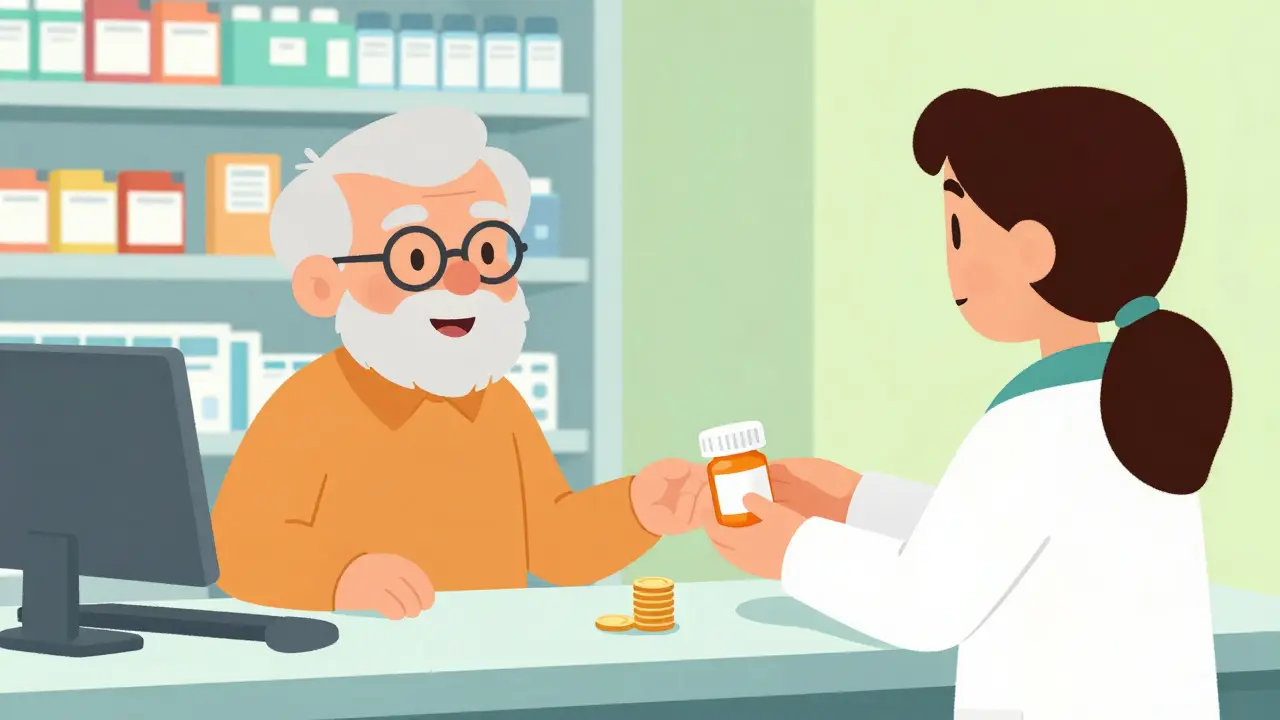
- Generic prescriptions: Maximum $4.90 per prescription at participating pharmacies
- Brand-name drugs: Maximum $12.15 per prescription
- Part D premiums and deductibles: Fully covered-$0 cost for both
For comparison, standard Part D beneficiaries face a $595 deductible before coverage begins. After meeting the deductible, they pay 25% coinsurance for generic drugs during the initial coverage phase. For example, a $50 generic prescription would cost $12.50 after the deductible. With Extra Help, the same prescription costs just $4.90-no deductible required.
| Cost Component | Standard Part D | With Medicare Extra Help |
|---|---|---|
| Monthly Premium | $10-$100+ | $0 |
| Deductible | $595 | Waived |
| Generic Prescription Copay | 25% coinsurance after deductible | $4.90 per prescription |
| Annual Cost for 12 Generics/Month | $1,343.80 | $588.00 |
How to Apply for Medicare Extra Help
Applying for Extra Help is straightforward. You can apply in three ways:
- Online: Visit SSA.gov and complete the application form. This is the fastest method.
- By phone: Call the Social Security Administration at 1-800-772-1213. Representatives can help you apply over the phone.
- In person: Visit your local Social Security office. Find your nearest location using SSA's office locator tool.
If you receive Medicaid, Supplemental Security Income (SSI), or a Medicare Savings Program, you'll automatically qualify for Extra Help. You don't need to apply separately in these cases.
State Health Insurance Assistance Programs (SHIPs) offer free help with applications nationwide. These programs have trained counselors who can guide you through the process. To find your local SHIP, visit Medicare.gov or call 1-800-MEDICARE (1-800-633-4227).
The application process typically takes 3-6 weeks for a decision. During this time, keep your current prescription coverage to avoid gaps in medication access.
Common Mistakes That Cost You Extra Help Benefits
Many eligible beneficiaries miss out on Extra Help due to avoidable errors. Here are the most frequent issues:
- Missing annual review deadlines: Every August, you'll receive a form to confirm your eligibility. You must return it within 30 days. Failure to do so means losing benefits starting January 1.
- Not reporting income changes: Even small increases in income (like a Social Security cost-of-living adjustment) can affect eligibility. Report changes promptly to avoid unexpected loss of benefits.
- Ignoring resource limits: Assets like investment accounts or second properties count toward your resource limit. Many people don't realize these assets impact eligibility.
- Assuming you don't qualify: Some people skip applying because they think they earn too much. However, the income limits are higher than many expect-$23,475 for individuals is more than the average Social Security benefit.
A real-world example: 'StressedSeniorCA' shared on Reddit in October 2024 that they lost Extra Help after a $500 increase in Social Security benefits. Their generic prescriptions jumped from $4.90 to $748.80 annually in copays-plus $1,200 in Part D premiums. This 'cliff effect' happens because the program doesn't have gradual phase-outs for income increases.
Keeping Your Extra Help Benefits Active
Once approved, maintaining your Extra Help benefits requires attention to annual reviews and enrollment rules:
- Annual review: Expect a form in August each year. Return it within 30 days to keep benefits active for the next year. The Social Security Administration will send reminders.
- Special Enrollment Period: Extra Help beneficiaries can change Part D plans once per month. This flexibility lets you switch to plans with better generic drug coverage when needed.
- Pharmacy choices: Not all pharmacies participate in the Extra Help program. Always confirm your pharmacy is in-network before filling prescriptions. Most major pharmacies (like CVS, Walgreens) accept Extra Help.
State Health Insurance Assistance Programs (SHIPs) report that 73% of applicants need help completing the Extra Help application due to its complexity. However, 92% of those who successfully enroll express satisfaction with the savings. If you're struggling with the process, reach out to SHIPs for free assistance-they're there to help.
Real Stories: How Extra Help Changes Lives
Medicare Extra Help has transformed medication access for countless seniors. Here are two examples:
- 'ElderlyPharmacist42' on Reddit (August 2024): A verified healthcare professional shared, 'I've seen patients who were skipping blood pressure meds due to $30 monthly costs suddenly get consistent refills when they qualified for Extra Help and paid $4.90 copays. It's life-changing for people with chronic conditions.' This highlights how the program directly improves health outcomes by making medications affordable.
- AARP's 2024 survey: Medicare Rights Center data shows 68% of callers reported improved medication adherence after obtaining Extra Help. This is critical for conditions like diabetes or hypertension where missing doses can lead to severe complications.
However, the program isn't perfect. Some beneficiaries face challenges when their income slightly exceeds the limit. As Susan Reinhard from AARP noted in June 2024 congressional testimony, 'the current rigid income thresholds create artificial barriers that leave many struggling seniors without assistance despite genuine financial need.'
Frequently Asked Questions
How do I check if I qualify for Medicare Extra Help?
You can check your eligibility using the Social Security Administration's online tool at SSA.gov or by calling 1-800-772-1213. Eligibility depends on your income and resources. For 2025, individuals must have income below $23,475 and resources below $17,600. Married couples living together must have income below $31,725 and resources below $35,130. Certain assets like your primary home and burial funds up to $1,500 don't count toward resources.
What happens if my income increases after I get Extra Help?
If your income increases but stays below the limit, your benefits continue. However, if it exceeds the limit, you'll lose Extra Help. The program doesn't phase out benefits gradually-it's an all-or-nothing threshold. You must report changes to Social Security immediately. Some states offer supplementary assistance programs for those who lose Extra Help due to income changes.
Can I switch my Part D plan if I have Extra Help?
Yes! Extra Help beneficiaries have a Special Enrollment Period that allows them to change Part D plans once per month. Changes take effect the first of the following month. This flexibility lets you choose plans with better generic drug coverage or lower costs for your specific medications. Always check if your current medications are covered before switching.
Do I need to reapply for Extra Help every year?
No, but you must complete an annual review. Social Security sends you a form each August to confirm your eligibility. You must return it within 30 days. If you don't, your benefits will end on January 1 of the next year. Most people qualify automatically if their circumstances haven't changed, but you still need to submit the form.
What if I'm denied Extra Help? Can I appeal?
Yes. If denied, you can appeal within 60 days of receiving the decision. Contact Social Security for appeal instructions. Many denials happen due to missing documentation or incorrect income reporting. SHIPs counselors can help you gather the right documents and file an appeal. In 2024, 45% of appeals resulted in overturned decisions after proper documentation was provided.


8 Comments
This guide is super helpfull! My grandma was confussed about the income limits but this breaks it down clearly. I didn't know about the automatic qualifaction for SSI recipients. That's a huge relief. The cost comparison table is exactly what we need to show why this matters. Just a heads up, the online application on SSA.gov works best on desktop, mobile's a bit glitchy. Also, make sure to check your bank statements for any hidden assets that might affect eligibility. Trust me, I've seen people miss out because of that. Overall, this program is a lifesaver for so many seniors. Just wish it was easier to apply for. Anyway, thanks for sharing this info!
Government handouts make people dependent Fix the system not patch it
The SSA is using this program to track seniors' health data Next thing you know they'll control all our meds This is a step towards government control Don't trust them
This is a scam
The LIS program has significant implications for healthcare economics Income thresholds are not aligned with regional cost of living adjustments Resource limits fail to account for inflationary pressures on asset values This creates systemic inequities Need policy reform
In my country healthcare is universal But here this program is a step in the right direction I've seen how seniors struggle This is important for our community We need more like this
The current LIS structure requires recalibration of income thresholds to reflect modern economic realities A tiered assistance model would mitigate cliff effects Stakeholder collaboration is essential for sustainable reform
This is all a setup The real agenda is to collect our data They want to know who's taking what meds Then they can control us This program is a Trojan horse Trust no one