
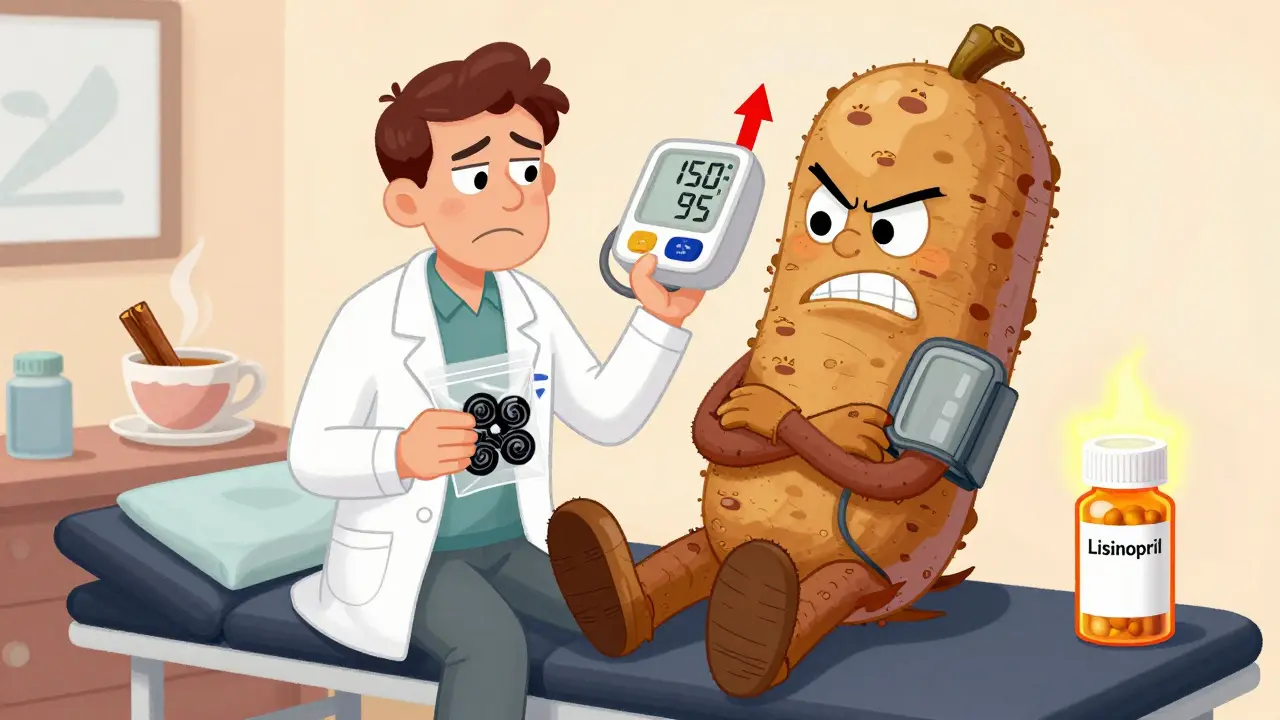
If you're taking medication for high blood pressure, your diet might be working against you - even if you think you're eating healthy. One surprising culprit? licorice. Not the candy you enjoy as a treat, but the real thing: black licorice, herbal teas, and supplements that contain glycyrrhizin. This natural compound, found in licorice root, doesn't just add sweetness. It can sabotage your blood pressure treatment in ways most people never expect.
How Licorice Throws Off Your Blood Pressure Control
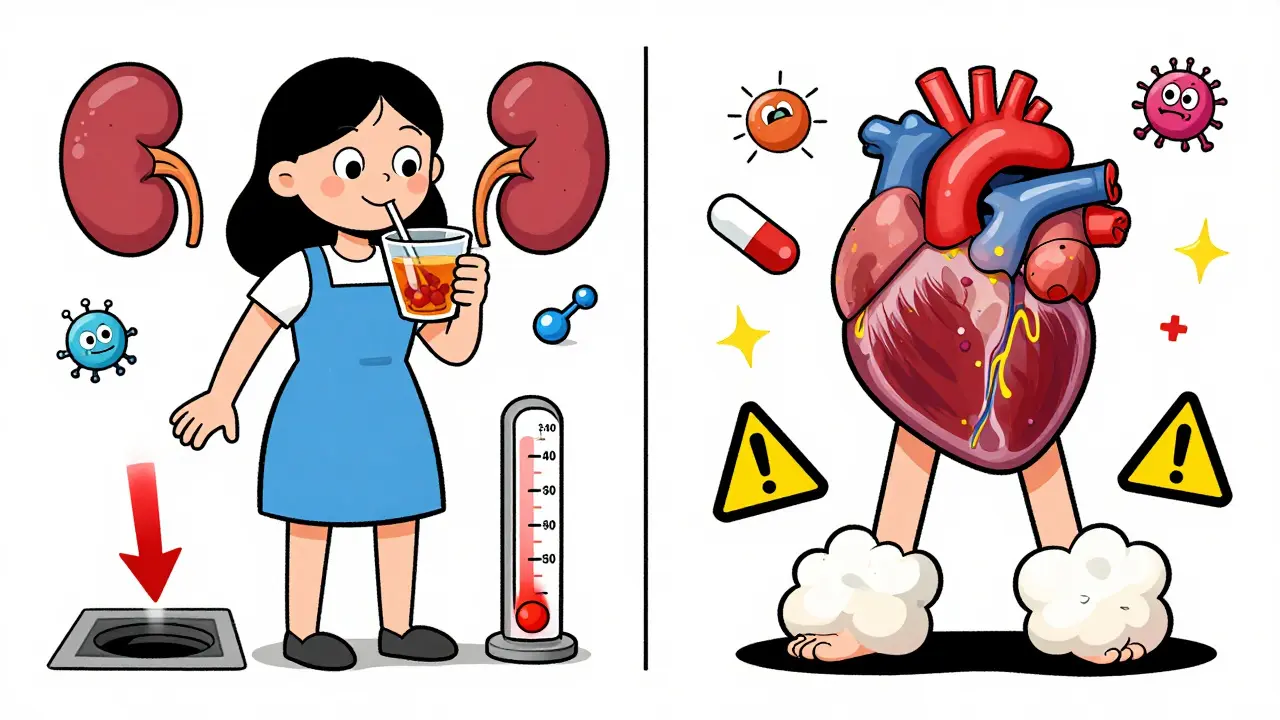
Glycyrrhizin, the active ingredient in licorice, doesn't raise blood pressure by making your heart beat faster. It works deeper - inside your kidneys. When you consume enough glycyrrhizin, your body breaks it down into glycyrrhetic acid. This substance blocks an enzyme called 11β-HSD2, which normally keeps cortisol (a stress hormone) from acting like aldosterone (a hormone that controls salt and water balance).
Without that enzyme doing its job, cortisol starts mimicking aldosterone. The result? Your kidneys hold onto sodium and water, and flush out potassium. More fluid in your bloodstream means higher blood pressure. Less potassium means your heart and muscles can't work right. This condition is called pseudoaldosteronism - and it's not theoretical. Studies show that people who eat more than 100 mg of glycyrrhizin a day (about 60-70 grams of black licorice candy) see their systolic blood pressure rise by an average of 5.45 mmHg. That’s enough to undo the effects of your medication.
Why Your Blood Pressure Meds Stop Working
Most blood pressure medications work by relaxing blood vessels, reducing fluid volume, or lowering heart rate. Licorice fights all of them at once. Here’s how it breaks down:
- ACE inhibitors (like lisinopril or captopril): These help your body get rid of sodium. Licorice makes you hold onto it.
- Diuretics (like hydrochlorothiazide or furosemide): These push out extra fluid. Licorice adds fluid back in.
- Potassium-sparing drugs (like spironolactone): These try to keep potassium up. Licorice drains it away.
- Calcium channel blockers (like amlodipine or nifedipine): These relax arteries. Licorice increases blood volume, forcing your arteries to work harder.
The problem isn’t just one class of drugs - it’s all of them. Even if your doctor carefully picked your medication, licorice can make it useless. A 2023 review in the Merck Manual confirms that licorice ‘decreases effectiveness of antihypertensive medications due to an increase in salt and water retention.’
The Hidden Danger: Digoxin and Potassium Loss
If you’re taking digoxin (Lanoxin) for heart rhythm problems, licorice becomes even more dangerous. Digoxin works by affecting how your heart muscle handles sodium and potassium. Low potassium levels make digoxin bind too tightly to heart cells - and that can cause toxicity. Symptoms? Nausea, confusion, irregular heartbeat, and even heart failure.
A documented case in the journal Cardiology involved an older man who started using a herbal laxative with licorice. Within weeks, he developed digoxin toxicity and congestive heart failure. He wasn’t overdosing on digoxin. He was eating licorice. His potassium dropped to dangerous levels, and the drug became toxic. The Merck Manual and MSD Manual both warn that people on digoxin or diuretics should avoid licorice completely.
What Counts as Too Much Licorice?
Not all licorice is the same. Many red or chewy candies use anise oil instead of real licorice root - those are safe. But black licorice, licorice tea, and herbal supplements often contain real glycyrrhizin. Here’s what 100 mg of glycyrrhizin looks like in real life:
- 60-70 grams of black licorice candy (about 2.1-2.5 ounces)
- 1-2 cups of licorice root tea brewed from dried root
- One standard herbal supplement capsule (if unlabeled or untested)
That threshold - 100 mg per day - isn’t arbitrary. It’s based on clinical studies from Medsafe (New Zealand’s medicines regulator) and confirmed by the Merck Manual. But here’s the catch: some people are more sensitive. Women, older adults, and those with existing high blood pressure or heart disease can see effects at lower doses. One study found that just 20 grams of licorice candy daily for two weeks was enough to lower potassium and raise blood pressure in elderly women.
How to Spot the Problem
If you’ve been eating licorice and your blood pressure suddenly spikes - even while taking meds - it might be time to stop. Watch for these signs:
- Unexplained rise in blood pressure (5 mmHg or more systolic)
- Swelling in your ankles or legs (edema)
- Muscle weakness or cramps
- Feeling tired or sluggish
- Heart palpitations or irregular heartbeat
- Low potassium levels confirmed by blood tests (below 3.5 mmol/L)
Doctors can confirm the issue with a simple test: a high cortisol-to-cortisone ratio in your blood. That tells them your body is reacting to glycyrrhizin. If your potassium is low and your renin and aldosterone levels are suppressed - and you’ve been eating licorice - the connection is clear.
What to Do If You’re Taking Blood Pressure Meds
Don’t panic. But do take action:
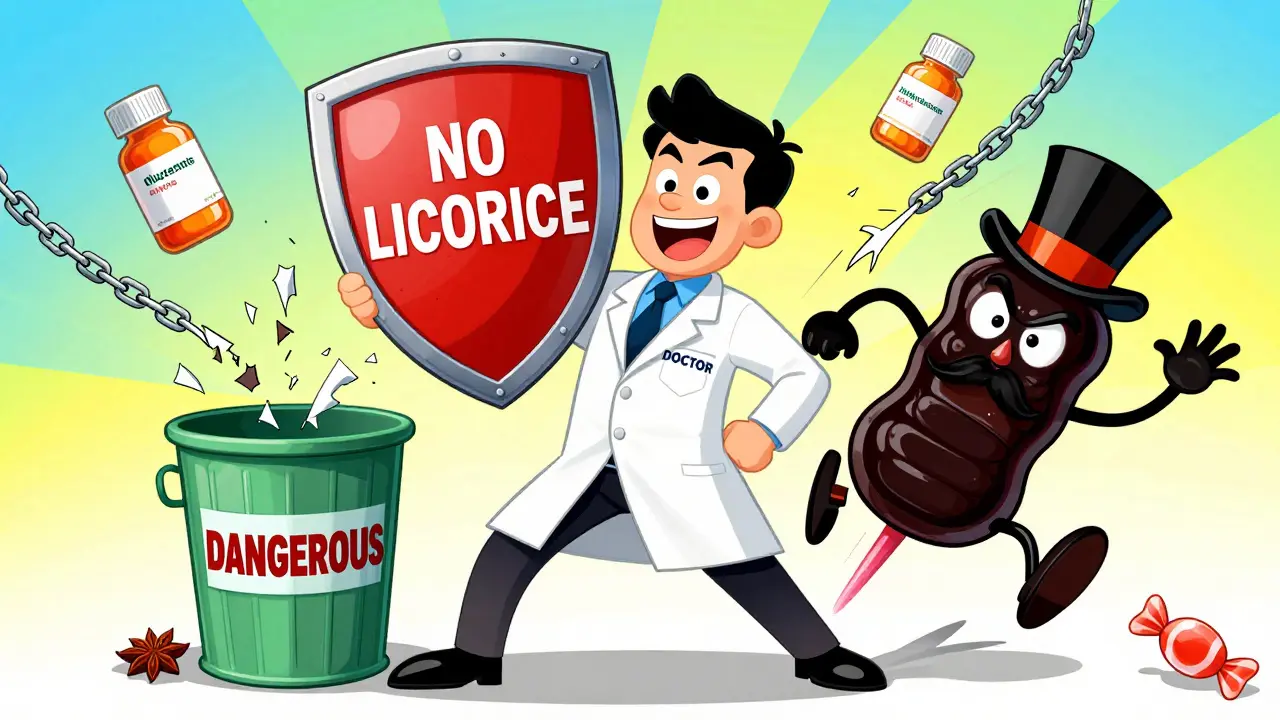
- Check labels. Look for ‘licorice root,’ ‘Glycyrrhiza glabra,’ or ‘glycyrrhizin’ on supplements, teas, and candies. If it’s not listed, assume it’s there - labeling isn’t required in the U.S.
- Avoid black licorice. Switch to anise-flavored or sugar-free alternatives.
- Stop herbal licorice supplements. Even ‘natural’ doesn’t mean safe. Many are concentrated and unlabeled.
- Talk to your doctor. Tell them if you’ve been eating licorice regularly. Ask for a potassium check and blood pressure review.
- Wait 1-2 weeks. Once you stop, your body usually clears glycyrrhizin. Blood pressure and potassium levels often return to normal.
The American Heart Association doesn’t have a formal guideline on licorice - but many clinicians use the 100 mg/day cutoff as a red flag. If you have resistant hypertension (blood pressure that won’t go down despite multiple meds), your doctor should ask you about licorice. It’s one of the most common overlooked causes.
What About Licorice for Other Health Reasons?
You might have heard licorice helps with digestion, sore throats, or liver health. Some studies even suggest it might help with inflammation. But none of those benefits outweigh the risks if you’re on blood pressure meds. The same compound that might soothe your throat is the one that’s raising your blood pressure and draining your potassium. There’s no safe middle ground here.
Even if you think you’re only having a small piece once in a while - if you’re on medication, that piece might be enough. Your body doesn’t need licorice. There are safer herbs for every use case. Don’t risk your heart for a sweet taste.
Final Word: It’s Not a Myth - It’s Medicine
This isn’t an old wives’ tale. It’s documented in medical textbooks, confirmed by clinical trials, and backed by case reports. Licorice doesn’t just ‘interact’ with blood pressure meds - it actively reverses their effects. For someone trying to control hypertension, that’s not a minor concern. It’s a medical emergency waiting to happen.
If you’re taking any kind of blood pressure medication - even if you feel fine - skip the black licorice. Skip the herbal teas with licorice root. Skip the supplements that list it. Your heart will thank you.
Can I eat licorice if I take blood pressure medicine?
No. If you're taking any blood pressure medication, avoid licorice products that contain glycyrrhizin. Even small amounts can raise your blood pressure and lower your potassium, making your meds less effective. This applies to black licorice candy, teas, and herbal supplements. Anise-flavored candies are safe because they don’t contain real licorice root.
How much licorice is dangerous?
More than 100 mg of glycyrrhizin per day is considered risky, especially for people with high blood pressure or heart conditions. That’s about 60-70 grams of black licorice candy - roughly the size of a small candy bar. Some people react to even less, especially older adults and women. If you’re unsure, avoid it entirely.
Does all licorice contain glycyrrhizin?
No. Many red, chewy, or fruit-flavored candies use anise oil or artificial flavoring instead of licorice root. But black licorice, licorice tea, and herbal supplements almost always contain glycyrrhizin. Always check the ingredient list. If it says ‘licorice root’ or ‘Glycyrrhiza glabra,’ it’s not safe if you’re on blood pressure meds.
What should I do if I’ve been eating licorice and my blood pressure went up?
Stop eating licorice immediately. Contact your doctor. Ask for a blood test to check your potassium levels and a blood pressure review. In most cases, symptoms improve within 1-2 weeks after stopping. But if you have heart symptoms like palpitations or swelling, seek medical care right away.
Can I take licorice if I’m not on blood pressure meds?
Occasional, small amounts (like one piece of candy a week) are usually safe for healthy people without kidney or heart issues. But regular use - even at low doses - can still cause potassium loss and fluid retention over time. It’s best to limit or avoid it. There’s no proven health benefit that requires you to take it daily.



15 Comments
I can't believe people still eat this stuff. 🤦♂️ I had a coworker who swore black licorice 'helped his digestion' while on lisinopril. His BP spiked to 180/110. We had to escort him to the ER. You think you're being healthy, but you're just playing Russian roulette with your heart. Stop it. Just stop.
Of course Big Pharma doesn't want you to know this. Licorice root has been used for millennia in Ayurveda and Traditional Chinese Medicine. The FDA's 100mg threshold? That's a corporate limit designed to keep you dependent on their overpriced pills. Real medicine is natural. And if your body can't handle a little root? Maybe you're the problem, not the licorice.
In India, we use licorice in chai and herbal remedies for coughs and stomach issues. But we also know our bodies. Elders teach us: if you're weak, if you have heart trouble, avoid it. It's not about fear - it's about balance. Modern medicine labels it 'dangerous' because it doesn't fit into a pill bottle. But wisdom? That's older than any guideline.
I find it profoundly concerning that this information is not mandated on packaging. The FDA's lack of regulation here is a national disgrace. I have personally written to my congressional representative, and I urge all responsible adults to do the same. This is not a dietary choice - it is a public health failure.
I’ve been on blood pressure meds for 8 years and I didn’t even know this. I thought licorice was just candy. I used to buy the big bag of black licorice for my mom who’s 72 and she eats like 3 pieces a day. I just stopped her cold turkey last week. She’s been feeling better already - less swollen ankles, more energy. I didn’t realize how much it was affecting her until I read this. I’m telling everyone I know. Seriously, if you’re on meds, just say no. It’s not worth it. I’m so glad I found this before something bad happened.
Lol so now we’re blaming candy for hypertension? Next they’ll say sugar causes diabetes and sunlight causes skin cancer. People are too lazy to take responsibility for their own health. My grandma ate licorice every day and lived to 94. Maybe your meds are just bad.
This is accurate. I’m a pharmacist. Licorice root is a known drug interaction. I’ve seen patients with potassium levels at 2.8. That’s life-threatening. If you’re on any BP med, avoid it. No exceptions. Anise candy? Fine. Licorice root tea? Don’t. Simple.
It is imperative to note, with utmost clarity and precision, that glycyrrhizin's inhibition of 11β-HSD2 is not merely a theoretical construct - it is a well-documented biochemical phenomenon, with reproducible clinical outcomes. Furthermore, the assertion that 'some people are more sensitive' is an understatement - genetic polymorphisms in CYP3A4 metabolism significantly modulate individual susceptibility. Therefore, blanket recommendations are insufficient. Personalized pharmacogenomic assessment is warranted.
I work in cardiology. We ask every patient with resistant hypertension: 'Do you eat licorice?' It’s one of the first things. I’ve had patients whose BP dropped 20 points in two weeks after quitting. No new meds. Just stop the candy. Simple fix. Don’t overthink it.
I grew up in a village where licorice root was used for tea during winter. But we never gave it to elders or people with heart issues. It’s not about banning it - it’s about knowing your body and your context. Modern life makes us forget that. Listen to your grandmother. Listen to your doctor. And if you’re unsure? Skip it. No shame in being careful.
I knew it!! I told my cousin last year she was gonna die from her licorice tea. She said I was paranoid. Guess what? She ended up in the hospital with low K+ and a weird heart rhythm. Now she’s off it. I told her it was the devil’s root. She still doesn’t believe me but I’m right. Also, I heard the FDA is hiding this because Big Pharma owns the licorice industry. Just saying.
The institutional failure to mandate disclosure of glycyrrhizin content in confectionery products constitutes a gross dereliction of public duty. The absence of regulatory clarity, particularly in jurisdictions lacking mandatory labeling, renders consumer autonomy a fiction. One cannot make informed decisions when the data is deliberately obscured. This is not negligence - it is malfeasance.
If you take blood pressure medicine, don’t eat black licorice. That’s it. Anise is fine. Tea with root? No. Supplements? No. One piece once in a while? Maybe. But why risk it? Easy fix.
I’m so tired of people treating this like a 'lifestyle choice.' This isn’t about 'being natural' or 'trusting your body.' This is about people ignoring medical science because they think they know better. My sister had a stroke last year. They found out she’d been drinking licorice tea daily for 3 years. She’s 52. She’s on a feeding tube now. This isn’t a cautionary tale - it’s a tragedy waiting to happen to your neighbor.
I used to love licorice root tea for my digestion. I had bloating and I thought it helped. But then I started feeling dizzy, my legs swelled, and I was always tired. My doctor asked if I was eating licorice and I said no. I didn’t even know tea had it. I stopped. Within 10 days, I felt like a new person. My BP dropped 12 points. My potassium went back up. I’m not saying you can’t have it - I’m saying you need to know what you’re putting in your body. I’m grateful I found out before it got worse.