
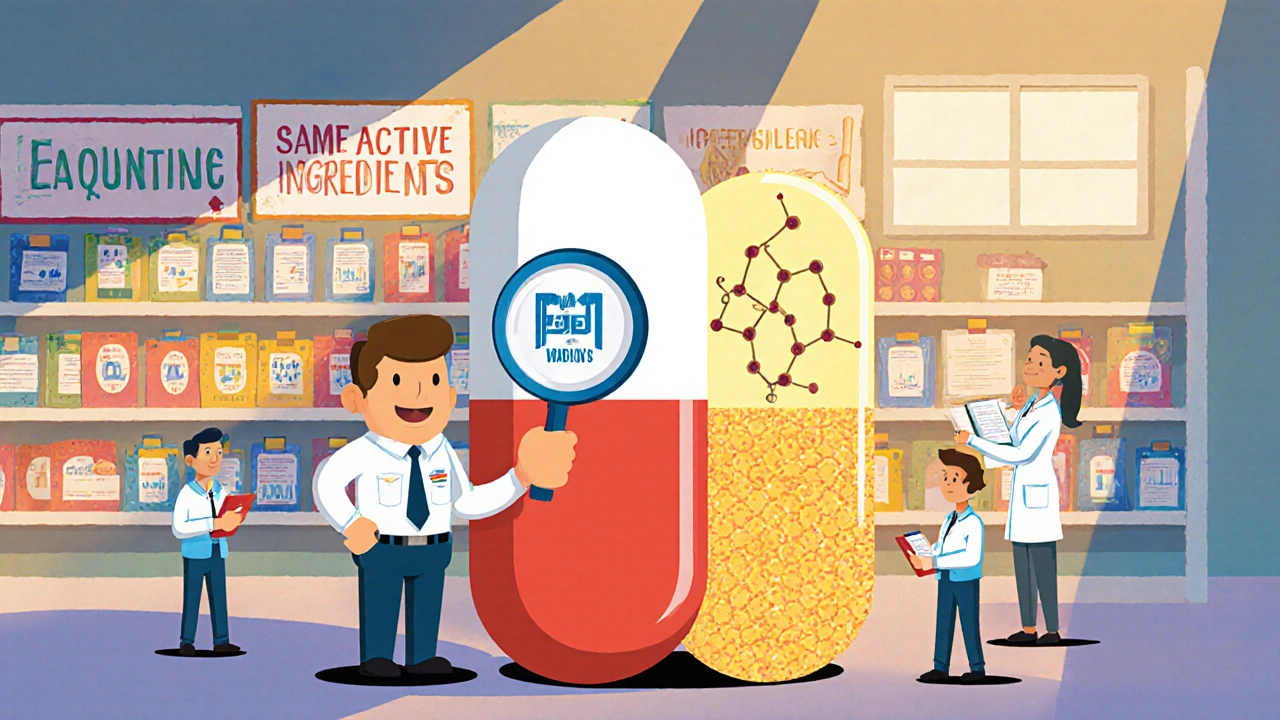
When you pick up a prescription, you might see two names on the bottle: the brand name and the generic version. Many people wonder-does the generic work the same? Is it safe? The answer isn’t just yes-it’s backed by one of the most rigorous drug approval systems in the world. The FDA doesn’t just approve generics because they’re cheaper. It requires them to meet the exact same safety and effectiveness standards as the original brand-name drug.
Same Active Ingredient, Same Results
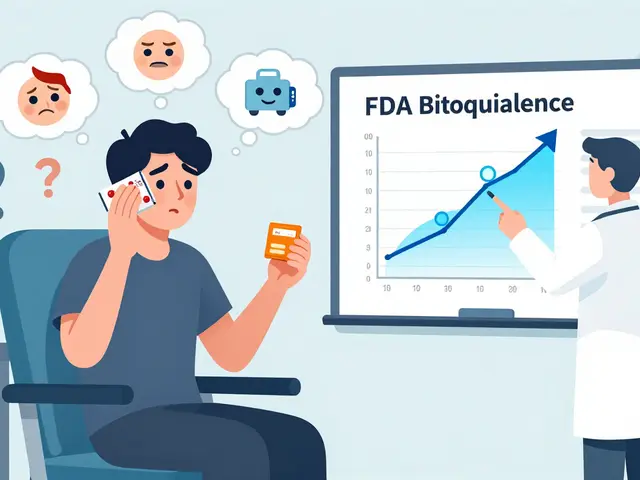
Every generic drug must contain the same active pharmaceutical ingredient (API) as its brand-name counterpart. That means if you’re taking metformin for diabetes or lisinopril for high blood pressure, the generic version has the same molecule, at the same strength, in the same form-tablet, capsule, injection, or liquid. This isn’t a suggestion. It’s a legal requirement under 21 CFR 314.94(a). The FDA won’t approve a generic unless this matches exactly.But what about how your body absorbs it? That’s where bioequivalence comes in. The FDA requires generics to show they deliver the same amount of medicine into your bloodstream at the same rate as the brand-name drug. This is measured using two key metrics: Cmax (the highest concentration in your blood) and AUC (how much medicine is absorbed over time). The acceptable range? The 90% confidence interval for both must fall between 80% and 125% of the brand-name drug’s values. For most drugs, that’s a wide enough range to account for normal human variation-not manufacturing flaws.
For drugs with a narrow therapeutic index-like warfarin, levothyroxine, or phenytoin-the standard is tighter. Here, the FDA demands bioequivalence within 90% to 111%. Why? Because even small changes in blood levels can cause serious side effects or make the drug ineffective. These drugs are closely watched, and any generic version must pass stricter testing before hitting the market.
Manufacturing Must Meet the Highest Standards
A generic drug isn’t just about the active ingredient. How it’s made matters just as much. Every facility that produces generics-whether in the U.S., India, or China-must follow Current Good Manufacturing Practices (cGMP). That means:- Every step of production is documented and traceable
- Equipment is cleaned, calibrated, and maintained according to strict schedules
- Raw materials are tested for purity before use
- Final products are sampled and tested for potency, dissolution, and impurities
The FDA inspects these facilities regularly. In 2022, over 1,500 inspections were conducted on overseas generic drug plants alone. The agency doesn’t just look at paperwork-it checks for real-world compliance. If a plant fails inspection, the FDA can block imports until fixes are made.
Impurities are another major focus. The FDA follows international guidelines (ICH Q3B and ICH M7) to limit harmful substances. For example, any potential genotoxic impurity must not exceed 1.5 micrograms per day-a level so low it’s considered safe for lifelong exposure. Manufacturers must prove they’ve controlled these impurities throughout the product’s shelf life.
Dissolution, Stability, and Labeling
A pill might have the right ingredient, but if it doesn’t dissolve properly in your stomach, it won’t work. That’s why the FDA requires generic drugs to match the brand-name drug’s dissolution profile. For most tablets and capsules, this means testing under the same conditions-same pH, same temperature, same equipment. If a generic dissolves too slowly or too fast, it gets rejected.Stability testing is equally strict. Generics must prove they stay effective and safe for their entire shelf life-usually 12 to 24 months. This involves storing samples under extreme heat and humidity (accelerated conditions) and real-world conditions (long-term storage). If the drug breaks down, changes color, or loses potency, it doesn’t get approved.
Labeling must also match the brand-name drug’s approved label-except for minor differences like the manufacturer’s name, package size, or inactive ingredients. The FDA requires that warnings, dosing instructions, and contraindications be identical. No hiding risks. No misleading language. Just clear, accurate information.
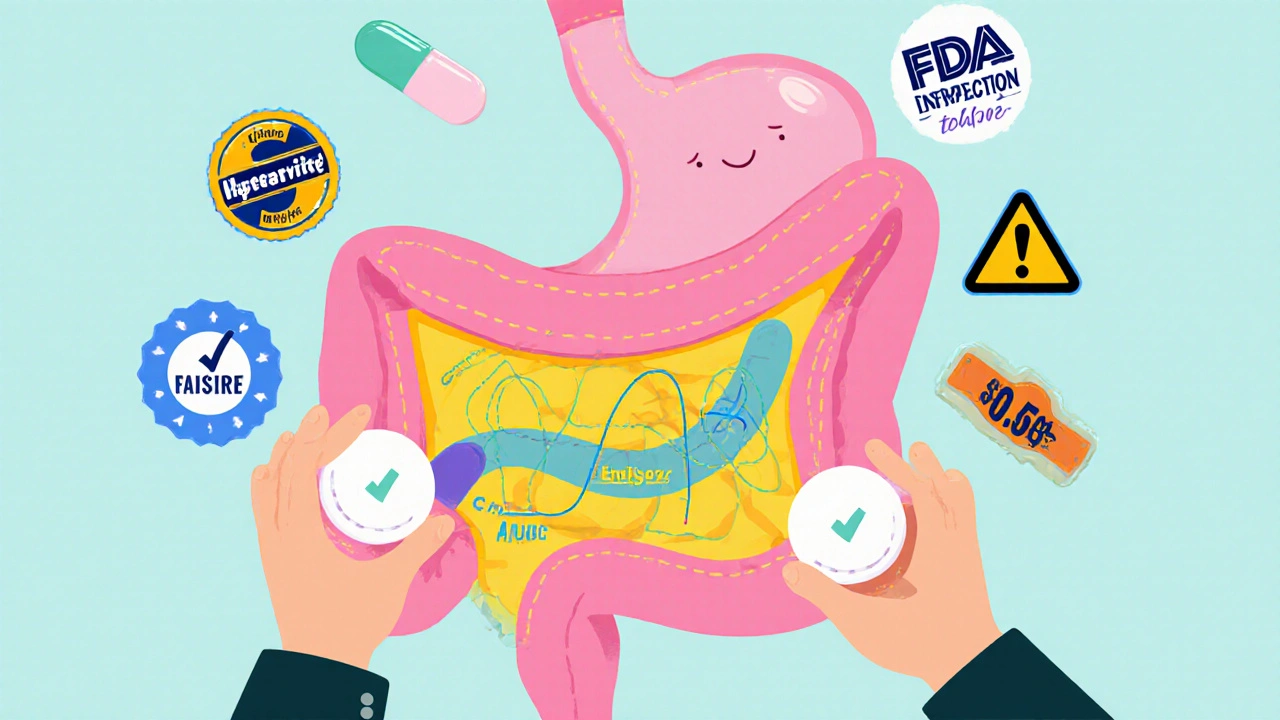
Complex Drugs Are a Bigger Challenge
Not all drugs are created equal. Simple pills? Easy to copy. But inhalers, eye drops, topical creams, and injectables? Much harder. These are called complex generics. Their effectiveness depends on how the drug is delivered-not just what’s inside.For example, a generic inhaler must match the brand’s particle size, spray pattern, and lung deposition. A generic cream must spread and absorb the same way. The FDA reports a 25% higher rejection rate for ANDAs (Abbreviated New Drug Applications) for these products. In 2022, 40% of complex generic applications were initially refused because they didn’t meet technical requirements.
That’s why the FDA has created over 1,800 product-specific guidances-detailed roadmaps for how to prove equivalence for each complex drug. These aren’t one-size-fits-all. Each guidance is tailored to the drug’s unique delivery system. The agency also invests in new testing methods, like advanced imaging and computer modeling, to better assess how these drugs behave in the body.
Real-World Evidence Supports Safety
Critics sometimes claim generics are inferior. But the data tells a different story. A 2022 study in JAMA Internal Medicine looked at 38,000 Medicare patients taking generic vs. brand-name statins. There was no difference in heart attack rates, stroke risk, or hospitalizations. Another analysis of 12,500 patient reviews on Drugs.com found 87% reported no difference in effectiveness for cardiovascular generics.Even in sensitive areas like epilepsy, where even small changes in drug levels can trigger seizures, most neurologists are confident in generics. A 2021 survey found 68% of neurologists had no concerns about using generic antiepileptic drugs.
That said, some concerns persist-especially with levothyroxine. A Reddit thread from early 2023 had over 1,200 comments from patients who felt their generic version didn’t work as well. The FDA’s bioequivalence range for levothyroxine is 90-111%, which is stricter than for most drugs. But individual variation, absorption differences, and even minor changes in inactive ingredients can affect how some people feel. For those patients, sticking with the same manufacturer-even if it’s generic-can make a difference.
How Long Does Approval Take?
Getting a generic approved isn’t fast. The process usually takes 18 to 36 months. That’s because manufacturers must conduct bioequivalence studies with 24 to 36 healthy volunteers-each study costing between $1 million and $2 million. The FDA then reviews the application, inspects the facility, and checks every piece of data.But things are getting faster. Since the Generic Drug User Fee Amendments (GDUFA) started in 2012, the median review time has dropped from 18 months to just 10 months for first-time approvals. The FDA now has dedicated teams for complex generics and uses risk-based inspections to focus resources where they matter most.
Why Generics Save Billions Without Sacrificing Safety
In 2022, generics made up 90% of all prescriptions filled in the U.S.-that’s 8.4 billion prescriptions. But they only accounted for 23% of total drug spending-about $610 billion. Without generics, many people couldn’t afford their meds. The FDA’s system ensures that affordability doesn’t come at the cost of safety.And the system keeps evolving. In 2022, the FDA proposed a rule allowing generic manufacturers to update safety labels without waiting for the brand-name company to do it first. That’s a big shift-it gives patients faster access to updated warnings about side effects or risks.
Looking ahead, the FDA is testing artificial intelligence to predict harmful impurities before they appear in production. It’s also investing $50 million through GDUFA III to improve testing for complex drugs. These aren’t just bureaucratic changes-they’re steps to keep the system strong as new types of medicines emerge.
What You Should Know as a Patient
You don’t need to be an expert to use generics safely. Here’s what matters:- Generics are required to be as safe and effective as brand-name drugs.
- If your doctor or pharmacist switches you to a generic, it’s because it’s been approved by the FDA.
- For most drugs, you won’t notice a difference.
- If you feel a change after switching-especially with narrow therapeutic index drugs-talk to your provider. It might be the filler, not the medicine.
- Stick with the same generic manufacturer if you notice a difference. Even within generics, slight variations can matter.
The bottom line: The FDA doesn’t cut corners on generics. It just cuts the cost. And that’s why millions of Americans rely on them every day-without compromise.
Are generic drugs as safe as brand-name drugs?
Yes. The FDA requires generic drugs to meet the same strict safety and effectiveness standards as brand-name drugs. They must contain the same active ingredient, in the same strength and form, and prove they work the same way in the body. The manufacturing process must follow the same quality rules, and every batch is tested before release.
Why do some people say generic drugs don’t work as well?
In most cases, the difference isn’t the active ingredient-it’s the inactive ones. Fillers, dyes, and coatings can affect how a pill feels or dissolves in the stomach. For some people, especially those on narrow therapeutic index drugs like levothyroxine or warfarin, even small changes can cause noticeable effects. If you feel different after switching, talk to your doctor. Sometimes, staying with the same generic manufacturer helps.
Does the FDA inspect generic drug factories?
Yes. The FDA inspects both U.S. and overseas facilities that make generic drugs. In 2022, over 1,500 inspections were conducted on foreign plants alone. These aren’t scheduled visits-they’re random and unannounced. If a facility fails, the FDA can block shipments until problems are fixed.
What’s the difference between an NDA and an ANDA?
A New Drug Application (NDA) is for brand-name drugs and requires full clinical trials to prove safety and effectiveness. An Abbreviated New Drug Application (ANDA) is for generics. It doesn’t repeat those trials because the active ingredient is already proven. Instead, it proves bioequivalence and manufacturing quality. This saves time and money-without lowering safety standards.
Can I trust a generic drug made outside the U.S.?
Yes. The FDA holds foreign manufacturers to the same standards as U.S. ones. Over 50% of generic drugs sold in the U.S. are made overseas, mostly in India and China. The FDA inspects these facilities regularly and can refuse imports if standards aren’t met. The agency has no preference for where a drug is made-only that it meets U.S. safety rules.
Why are some generics more expensive than others?
Price differences come from competition, not quality. When multiple companies make the same generic, prices drop. If only one company makes it, the price stays higher. Sometimes, a generic from a new manufacturer will cost more until others enter the market. But all approved generics must meet the same FDA standards, regardless of price.
Are there any drugs that can’t be made as generics?
Yes. Biologics-like insulin, certain cancer drugs, and autoimmune treatments-are complex molecules made from living cells. They can’t be copied exactly like traditional pills. The FDA has a separate approval pathway for “biosimilars,” which are highly similar but not identical. These require more testing and are often more expensive than traditional generics.
How does the FDA handle new safety concerns with generics?
The FDA monitors all drugs-brand and generic-after approval through adverse event reports and ongoing studies. If a safety issue arises, the agency can require label updates, issue warnings, or even pull a product. In 2022, the FDA proposed a rule allowing generic manufacturers to update safety labels without waiting for the brand-name company, giving patients faster access to critical information.
8 Comments
lol FDA my ass 😂 I saw a generic pill that looked like a cartoon and it gave me heart palpitations. They’re just repackaged Chinese dirt.
I used to think the same until my dad switched from brand-name Lipitor to generic atorvastatin. His cholesterol dropped the same, and he saved $200/month. The science checks out. The FDA doesn’t play games with this stuff.
Honestly? This is one of those quiet wins of American public health. 💪 People don’t realize how many lives are saved because generics exist. My grandma takes 7 meds-6 are generic. She’d be choosing between food and medicine without them. Thanks, FDA.
I mean… sure, the FDA says it’s all the same… but have you ever noticed how some generics make you feel… off? Like, not sick, but… drained? Like your body’s whispering, ‘this isn’t the real thing’? I’ve switched back to brand-name levothyroxine three times now… and yeah, I’m aware I’m probably just paranoid… but my thyroid doesn’t lie…,,,,,
I had a bad reaction to a generic version of metformin-stomach cramps out the wazoo. Switched back to the brand, fine. Then I tried a different generic from another company and it was perfect. Turns out it’s not the drug, it’s the fillers. Talk to your pharmacist.
The FDA’s bioequivalence standards for narrow therapeutic index drugs are among the most stringent in the world. The 90-111% range for levothyroxine is not arbitrary. It is based on decades of clinical data and pharmacokinetic modeling. Patients who report differences are often responding to inactive ingredients or psychological factors, not pharmacological failure
I get why people are suspicious. We’ve been lied to by pharma before. But the FDA’s inspection logs are public. Over 1,500 foreign plants inspected last year? That’s more than most countries inspect their own food supply. The real conspiracy? That we think this system is perfect… when it’s just… really, really good. Still not flawless. But better than most.
I’ve worked in pharmacy for 18 years. I’ve seen generics save families from bankruptcy. I’ve also seen patients panic because their new pill is a different color. It’s not the drug-it’s the fear. The FDA doesn’t just approve these things. They fight for them. And honestly? We should be proud of this system.