
When a generic drug company submits an Abbreviated New Drug Application (ANDA) to the FDA, they’re not just filling out forms-they’re asking for permission to sell a medicine that must be identical in every meaningful way to the brand-name drug. But here’s the hard truth: over half of these applications don’t pass on the first try. The reason? Deficiency letters. These aren’t polite suggestions. They’re red flags that say: "You missed something critical. Fix it before we approve this." Deficiency letters are the FDA’s way of saying, "We can’t approve this until you answer these specific questions." And they’re not random. The same problems pop up again and again. If you’re submitting an ANDA, you need to know what those are-not just to fix them, but to avoid them in the first place. Let’s break down the most common reasons generic drug applications get stuck in limbo-and how to steer clear of them.
Why Dissolution Methods Are the #1 Problem
If you’re submitting a generic tablet or capsule, the FDA cares deeply about how quickly it dissolves in the body. Not just whether it dissolves, but how fast, and under what conditions. This is called dissolution testing. It’s not a formality. It’s the core of bioequivalence. In 2023, dissolution issues were the single biggest reason for deficiency letters, affecting 23.3% of all ANDAs. Why? Because too many companies still use outdated equipment and methods that don’t reflect real human physiology. For example, using Apparatus 2 (the paddle) for a modified-release tablet might be technically legal, but if the FDA’s guidance says Apparatus 3 or 4 is needed to simulate gut movement, your method is flawed. Same goes for pH testing. The FDA expects dissolution testing across three pH levels: 1.2 (stomach), 4.5 (upper intestine), and 6.8 (lower intestine). Skip one? You’ll get a deficiency letter. And it’s not just about running the test. You have to prove your method can tell the difference between your drug and the reference product. That’s called discrimination testing. If your method can’t distinguish between a good batch and a bad one, it’s useless. And the FDA knows it.Drug Substance Sameness: The Silent Killer
Your generic drug must have the same active ingredient as the brand-name version. Sounds simple, right? But "same" doesn’t mean just the same chemical formula. It means the same purity, the same crystal form, the same particle size, and the same behavior in the body. In 2024, DS (Drug Substance) sameness issues accounted for 19% of major deficiencies. The biggest culprit? Incomplete characterization of the starting material. Many applicants rely too heavily on the Drug Master File (DMF) provided by their supplier. But if that DMF lacks data on polymorphs, residual solvents, or particle size distribution, your application will fail. Peptide-based generics are especially tricky. You can’t just say, "It’s the same peptide." You need to prove it. That means using circular dichroism, Fourier-transform infrared spectroscopy, and size-exclusion chromatography to show the protein folds the same way, doesn’t aggregate differently, and behaves the same in solution. A 2023 study found that nearly half of DS sameness failures came from academic-style development-where scientists focus on purity in the lab but ignore how the drug behaves in real manufacturing. The FDA doesn’t care if your lab sample is 99.9% pure. They care if your factory batch is consistent across 10,000 units.Impurities: The Hidden Trap
Every drug has impurities. That’s normal. But the FDA doesn’t accept "it’s always been this way." They require you to identify, quantify, and justify every impurity above a certain threshold. In 2024, unqualified impurities were the second most common deficiency, hitting 20% of applications. Why? Because applicants often assume ICH guidelines don’t apply to generics. They do. Every single one. The M7 guideline on mutagenic impurities is a major pain point. If your drug degrades into a compound that could damage DNA, you need a (Q)SAR analysis-a computational model that predicts mutagenicity. Skip it? You’ll get a deficiency. And if you don’t have toxicology studies to back up the impurity levels, expect a 14- to 18-month delay. That’s not just a setback. It’s a financial hemorrhage. Elemental impurities are another silent killer. ICH Q3D sets limits for metals like lead, arsenic, and cadmium. If your manufacturing process uses stainless steel equipment or catalysts, you need to prove those metals aren’t leaching into your product. In 2023, 13% of ANDAs failed because of incomplete elemental impurity control strategies.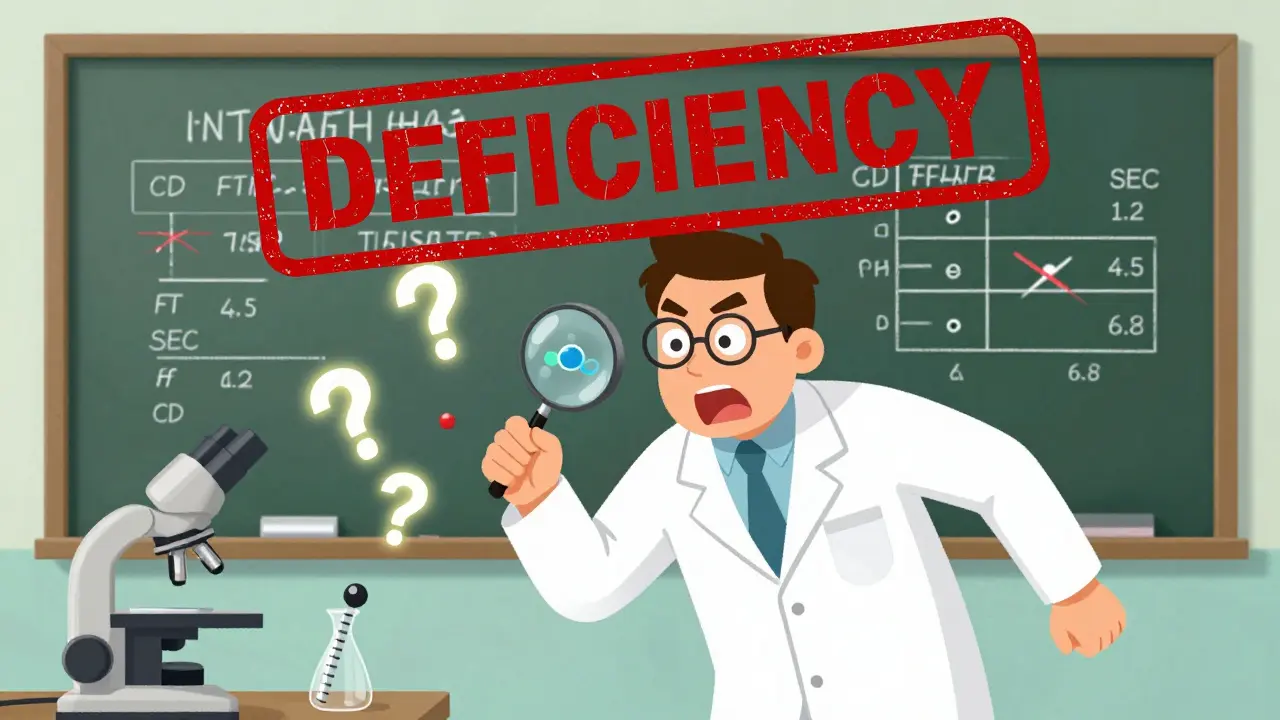
Manufacturing: It’s Not Just About the Drug
The FDA doesn’t just review the drug. They review how you make it. And they care about scale. Too many companies run perfect lab-scale batches but then switch to commercial equipment without proving the change doesn’t affect quality. That’s called process validation. If you can’t show that your pilot-scale process reliably produces batches identical to your bioequivalence batches, you’ll get a deficiency. Modified-release products are the worst offenders. A 2021 FDA study found that most Complete Response letters for these products came from multiple failures at once-poor dissolution, unvalidated manufacturing, inconsistent particle size, and lack of stability data. It’s not one mistake. It’s a chain of them. And don’t forget control strategies. You need to define what you’ll test, how often, and what you’ll do if something goes out of spec. Generic manufacturers often treat this as an afterthought. The FDA doesn’t.Why Some Companies Keep Failing
It’s not luck. It’s experience. Companies with fewer than 10 approved ANDAs have deficiency rates 22% higher than those with 50 or more. Why? Because they haven’t learned the unwritten rules. The FDA’s review teams are trained to spot patterns. They’ve seen the same mistakes repeated for years. If you submit an ANDA without a detailed development report-explaining why you chose a method, why you picked a specific excipient, why you rejected an alternative-you’re making it harder for reviewers to say yes. Data shows that applications with clear, thorough documentation have 27% fewer deficiencies. That’s not magic. It’s clarity. And here’s the kicker: companies that request pre-ANDA meetings have deficiency rates 32% lower. Why? Because they get direct feedback. They don’t guess what the FDA wants. They ask.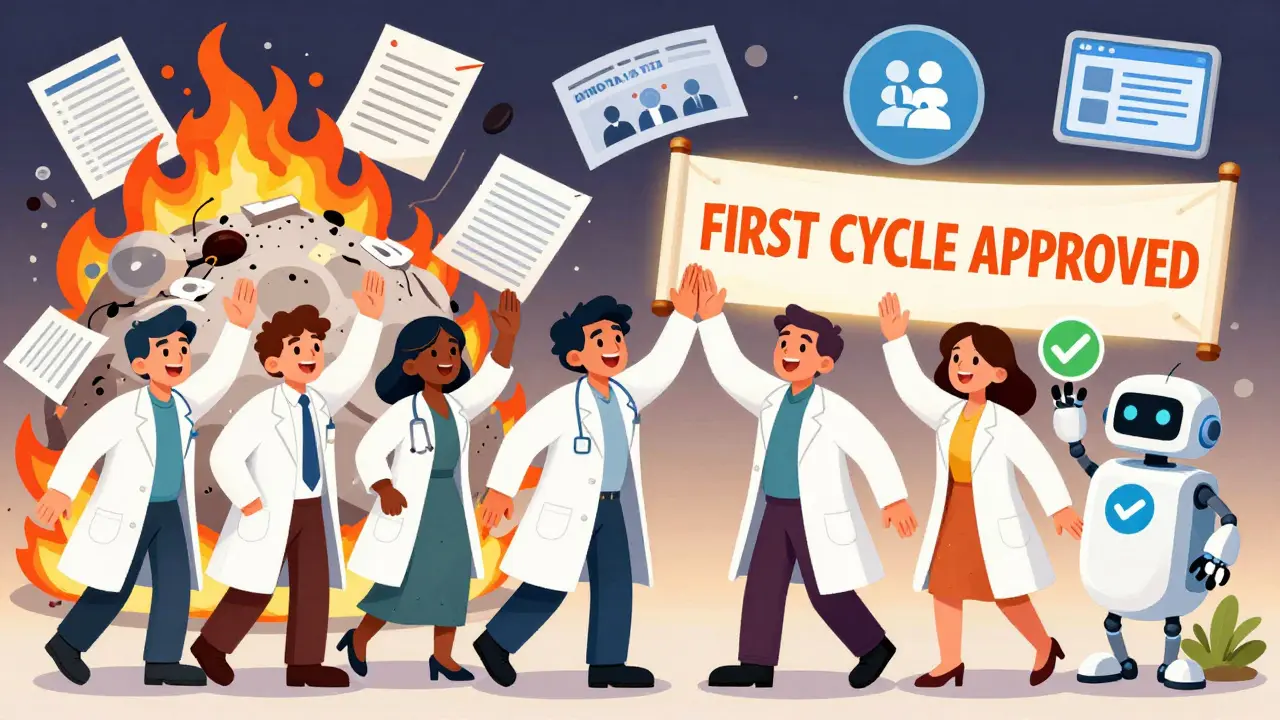
What’s Changing? What’s Next?
The FDA isn’t just sitting back. They’re trying to fix this. In 2023, they launched the "First Cycle Generic Drug Approval Initiative," targeting the top deficiency categories with new templates, guidance, and pre-submission tools. Early results? A 15% drop in dissolution-related deficiencies among participants. They’ve also created specialized review teams for complex products like peptides and modified-release tablets. That’s cut inconsistent decisions by 22%. By 2026, they plan to roll out AI-assisted pre-submission screening. Think of it like a spell-checker for ANDAs. It’ll flag common errors-missing (Q)SAR data, wrong apparatus selection, incomplete impurity profiles-before you even submit. Early tests show it could cut preventable deficiencies by 35%. Meanwhile, the Competitive Generic Therapy (CGT) program is working. Products with CGT designation have a 73% first-cycle approval rate-compared to the industry average of 52%. Why? Because they get focused attention and clearer guidance.How to Avoid a Deficiency Letter
If you’re submitting an ANDA, here’s what you need to do:- Don’t assume. If the FDA guidance says something, follow it exactly. No shortcuts.
- Test like the FDA expects. Use biorelevant dissolution conditions. Test across pH 1.2, 4.5, and 6.8. Validate your method with discrimination testing.
- Characterize everything. For drug substance: polymorphs, particle size, residual solvents. For peptides: secondary structure, aggregation profile.
- Document everything. Explain why you chose your method, your excipients, your controls. Don’t just dump data-tell the story.
- Request a pre-ANDA meeting. It’s free. It’s fast. It’s the best investment you’ll make.
- Know your impurities. Apply ICH M7 and Q3D. Don’t wait until the FDA asks. Prove compliance upfront.
- Validate your process. Your lab batch isn’t your commercial batch. Prove they’re the same.



8 Comments
Dissolution testing is the biggest trap. Apparatus 2 for modified release? That's a one-way ticket to deficiency city. FDA guidance isn't optional. Use the right apparatus, test at all three pH levels, and prove discrimination. No excuses.
lol i just read this and thought "wait so i dont need to be a phd to get my ANDA approved?" turns out you do. but like... the docs are actually clear if you read em. why do people skip pre-meetings? its free.
This is one of the clearest breakdowns of ANDA pitfalls I've seen. 🙌 The dissolution section alone could save a company millions. And the part about peptide characterization? Spot on. Circular dichroism isn't optional - it's the difference between approval and a 14-month delay. The FDA isn't being harsh. They're being precise. And we should be too. 👏
Ohhhhh, so THAT’S why my last submission got slapped with a deficiency letter?!?!?!?!?!? I mean, I knew it was bad, but I didn’t realize I’d committed 7 cardinal sins at once - dissolution at pH 1.2 only?!?!? No (Q)SAR?!?!? Used stainless steel without ICH Q3D?!?!? I’m not a bad person - I’m just tragically under-resourced and surrounded by clueless contractors who think "it’s just a tablet"! 😭💔
Let me guess - the FDA is "just trying to protect patients." Meanwhile, they’re sitting in their 10th-floor DC offices sipping lattes while small biotechs go bankrupt trying to meet impossible standards. And don’t even get me started on AI-assisted screening - that’s just surveillance dressed up as help. They don’t want you to succeed. They want you to beg.
Pre-ANDA meeting changed everything for us. We went in thinking we were ready. Left with 3 major fixes we never saw coming. Best $0 we ever spent. Seriously - do it. Even if you think you know it all. The reviewers have seen 1000 versions of "I thought this was fine."
While I appreciate the comprehensive nature of this analysis, I must respectfully posit that the underlying assumption - that adherence to regulatory guidelines is tantamount to regulatory compliance - may be overly reductive. The regulatory landscape, particularly with respect to biorelevant dissolution methodologies and ICH Q3D elemental impurity thresholds, is not merely a checklist but a dynamic, context-sensitive framework that requires nuanced interpretation. Furthermore, the assertion that companies with fewer than 10 approved ANDAs exhibit higher deficiency rates may conflate institutional experience with systemic bias, as smaller entities often operate under constrained resources and may not have access to the same quality assurance infrastructure as larger firms. The FDA's initiative, while commendable, may inadvertently reinforce structural inequities in the generic drug approval ecosystem.
You know what they don’t tell you? The FDA is owned by Big Pharma. They’re not protecting patients - they’re protecting profits. That’s why they make you test at pH 1.2, 4.5, AND 6.8 - it’s not science, it’s a $$$ trap. And those AI tools? They’re coded to reject small companies. I’ve seen it. The same company that got approved last year? They changed one excipient and got a deficiency letter. Coincidence? NO. It’s a war on generics. They want you to pay them $500K for "consulting." Don’t fall for it.