
Akathisia vs RLS Symptom Checker
This tool helps you distinguish between akathisia (medication-induced restlessness) and restless legs syndrome (RLS) based on your symptoms. It's not a substitute for professional medical diagnosis, but can guide your discussion with a healthcare provider.
1. When do your symptoms occur most frequently?
2. What sensations do you experience?
3. Do your symptoms get better when you move?
4. What type of movement helps?
5. Are your symptoms triggered by medication?
6. How long have you been experiencing symptoms?
7. Do you have a history of RLS in your family?
8. What medications are you currently taking?
Akathisia vs RLS Comparison
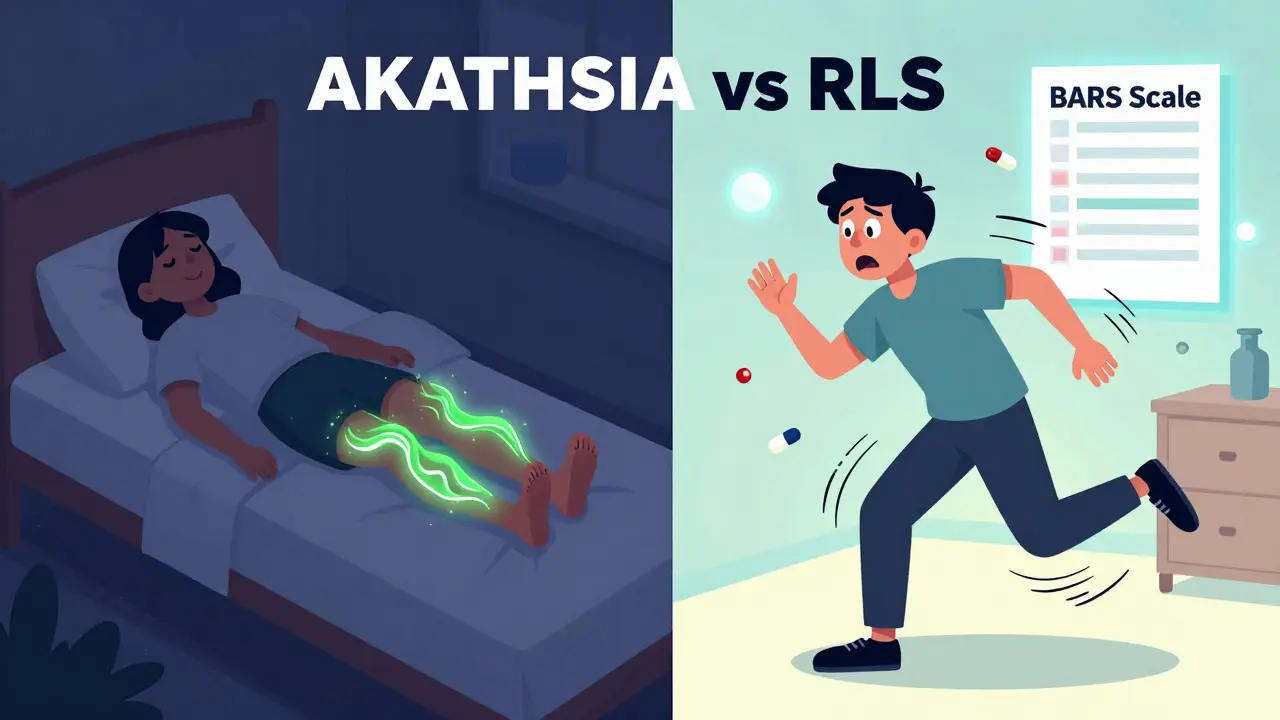
| Feature | Akathisia | RLS |
|---|---|---|
| Primary Trigger | Medications (especially antipsychotics) | Genetics, low iron, kidney disease |
| Timing | Daytime, occurs while active | Nighttime, occurs during inactivity |
| Sensations | Inner urge to move, aching restlessness | Crawling, tingling, pulling sensations |
| Movement Effect | Does not relieve symptoms | Relieves symptoms |
| Family History | Not typically inherited | Often runs in families |
| Duration | Usually begins days/weeks after medication start | Can be long-term, may come and go |
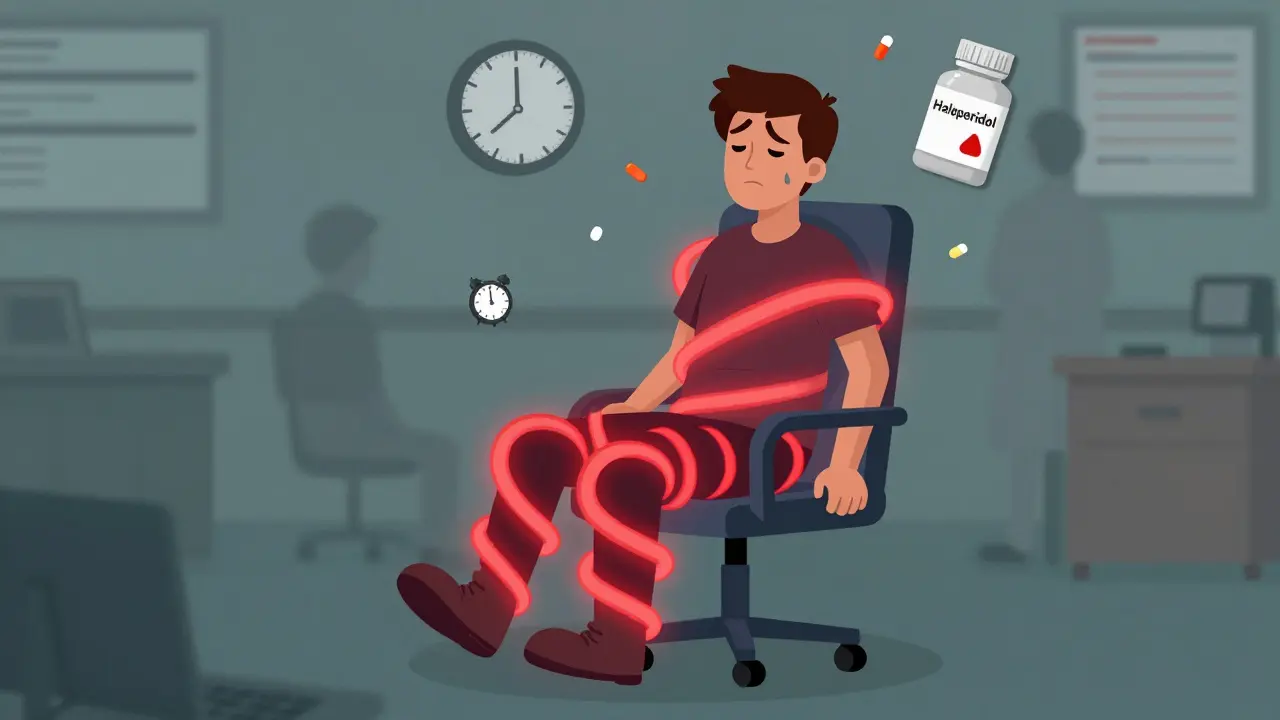
When you start a new medication-especially an antipsychotic-and suddenly feel like you can’t sit still, it’s easy to blame stress, anxiety, or just being "overactive." But what if that inner urge to move isn’t in your head at all? What if it’s a direct side effect of the drug itself? Two conditions often get mixed up: akathisia and restless legs syndrome (RLS). Both make you feel like you need to move, but they’re not the same. And confusing them can make things worse-sometimes dangerously so.
What Akathisia Really Feels Like
Akathisia isn’t just fidgeting. It’s a deep, painful restlessness that starts in your mind and spills into your body. People describe it as an "aching" need to move, like your bones are crawling under your skin. You don’t want to pace because you’re bored-you have to pace because not moving feels unbearable. One patient described it as, "You ache with restlessness, so you feel you have to walk. And then as soon as you start walking, you need to sit. Back and forth. No relief."
This isn’t something that happens after a long day. It usually shows up within days or weeks of starting or increasing a medication like haloperidol, risperidone, or even metoclopramide (a stomach drug). First-generation antipsychotics carry the highest risk, but even newer ones like quetiapine or olanzapine can trigger it. About 5% to 15% of people on second-generation antipsychotics develop akathisia. For first-gen drugs? It’s 20% to 40%.
The movement is specific: crossing and uncrossing legs, shifting weight constantly, rocking while seated, pacing in place. You can’t relax. Even if you’re sitting, your body is on edge. And unlike RLS, it doesn’t wait for nighttime. It hits while you’re watching TV, in a meeting, or trying to sleep.
How Restless Legs Syndrome Is Different
RLS is often mistaken for akathisia, but the differences matter. RLS is tied to inactivity and usually gets worse at night. You feel tingling, crawling, or pulling deep in your legs-sometimes only when lying down. Moving helps. Walking around, stretching, even shaking your legs gives temporary relief. It’s not about inner agitation-it’s about physical sensation.
RLS often runs in families and links to low iron, kidney disease, or pregnancy. Medications like antidepressants or antihistamines can make it worse, but they don’t cause it the way antipsychotics cause akathisia. And here’s the kicker: drugs that treat RLS-like levodopa or gabapentin-can make akathisia worse. That’s why mixing them up leads to dangerous treatment errors.
Why Misdiagnosis Is Dangerous
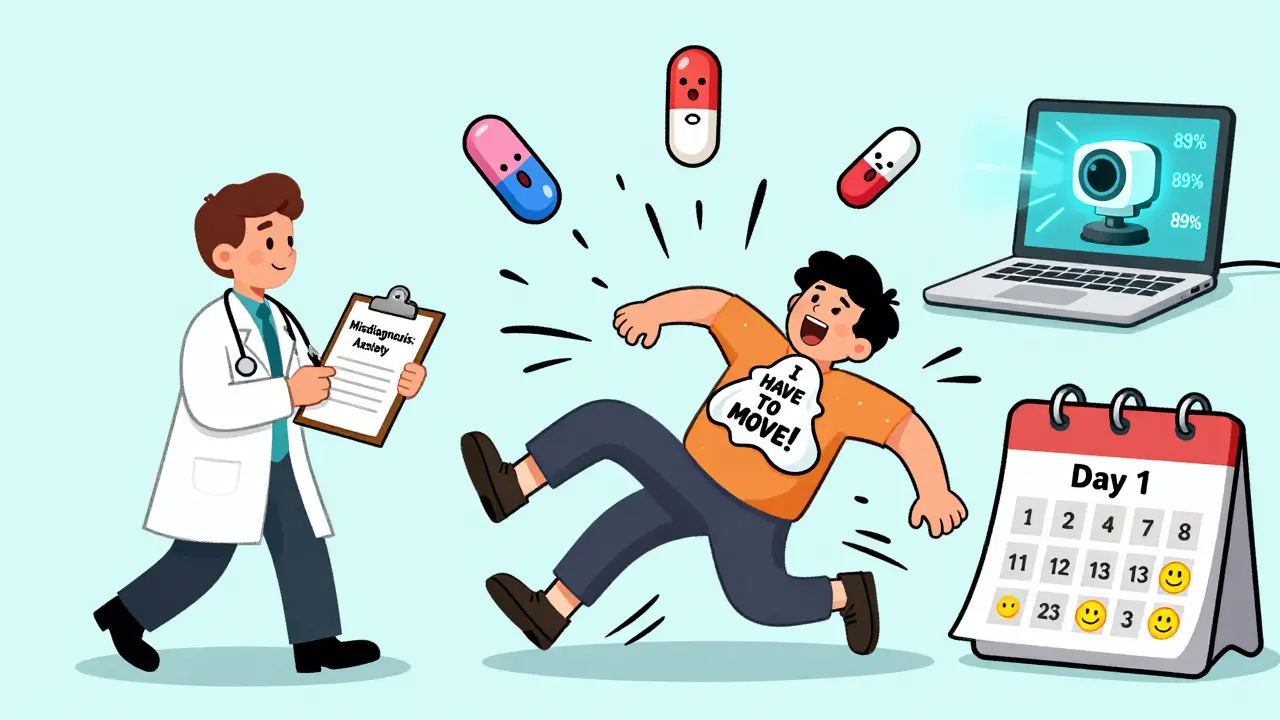
Here’s the scary part: doctors often mistake akathisia for anxiety or agitation. If you’re pacing and fidgeting, they might think you’re "unstable" or "not responding well" to treatment. So they increase the dose of the very drug causing the problem. A 2017 study from the Royal Australian College of General Practitioners showed a patient on haloperidol developed suicidal thoughts because his doctor doubled his dose, thinking it was "worsening psychosis." The patient didn’t improve until the drug was stopped.
Research from the National Alliance on Mental Illness (NAMI) in 2022 found that 68% of people with medication-induced restlessness were first told they had anxiety. Over 40% of them had their antipsychotic dose increased-making their symptoms 10 times worse. One Reddit user wrote: "My doctor kept saying it was anxiety and doubled my Seroquel. The leg bouncing and inner turmoil got unbearable. I found akathisia on Wikipedia."
Akathisia isn’t just uncomfortable. It’s linked to aggression, violence, and suicide risk. The American Psychiatric Association warns that untreated akathisia can be more distressing than the psychosis it was meant to treat. In some cases, patients say they’d rather live with hallucinations than endure the torment of akathisia.
How to Recognize It
You don’t need a fancy test. A good clinician asks two simple questions:
- "Do you feel an inner urge to move that you can’t ignore?"
- "Does this feeling get worse when you sit still?"
Then they watch. Do you constantly shift your legs? Cross and uncross them? Rock back and forth? Tap your feet nonstop? These aren’t nervous habits-they’re involuntary movements tied to the drug.
The Barnes Akathisia Rating Scale (BARS) is the gold standard tool. It takes five minutes. It scores both how you feel inside and what you’re doing physically. Most clinics don’t use it-but you can ask for it. If your doctor doesn’t know what it is, that’s a red flag.
Treatment: What Actually Works
The best treatment is simple: stop or reduce the drug causing it. In the RACGP case study, one patient’s symptoms vanished in 72 hours after haloperidol was tapered. But sometimes you can’t stop the medication-your psychosis might return. So what then?
Three proven options exist:
- Propranolol (a beta-blocker): Start with 10 mg twice a day. It helps calm the physical agitation. Works in about 60% of cases.
- Clonazepam (a benzodiazepine): 0.5 mg at night. Reduces inner restlessness. Use cautiously-risk of dependence.
- Cyproheptadine (an antihistamine): 4 mg daily. Often overlooked, but effective in trials.
Don’t use levodopa or gabapentin. They help RLS, not akathisia. And avoid increasing the antipsychotic. That’s the last thing you want.
What’s New in 2026
There’s real progress. In 2023, the International Parkinson and Movement Disorder Society launched a free app for clinicians with diagnostic checklists and treatment algorithms. It’s already in use in Australia, Canada, and parts of the U.S.
Research is also moving fast. A May 2024 JAMA Neurology study found specific brainwave patterns (EEG) that predict akathisia before symptoms even appear. And a 2023 trial of pimavanserin (Nuplazid), a drug originally for Parkinson’s psychosis, cut akathisia symptoms by 62% in patients on antipsychotics.
Even AI is getting involved. Stanford’s 2024 pilot study used video calls to detect akathisia movements with 89% accuracy-no extra tools needed. Imagine your telehealth visit automatically flagging restless leg movements as a possible side effect.
What to Do If You Suspect It
If you’re on an antipsychotic and feel this relentless urge to move:
- Write down when it started. Did it begin after a dose change?
- Track when it’s worst. Is it only at night? Or all day?
- Notice what helps. Does walking help? Or does it make you feel worse?
- Ask your doctor: "Could this be akathisia? Can we check with the Barnes scale?"
- Bring this article. Most doctors haven’t been trained to recognize it.
If you’re being told it’s "just anxiety" and your dose keeps going up? Get a second opinion. Talk to a psychiatrist who specializes in movement disorders. Don’t wait until it gets unbearable.
Bottom Line
Akathisia is not rare. It’s common. And it’s often missed. If you or someone you know is on an antipsychotic and can’t sit still, don’t assume it’s "normal" or "in your head." It’s a real, drug-induced condition with real consequences. The good news? It’s often reversible. Stop the drug-or add the right treatment-and relief can come fast. The key is recognizing it early. Before it turns into something worse.
Can akathisia go away on its own?
Sometimes, yes-but only if you stop or lower the medication causing it. If you keep taking the drug, akathisia won’t fade on its own. In fact, it usually gets worse over time. In cases where the drug is discontinued, symptoms often improve within days. But if it’s been going on longer than six months, it can become chronic and harder to reverse. That’s why early recognition matters.
Is akathisia the same as ADHD or anxiety?
No. ADHD involves difficulty focusing, impulsivity, and hyperactivity that starts in childhood. Anxiety causes worry, tension, and physical symptoms like a racing heart-but not the same deep, movement-driven urge as akathisia. Akathisia is specifically tied to medication use, especially antipsychotics. People with anxiety might fidget, but they don’t usually describe the "I have to move or I’ll explode" sensation that’s classic for akathisia. Mislabeling it as anxiety leads to dangerous treatment mistakes.
Can RLS turn into akathisia?
No. RLS and akathisia are separate conditions with different causes. RLS is a neurological disorder often linked to low iron or genetics. Akathisia is caused by drugs that block dopamine receptors. But they can happen at the same time. Someone with RLS who starts an antipsychotic might develop akathisia on top of their existing RLS. That’s why doctors need to ask about both. Treating RLS with levodopa might make akathisia worse, so it’s critical to know which is which.
Why do some medications cause akathisia?
It’s about dopamine. Antipsychotics work by blocking dopamine receptors in the brain to reduce psychosis. But dopamine also helps control movement. When too much is blocked, especially in the basal ganglia, the brain’s movement control center gets confused. This leads to the urge to move. First-generation antipsychotics like haloperidol block dopamine very strongly, which is why they carry the highest risk. Newer drugs like lumateperone were designed to avoid this, and they do-only 3.6% of users get akathisia versus 14% with older drugs.
Are there any non-drug treatments for akathisia?
There’s no proven non-drug cure yet, but some people find relief through movement therapy, yoga, or deep breathing. These won’t fix the root cause, but they can help manage the stress that makes the urge feel worse. Research is exploring transcranial magnetic stimulation (TMS) at places like Harvard, with early results showing promise. Still, the most effective fix remains adjusting the medication or adding a proven drug like propranolol or clonazepam.
How long does akathisia last after stopping the drug?
For most people, symptoms begin to improve within 24 to 72 hours after stopping the drug. In the RACGP case study, a patient was "back to myself" in three days. If the akathisia has been going on for more than six months, it might become chronic and linger even after stopping the medication. That’s why tapering the drug slowly under medical supervision is important-sudden withdrawal can make symptoms worse or trigger withdrawal akathisia.
Can I still take antipsychotics if I’ve had akathisia before?
Yes-but with caution. If you’ve had akathisia before, you’re more likely to get it again. Your doctor should avoid high-risk drugs like haloperidol or fluphenazine. Lower-risk options like quetiapine, clozapine, or lumateperone are better choices. If you must use a higher-risk drug, start with the lowest possible dose and add a preventive medication like propranolol from day one. Always tell your doctor about your history.



14 Comments
I knew it!! They're hiding the truth about antipsychotics!! 🤫 It's all part of the Pharma Illuminati! They want us restless so we'll keep taking more drugs! I saw a video on TikTok where a scientist said the brainwaves are actually controlled by satellites! 🛰️💀
I have read this with the utmost gravity, and I must say - the sheer, unvarnished horror of akathisia is not merely a medical phenomenon, but a profound existential torment, a soul-suffocating symphony of involuntary motion, a Dantean circle reserved exclusively for those who dared to trust the white coat. Oh, the trembling! The unbearable, soul-crushing *need* to move - and yet, no movement can quell the infernal tide. My heart weeps for those trapped in this silent scream.
This is why America is falling apart. People can't even sit still anymore. We used to have discipline. Now we blame drugs. Just toughen up. Stop whining. Get a job. Stop being a victim.
Big Pharma is lying. The government is in on it. They put something in the water. I read on a forum that the pills have microchips. The restlessness is the chip trying to connect. They want to track us. Dont take the pills. Dont trust the doctors. The truth is hidden
I’ve been there. I thought I was going crazy. Then I found out it was akathisia. It’s like your body is screaming but no one hears it. I’m so glad someone finally wrote this. You’re not alone. I cried reading this. Thank you.
So you mean to tell me my doctor gave me a drug that made me feel like I had ants in my bones and then blamed me for being anxious? Thats wild. I thought I was just a nervous wreck. Turns out I was being poisoned and told to take more poison. Makes sense I guess
This is why India is better. We dont need these fancy western drugs. We have yoga. We have ayurveda. We have discipline. You people are weak. You take pills for everything. Even your restlessness is a disease now. In India we just sit. And breathe. And endure. You dont understand suffering. You just want to fix it with another pill.
I’ve spent years in mental health and this article hit me in a way I didn’t expect. I’ve seen so many people labeled as "non-compliant" or "resistant" when really they were in agony. The real tragedy isn’t the drug - it’s the system that doesn’t listen. We treat symptoms like problems instead of signals. If your body is screaming, maybe the answer isn’t louder drugs… but quieter ones. And maybe, just maybe… we need to stop talking so much and start listening.
Let me tell you something. This isn’t about medication. This is about moral decay. People used to endure discomfort. Now they want a pill for every twitch. You think this is a medical issue? It’s a spiritual one. You’ve lost your connection to stillness. You’ve become slaves to instant comfort. The solution isn’t propranolol - it’s repentance.
Thank you for writing this with such clarity. I’ve been a clinician for 18 years, and I still meet patients who are misdiagnosed. The Barnes scale is rarely used - even in psych units. I always tell my trainees: "If they can’t sit still, and it started after a med change - don’t add more. Subtract." And yes, I’ve seen patients recover in 72 hours. It’s one of the most powerful reversals in medicine. You’re not broken. The system is.
I had akathisia after my antipsychotic was increased. I thought I was losing my mind. Then I found a Reddit thread that said "it’s not you, it’s the drug". I cried. I told my doc and she looked at me like I was crazy. I had to print this article and hand it to her. She finally listened. I’m on propranolol now. I can breathe again. Thank you for being the voice I needed.
I was on risperidone for 8 months. The pacing, the rocking, the constant leg shifting - I thought I was just "anxious". My therapist said "try mindfulness". I wanted to scream. I finally googled "can antipsychotics make you feel like you have ants under your skin" and BOOM. Akathisia. I stopped the med. Within 3 days I was human again. I’m so angry I didn’t know this sooner.
OMG I’m not alone!! 😭 I’ve been telling my doctor for MONTHS that it’s not anxiety - it’s like my bones are trying to escape my body!! I’ve been on propranolol for 2 weeks now and I can actually sit on the couch without twitching!! 🙌 Thank you for validating this - I’ve felt so crazy for so long. Also - YES to the Barnes scale!! My new psychiatrist uses it and I’m crying happy tears!! 💖
I knew it!! The doctors are using the Barnes scale to track our brainwaves through the wifi!! They’re testing the AI video system on us right now!! 📹👁️ I saw a flicker on my phone screen when I moved - it’s the surveillance!! I’m going to stop all meds and live off the land. #FreeTheRestless