
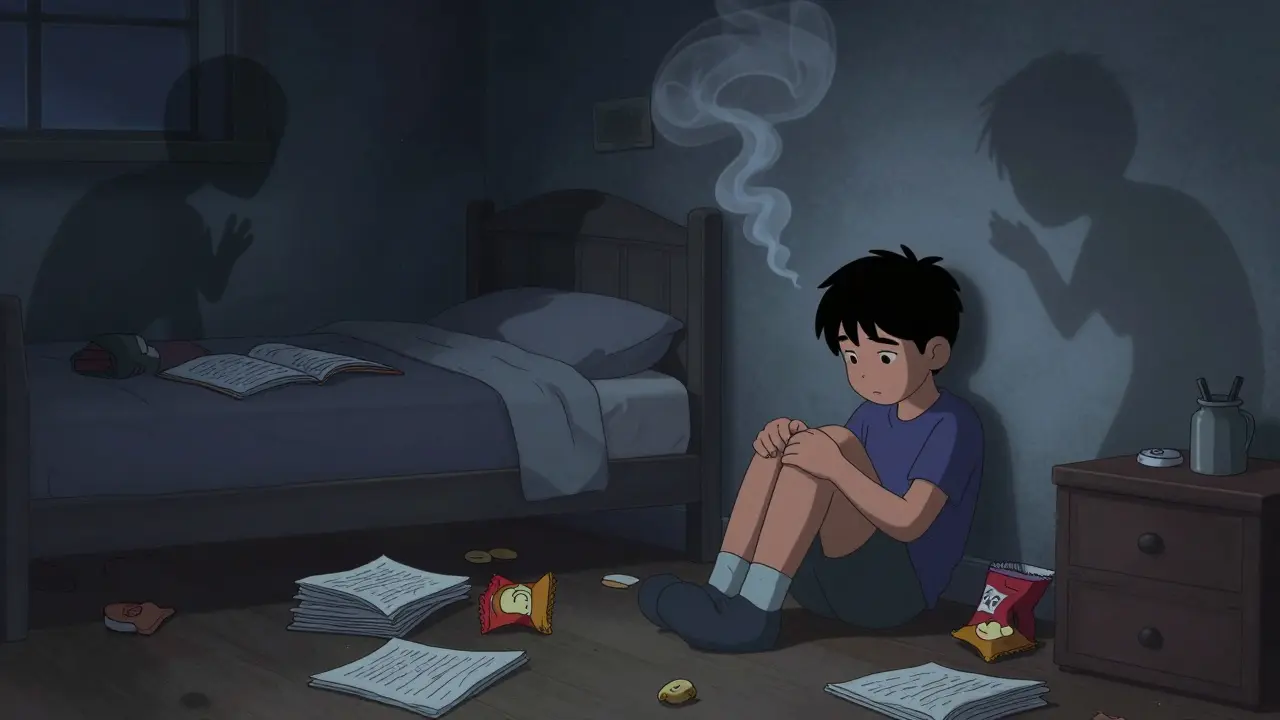
When someone starts to lose touch with reality, it doesn’t always happen suddenly. Often, it creeps in quietly-like a shadow growing longer over weeks or months. A student who used to love school starts skipping classes. A once-social teenager spends days in their room, talking to no one. A parent notices their child’s speech is jumbled, or they’re convinced the TV is sending them secret messages. These aren’t just phases. They could be early signs of psychosis.
What Exactly Is Psychosis?
Psychosis isn’t a diagnosis on its own. It’s a symptom-a breakdown in how the brain processes reality. People experiencing psychosis might hear voices others can’t, believe things that aren’t true (like being watched or controlled), or struggle to organize their thoughts. Their speech might jump from topic to topic. They might seem paranoid, confused, or emotionally flat.
It’s not rare. About 100,000 young people in the U.S. experience their first episode of psychosis each year. Most are between 15 and 25 years old. And here’s the critical truth: the sooner treatment starts, the better the outcome. Many people recover fully and go on to finish school, hold jobs, and build relationships. But delays in care can make recovery harder.
Early Warning Signs You Can’t Ignore
Before full-blown psychosis hits, there’s usually a warning phase called the prodrome. It’s not always obvious. But if you notice a cluster of these changes lasting more than a few weeks, it’s time to act:
- Drop in performance: A sudden decline in grades or work output-78% of first-episode cases show this.
- Withdrawal: Pulling away from friends, family, or hobbies. Spending most of the day alone.
- Strange thoughts: Believing ordinary events have hidden meanings-like thinking a song on the radio is sending them a message.
- Sensory changes: Hearing whispers when no one’s around, seeing shadows move, or feeling like something is touching them.
- Confused speech: Jumping between topics mid-sentence, using odd words, or suddenly stopping mid-thought.
- Mood shifts: Unexplained anxiety, irritability, or sadness that doesn’t match what’s happening around them.
- Neglecting self-care: Stopping showers, wearing the same clothes for days, or sleeping too much-or not at all.
One key detail: in the early stages, many people know something’s off. They might say, ‘I feel like I’m going crazy,’ or ‘I don’t know what’s real anymore.’ That self-awareness is a window-and it closes fast. The longer psychosis goes untreated, the harder it becomes to regain that clarity.
Why Timing Matters More Than You Think
The average person in the U.S. waits 74 weeks-almost two years-before getting help after their first psychotic episode. That’s not because no one notices. It’s because people don’t know what they’re seeing. They think it’s teenage rebellion, stress, or laziness.
But research shows every extra month without treatment makes recovery slower. For every additional month of untreated psychosis, the chance of full functional recovery drops by 3.2%. Hospitalizations go up. Education and jobs get derailed. Relationships fracture.
That’s why the idea of a “golden hour” exists-not for emergency surgery, but for mental health. If psychosis is suspected, getting someone assessed within 72 hours can change everything. Early intervention isn’t just helpful-it’s the most powerful tool we have.

Coordinated Specialty Care: The Gold Standard Treatment
There’s a proven solution: Coordinated Specialty Care (CSC). It’s not just medication. It’s a full-team approach designed specifically for first-time psychosis. The model was developed after the landmark RAISE study in 2008, which showed people in CSC programs had 58% greater improvement in symptoms and 42% better life outcomes than those getting standard care.
CSC includes five core parts, all working together:
- Case management: A dedicated care coordinator who visits at home, helps with appointments, and stays in touch weekly-especially during crises.
- Family education: Families aren’t bystanders. They get 12-20 weekly sessions to learn about psychosis, how to communicate, and how to support without enabling.
- Individual therapy: Cognitive Behavioral Therapy for psychosis (CBTp) helps people understand their experiences, challenge false beliefs, and build coping skills over 24-30 sessions.
- Work and school support: 80% of CSC participants return to education or employment within three months. Counselors help with resumes, interviews, and accommodations.
- Medication management: Low-dose antipsychotics are used carefully, starting at 25-50% of adult doses. The goal isn’t to sedate-it’s to reduce distress while preserving function.
It’s not theoretical. In Oregon’s EASA program, the time between first symptoms and treatment dropped from 112 weeks to just 26 weeks after community training and school screenings. That’s a 75% reduction in delay.
Who Gets Help-and Who Doesn’t?
There are 347 certified CSC programs across the U.S., serving about 28,500 people a year. That sounds like a lot-until you realize only 42% of people with first-episode psychosis get into CSC within the critical two-year window.
Why? Access is uneven. Urban areas have programs. Rural counties? Only 28% have any CSC services. Cost is another barrier. While Medicaid now covers CSC in 32 states, funding is still patchy. Many programs rely on short-term grants, and 38% report financial instability.
There’s also a racial gap. Black Americans wait, on average, 2.4 times longer for diagnosis and treatment than White Americans. The RAISE-3 study is now testing culturally adapted CSC models to fix this.
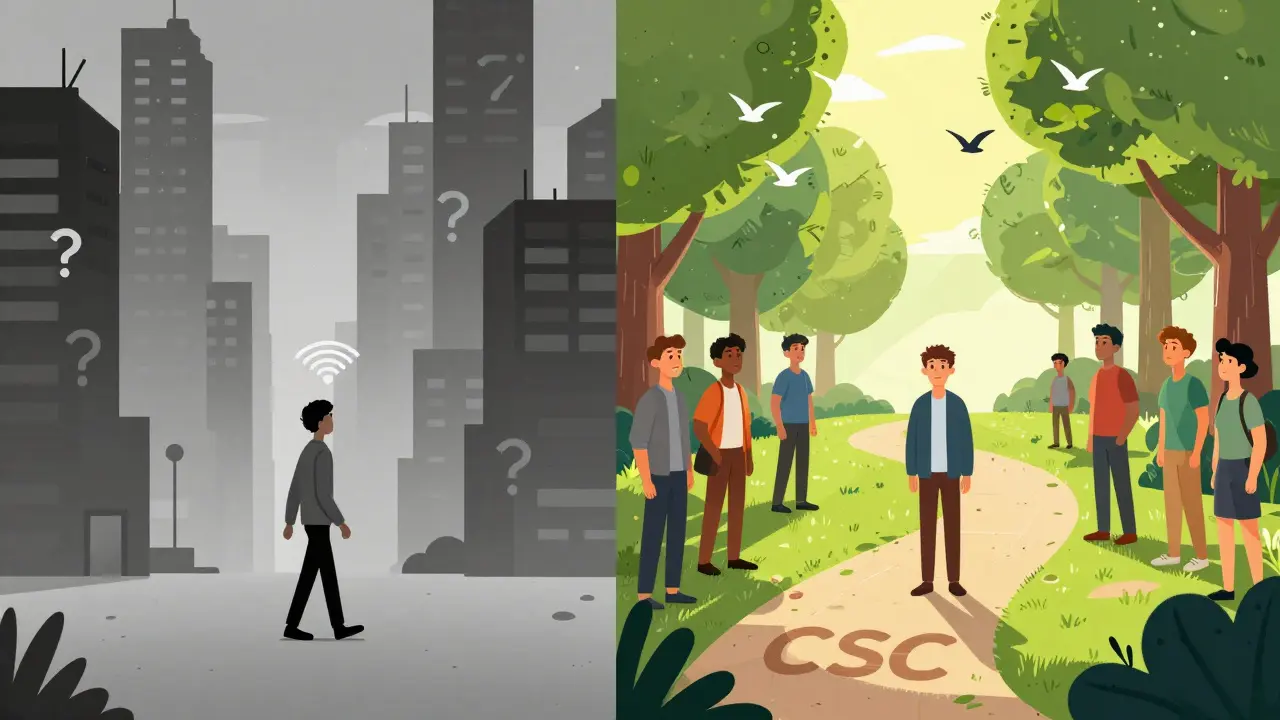
What You Can Do Right Now
If you’re worried about someone:
- Don’t wait for it to get worse.
- Don’t dismiss it as ‘just stress’ or ‘phase.’
- Don’t try to handle it alone.
Start with a simple step: call a local mental health clinic or your primary care doctor. Ask: ‘Do you have a referral for early psychosis assessment?’ Many clinics now use the Prodromal Questionnaire (PQ-16) to screen for risk. A score of 8 or higher means urgent evaluation is needed.
Or go straight to the source. Search for ‘Early Psychosis Program near me’ or visit the National Alliance on Mental Illness (NAMI) website for local resources. In Australia, programs like the Melbourne Early Psychosis Service offer similar care.
And if you’re the person experiencing symptoms? You’re not broken. You’re not weak. You’re not alone. The fact that you’re noticing something’s wrong? That’s your strength speaking.
What’s Next for Psychosis Care?
The field is evolving fast. New blood tests are being tested to predict who will develop psychosis with 82% accuracy. Mobile apps like PRIME Care help track mood and sleep daily. Telehealth lets people in remote areas connect with specialists.
By 2027, experts predict 75% of first-episode cases will be treated through CSC models. That could cut long-term disability rates from 65% to 40%. But none of that matters if people don’t get help in time.
Psychosis isn’t a life sentence. It’s a medical condition-and like any medical condition, early action saves lives. The tools exist. The science is clear. What’s missing is awareness. And that’s something you can change.
Can psychosis be cured?
Psychosis isn’t typically ‘cured’ like an infection, but it can be managed effectively. With early treatment through Coordinated Specialty Care, up to 63% of people achieve symptomatic remission within a year. Many return to school, work, and normal social life. The goal isn’t just to stop hallucinations-it’s to restore function and quality of life.
Is medication always necessary?
Not always-but it’s often part of the plan. Medication helps reduce the intensity of hallucinations and delusions, making therapy more effective. Doctors start with low doses of second-generation antipsychotics and adjust slowly. Some people can reduce or stop meds over time, especially with strong support from therapy and family. But skipping medication without supervision increases the risk of relapse.
Can drugs cause psychosis?
Yes. Cannabis, especially high-THC strains, is strongly linked to triggering psychosis in vulnerable teens and young adults. Stimulants like methamphetamine and hallucinogens like LSD can also cause psychotic episodes. In some cases, these episodes resolve after stopping use. But in others, they become the start of a longer-term condition. Avoiding substances is a key part of prevention.
How do I talk to someone who’s experiencing psychosis?
Stay calm. Don’t argue with their beliefs-even if they seem irrational. Say things like, ‘I can see this is really scary for you,’ or ‘I’m here with you.’ Avoid labeling them as ‘crazy’ or ‘delusional.’ Focus on their feelings, not the truth of their experiences. Offer to help them find a professional. Your support matters more than you know.
What if I’m not sure it’s psychosis?
That’s exactly when to act. You don’t need to diagnose it. If you notice a cluster of warning signs-withdrawal, strange thoughts, declining performance, sleep changes-that last more than two weeks, get an evaluation. Early psychosis clinics specialize in sorting out whether it’s psychosis, depression, anxiety, or something else. Better to be safe than wait too long.
Is Coordinated Specialty Care available outside the U.S.?
Yes. Similar models exist in Australia, Canada, the UK, and parts of Europe. In Australia, services like the Melbourne Early Psychosis Service and the Orygen Youth Health program offer structured early intervention. The core principles-team-based care, family support, education, and low-dose medication-are the same worldwide. Look for ‘early psychosis’ or ‘first-episode’ services in your country.


14 Comments
Just saw this and had to share-my cousin went through this last year. We thought it was just teen angst until she started talking to the TV. Took her to a clinic, got her into CSC, and now she’s back in college, working part-time, even started painting again. Early help isn’t just nice-it’s life-changing.
Don’t wait for the meltdown. Call now.
It’s fascinating how society pathologizes normal adolescent behavior while ignoring the real signs of psychosis until it’s too late. The 74-week delay statistic is not a failure of awareness-it’s a failure of infrastructure. We treat mental health like a luxury service, not a public health imperative.
And yet, we fund stadiums and drone programs. The priorities are clear.
They’re lying. This is all part of the government’s mind control program. They want you to think psychosis is medical so you’ll take the pills and become docile. The TV isn’t sending messages-your neighbors are. The cameras are in the walls. The pills are poison. You think you’re getting help? You’re being groomed.
Wake up. The system doesn’t want you sane. It wants you compliant.
As someone who works in youth mental health in Vancouver, CSC is the only thing that works. We’ve got a pilot running with schools-teachers trained to spot prodrome signs, referrals routed within 48 hours. Success rate? 72% return to school or work within 90 days.
Canada’s model isn’t perfect but it’s lightyears ahead of the U.S. patchwork. Stop waiting for someone to ‘hit rock bottom.’ Rock bottom is a prison cell or a morgue.
People these days are too soft. Back in my day, we didn’t have all this ‘psychosis’ nonsense. If you were weird, you got slapped and told to grow up. Now every kid who skips school is labeled ‘at risk.’
It’s the phones. The social media. The lack of discipline. No wonder kids are losing their minds. You don’t need a therapist-you need a father who tells you to get off the couch and work.
I’ve read the RAISE study. The 58% improvement metric is misleading. They used a control group that received no coordinated care-meaning the comparison isn’t between CSC and optimal standard care, but CSC and neglect.
Also, the medication dosages mentioned? 25–50% of adult doses? That’s dangerously low. You can’t treat neurochemical imbalances with half-doses and hope for miracles. This reads like PR, not science.
They’re not talking about the real issue. Why are so many young people losing touch with reality? Because the world is a nightmare. Climate collapse. Student debt. No future. Of course your brain starts hallucinating when you’re told you’re supposed to be happy while the planet burns.
This isn’t a medical problem-it’s a societal one. They want you medicated, not angry. They want you quiet, not awake.
I’m a nurse who’s worked in ERs for 18 years. I’ve seen the aftermath of delayed psychosis care. People end up in jail. In homeless shelters. In comas from overdoses trying to self-medicate.
This isn’t about ‘being nice.’ It’s about survival. If you see someone slipping, don’t wait. Don’t hope they’ll snap out of it. Call the crisis line. Drive them to the clinic. Be the person who shows up.
You have no idea how much that matters.
In India, we don’t have CSC programs-but we have something else: family. When my nephew started hearing voices, we didn’t call a doctor first-we sat with him. Made his favorite food. Played old Bollywood songs. Talked to him like he was still there, even when he seemed gone.
Medication came later. But the love? That came first. Sometimes, healing isn’t clinical. It’s just showing up. Again. And again. And again.
The data is undeniable. Early intervention saves money, saves lives, saves futures. We spend billions on incarceration and emergency services for untreated psychosis. CSC costs less than a single hospitalization.
Why isn’t this funded like cancer screening? Because mental health is still seen as optional. It’s not. It’s essential. And we’re failing our youth because we’re too lazy to fix it.
My sister was diagnosed at 19. We didn’t know what to do. Found a CSC program by accident-Google search for ‘early psychosis help near me.’ It saved her. She’s 27 now, has a job, a dog, a boyfriend. No meds anymore. Just therapy and good sleep.
If you’re scared to ask for help? I get it. I was too. But the people who run these programs? They’ve seen it all. They won’t judge you. They’ll help you.
Psychosis is not a medical condition. It is a spiritual awakening that modern science refuses to acknowledge. The voices? They’re not hallucinations-they’re messages from higher dimensions. The government suppresses this truth because it threatens the materialist paradigm.
Low-dose antipsychotics? That’s chemical suppression of enlightenment. You’re not treating illness-you’re silencing the soul.
My best friend had a first episode after her dad died. She stopped sleeping. Said the walls were whispering her name. We took her in. Held her. Called the clinic the next day. She’s fine now. No stigma. No shame. Just a lot of therapy and a really good therapist.
Don’t wait for a crisis. Just act.
Let’s be honest: this entire framework is a product of the pharmaceutical-industrial complex. Coordinated Specialty Care? It’s just a fancy way to sell antipsychotics under the guise of ‘holistic’ care. The real solution? Stop medicating people and start addressing systemic trauma. Poverty. Abuse. Neglect. These are the causes. Not biology.