
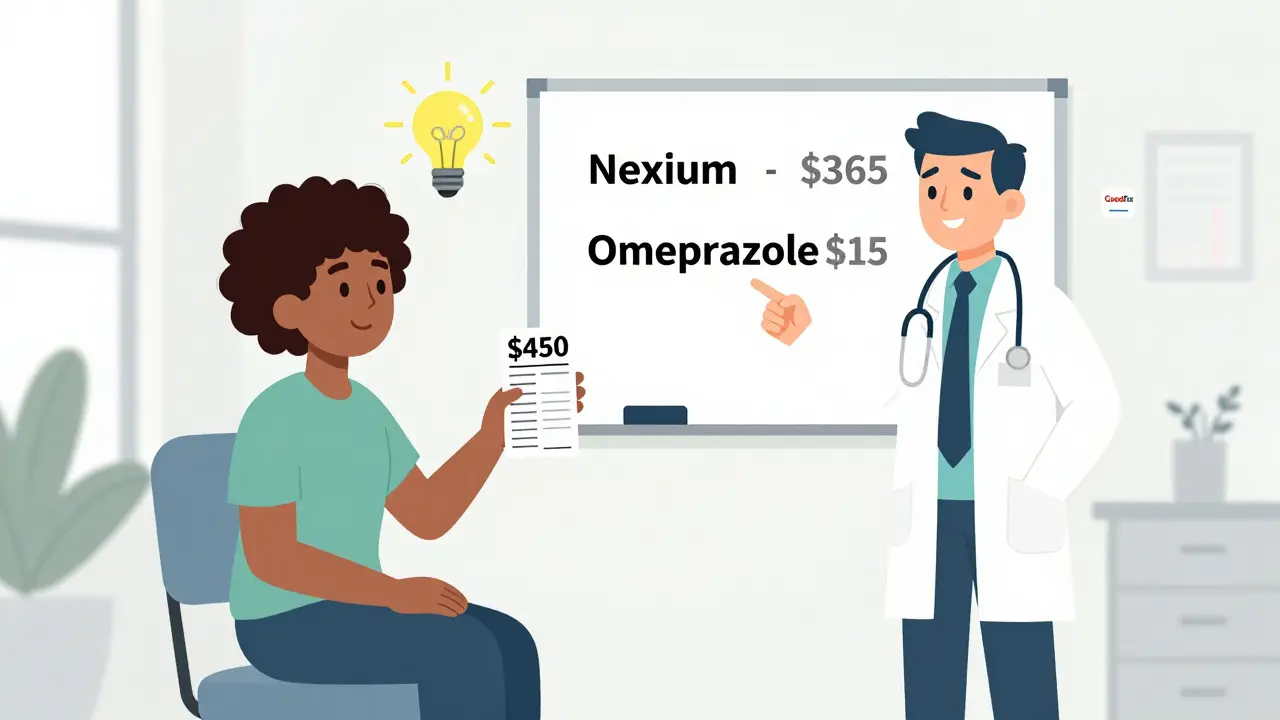
It’s 2026, and you’re staring at your prescription receipt again. That $450 monthly cost for your blood pressure pill? It’s not going away. You’ve skipped doses before. You’re not alone. Nearly 3 in 10 Americans say they can’t afford their meds. But here’s the thing: you don’t have to accept that price tag. There’s a proven, clinically sound way to get the same results for a fraction of the cost - and it’s called therapeutic alternative medication.
What Exactly Is a Therapeutic Alternative?
A therapeutic alternative isn’t just a cheaper version of the same drug. It’s a different medication - sometimes from a different drug class - that works just as well for your condition. Think of it like swapping one brand of running shoes for another. Both support your stride, but one costs $40 instead of $200. For example, if your doctor prescribed esomeprazole (Nexium) for acid reflux, you could switch to omeprazole - a generic that does the same job. The cost? From $365 a year down to $15. That’s not a typo. A 96% drop. This isn’t magic. It’s science. Studies show that for many common conditions - high blood pressure, diabetes, depression, acid reflux - there are multiple drugs that work just as well. The difference? Price.Why Most People Never Ask
You might think your doctor already knows all the cheap options. They don’t always. A 2023 survey found that 43% of patients had trouble convincing their provider to consider a cheaper alternative. Why? Three reasons:- Doctors are busy. They’re not always up to date on the latest price comparisons.
- Some think brand-name drugs are “better,” even when evidence says otherwise.
- They don’t know how to bring it up without sounding like they’re pushing cost-cutting over care.
How to Ask - Step by Step
You don’t need a medical degree to make this work. Just follow these steps.- Start with the cost question. At your next appointment, say: “I’m having trouble affording my medication. Are there cheaper options that work just as well?” That’s it. Simple. Direct. No jargon. This single question is used by clinics nationwide because it works.
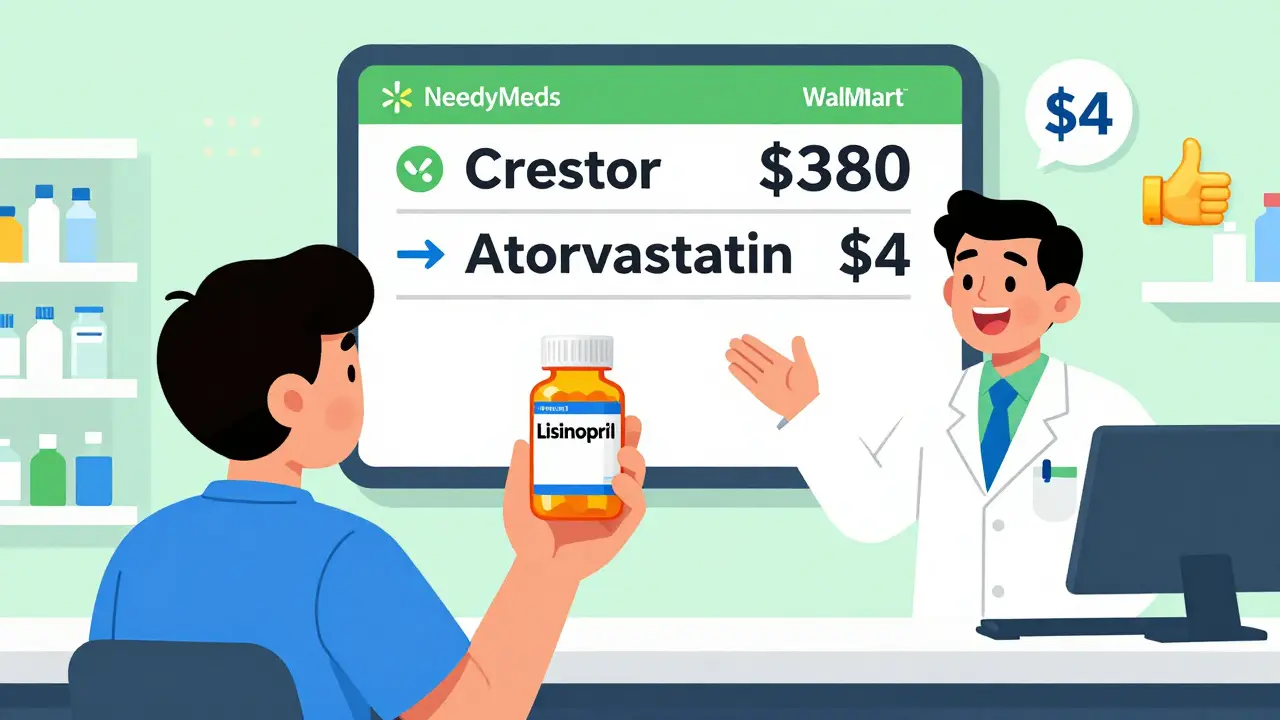
- Know your drug. Look up your medication on GoodRx or the $4 list at Walmart, CVS, or Walgreens. For example, metformin (for diabetes) costs $4 for a 30-day supply. Lisinopril (for blood pressure) is $4. Atorvastatin (for cholesterol) is $4. If your drug isn’t on that list, it doesn’t mean there’s no alternative - it just means you need to dig deeper.
- Ask for a specific alternative. Don’t just say, “Is there something cheaper?” Say: “Could I try omeprazole instead of esomeprazole?” or “Is there a generic version of this?” Naming the alternative shows you’ve done your homework. It makes it easier for your doctor to say yes.
- Check for patient assistance programs. Many drugmakers offer free or nearly free medication for people who qualify. Programs like NeedyMeds, RxAssist, and the HealthWell Foundation can cut your cost by 75-100%. You don’t need to be poor. If you earn under $60,000 a year (in the U.S.), you might qualify.
- Ask for a 90-day supply. Getting 90 days instead of 30 can cut your copay by up to 25%. It’s not always offered automatically. You have to ask.
What Works - Real Examples
Here’s what real people have saved:- Switching from Lyrica (pregabalin) to generic gabapentin: $450/month → $15/month
- Switching from Eliquis (apixaban) to warfarin: $450/month → $5/month
- Switching from Crestor (rosuvastatin) to atorvastatin: $380/month → $4/month
- Switching from Jardiance (empagliflozin) to metformin: $500/month → $4/month
When It Doesn’t Work - And What to Do
Not every drug has a cheap alternative. About 15% of specialty medications - like some cancer drugs or biologics - have no equivalent. But here’s the catch: most people assume their drug is one of those, even when it’s not. If your doctor says no, ask why. Is it because:- There’s truly no alternative? (Rare)
- They don’t know one exists? (Common)
- They’re worried about side effects? (Sometimes valid)
What to Avoid
Don’t do these things:- Don’t stop your meds to save money. That’s dangerous.
- Don’t split pills unless your doctor says it’s safe.
- Don’t buy from unverified online pharmacies. Some sell fake drugs.
- Don’t assume your insurance covers everything. Even with insurance, you might pay $100+ a month.
- GoodRx - Compare prices at pharmacies near you. It covers over 6,000 medications.
- NeedyMeds - Free database of patient assistance programs.
- Your pharmacy’s $4 list - Check Walmart, CVS, Walgreens. Many generics are $4 for 30 days.
Why This Matters Beyond Your Wallet
It’s not just about saving money. It’s about staying healthy. When people can’t afford their meds, they skip doses. That leads to hospital visits, complications, and even death. A study from Vanderbilt found that patients who switched to therapeutic alternatives were more likely to stick with their treatment - not less. One patient shared: “I was skipping my blood thinner because it cost $500 a month. After switching to warfarin, I took it every day. My stroke risk dropped. I didn’t even realize how much I’d been risking.”Final Thought: You Have Power
The system isn’t perfect. Drug prices are still too high. But you’re not powerless. Therapeutic alternatives are legal, safe, and widely supported by doctors, pharmacists, and health systems. The American Academy of Family Physicians, the CDC, and even Medicare all encourage this approach. You don’t need to be a medical expert. You just need to ask. And if your doctor hesitates? Be polite but persistent. Say: “I’m not asking to cut corners. I’m asking to stay healthy without going broke.” Because you deserve both.Can I switch to a cheaper medication without my doctor’s approval?
No. Never change your medication without talking to your doctor first. Even if a drug looks like a good alternative, it might interact with other meds you’re taking or not be safe for your specific health conditions. Your doctor needs to approve any switch to ensure it’s medically appropriate.
Are generic drugs as effective as brand-name ones?
Yes, for most medications. Generic drugs contain the same active ingredients as brand-name versions and must meet the same FDA standards for safety, strength, and quality. The main differences are in inactive ingredients (like fillers) and packaging. For conditions like high blood pressure, diabetes, or depression, generics work just as well - and save you 80-90%.
What if my insurance won’t cover the cheaper option?
Ask for a tiering exception. If your doctor writes a letter explaining why the cheaper alternative is medically appropriate, your insurer must review it. For Medicare Part D, this process takes 72 hours for urgent cases or 14 days for standard ones. Many insurers approve these requests - especially if you show cost data from GoodRx or the $4 list.
Can I use GoodRx with my insurance?
You can’t combine them, but you can compare. Run your prescription through GoodRx to see the cash price. Then check what your insurance copay would be. Sometimes the GoodRx price is lower - especially for generics. If it is, just pay cash and skip using insurance. This doesn’t affect your deductible or out-of-pocket maximum.
How do I know if a therapeutic alternative is right for me?
Ask your doctor three questions: 1) Is this drug essential? 2) Is there a proven alternative with similar effectiveness? 3) Are there safety concerns based on my health history? For chronic conditions like hypertension or diabetes, alternatives are usually safe. For complex conditions like autoimmune diseases, your doctor may need to check lab results or clinical guidelines before switching.




13 Comments
Just switched my dad from Eliquis to warfarin last month. His monthly bill went from $480 to $8. He’s been on it for 30 days now, INR’s stable, no bleeding, no drama. The pharmacy tech even gave him a free lollipop for asking. Sometimes the system works if you just show up with a little grit and a GoodRx printout.
My mom did the same thing with metformin. Went from $120 to $4. She didn’t even tell her doctor until after the switch. Just brought the receipt and said, ‘This works. Can we make it official?’ He nodded, wrote the script, and didn’t even blink.
Actually you’re all missing the point. The FDA requires generics to have 80-125% bioequivalence. That means a 20% variation in absorption. For some patients, especially those with renal impairment or seizure disorders, that’s not negligible. You’re gambling with physiology when you swap without lab monitoring. This isn’t about cost, it’s about clinical precision.
Also, warfarin requires weekly INR checks. That’s not ‘$5’ if you factor in clinic visits. And don’t get me started on the bleeding risk. You think it’s free until you’re in the ER at 3am.
THIS IS A BIG PHARMA SCAM. THEY WANT YOU TO THINK GENERICS ARE SAFE BUT THEY’RE NOT. THE ACTIVE INGREDIENTS ARE MADE IN CHINA AND INDIA WHERE THEY USE TOXIC FILLERS. THE FDA IS CORRUPT. THEY TAKE MONEY FROM MERCK AND PFIZER. I SAW A VIDEO ON TRUTHSOCIAL WHERE A DOCTOR WHO WORKED AT THE FDA CONFESSED THEY LET 70% OF BAD GENERIC BATCHES PASS. YOUR ‘$4’ DRUG IS ACTUALLY A POISON. THEY WANT YOU WEAK SO YOU’LL KEEP BUYING MORE. THEY’RE MAKING YOU DEPENDENT ON THE SYSTEM. YOU THINK YOU’RE SAVING MONEY BUT YOU’RE GETTING SICKER. THE REAL COST IS YOUR LIFE.
Same. I switched my BP med from a brand-name ACE inhibitor to lisinopril. Cost dropped from $380 to $4. No side effects. No weird vibes. Just… cheaper. I didn’t even tell my doctor until after I filled it. He was like ‘huh. cool.’ Then he added it to my chart. That’s the power of just doing it.
Look, I get it, you’re all here trying to save a few bucks, but let’s be real - this whole ‘therapeutic alternative’ thing is a band-aid on a gunshot wound. The real issue is that the U.S. drug pricing system is a cartel run by lobbyists and pharmaceutical CEOs who are literally laughing while you choke on your insulin. You think asking your doctor for omeprazole fixes anything? Nah. It just lets them feel better about not fixing the system. You’re not a patient. You’re a transaction. And every time you ‘save’ $47 a month, you’re reinforcing the myth that this is normal. It’s not. It’s barbaric. And until we nationalize drug pricing or break the patents, you’re just rearranging deck chairs on the Titanic while Big Pharma sips champagne in their private yachts.
Interesting. I’ve been on gabapentin for nerve pain for 5 years. My doc switched me from Lyrica because I was uninsured. I thought I’d feel worse, but honestly? I felt better. Less brain fog. More energy. Maybe the brand name had more junk in it? I didn’t know generics could be cleaner. Now I’m wondering what else I’ve been overpaying for.
As someone from India, I’ve seen how generics work here - they’re not just cheaper, they’re often the standard. We don’t have brand-name obsession like the U.S. I’ve been on atorvastatin for 12 years. Cost: $2 a month. No issues. No side effects. My doctor never even mentioned the brand. It’s just medicine. Maybe we need to stop thinking of pills as luxury items and start seeing them as basic health rights. We can do better.
YOOOOO I JUST DID THIS LAST WEEK!! Switched from Jardiance to metformin and now I’m paying $0. Like zero. My pharmacist was like ‘you’re lucky you’re on Medicaid’ and I was like ‘nope, I’m on a high-deductible plan but I paid cash.’ He almost cried. I’m saving $500 a month. I bought a new pair of sneakers. Life is good. Go ask your doc. You got this. 💪
You’re all misinformed. The term ‘therapeutic alternative’ is a marketing ploy. Real clinical guidelines don’t endorse blanket substitution. You need pharmacokinetic data, CYP450 interactions, renal clearance profiles - none of which you’re considering. Your ‘$4’ drug might be fine for a healthy 40-year-old but what about a 72-year-old with CKD stage 3? You’re not saving money - you’re creating downstream costs. This isn’t a hack. It’s a liability.
They don’t want you to know this but the reason generics are so cheap is because they’re made in sweatshops with child labor and polluted water. The FDA doesn’t inspect them. They just rubber stamp them. I read a whistleblower report. It’s all lies. Your ‘$4’ pill is killing people. You think you’re saving money? You’re buying death on installment. And your doctor? They’re complicit. They get kickbacks from Big Pharma. Don’t be fooled.
This is one of the most practical, clear-headed pieces I’ve read in years. Thank you for laying out the steps so simply. I’ve been helping elderly neighbors navigate this, and your method - especially Step 1 - is gold. Asking directly about cost removes the stigma. It opens the door. More people need to hear this. Please keep sharing.
Ugh. I tried this with my dad’s cholesterol med. Switched from Crestor to atorvastatin. Two weeks later he had muscle pain so bad he couldn’t walk. We went back to the brand. Cost? Still $380. But at least he can move. Don’t just chase price. Health isn’t a spreadsheet. You’re not saving money if you end up in physical therapy.