
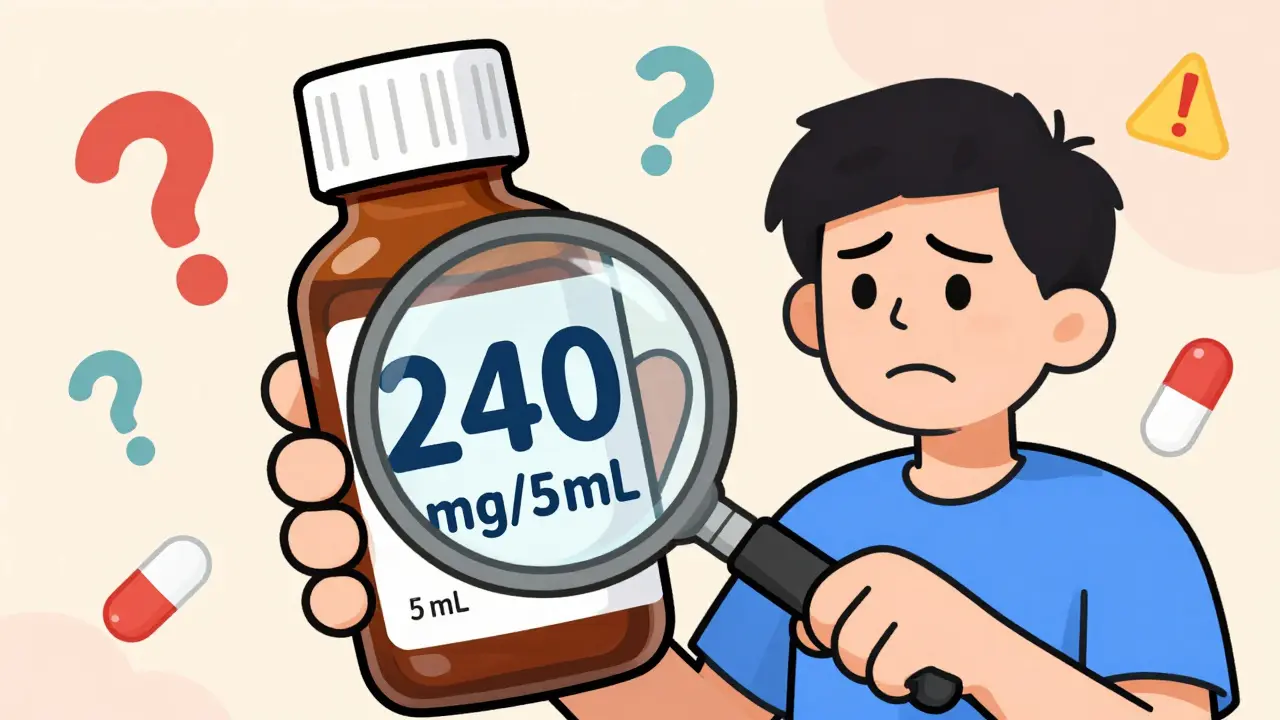
Getting the right dose of liquid medicine isn’t just about following the label-it’s about avoiding mistakes that can land someone in the hospital. Every year, over a million people in the U.S. are injured because of errors in liquid medication dosing, and most of those mistakes happen because people misread the label. It’s not because they’re careless. It’s because the information is confusing, poorly presented, or they’ve never been taught how to read it properly.
What You’re Actually Looking At on the Label
The label on a liquid prescription bottle doesn’t just say "take 5 mL." It gives you three critical pieces of information, all of which you need to understand together:- Total container volume - This tells you how much medicine is in the whole bottle, like 118 mL or 237 mL. This is not your dose. It’s just the size of the bottle.
- Concentration - This is the most important part. It looks like "125 mg per 5 mL" or "240 mg/5 mL." That means every 5 milliliters of liquid contains 125 mg or 240 mg of the active drug. If your dose is 10 mL, you’re getting two times that amount of medicine.
- Dosage instructions - This says how much to take and how often, like "Take 10 mL twice daily." That’s your actual dose, measured in milliliters (mL).
Confusing the total volume with the dose is one of the most common mistakes. Someone might see "240 mL" on the bottle and think they’re supposed to take that much. But that’s the whole bottle. The dose might be just 5 mL. Mixing those up can lead to a dangerous overdose.
Why Milliliters (mL) Are the Only Unit That Matters
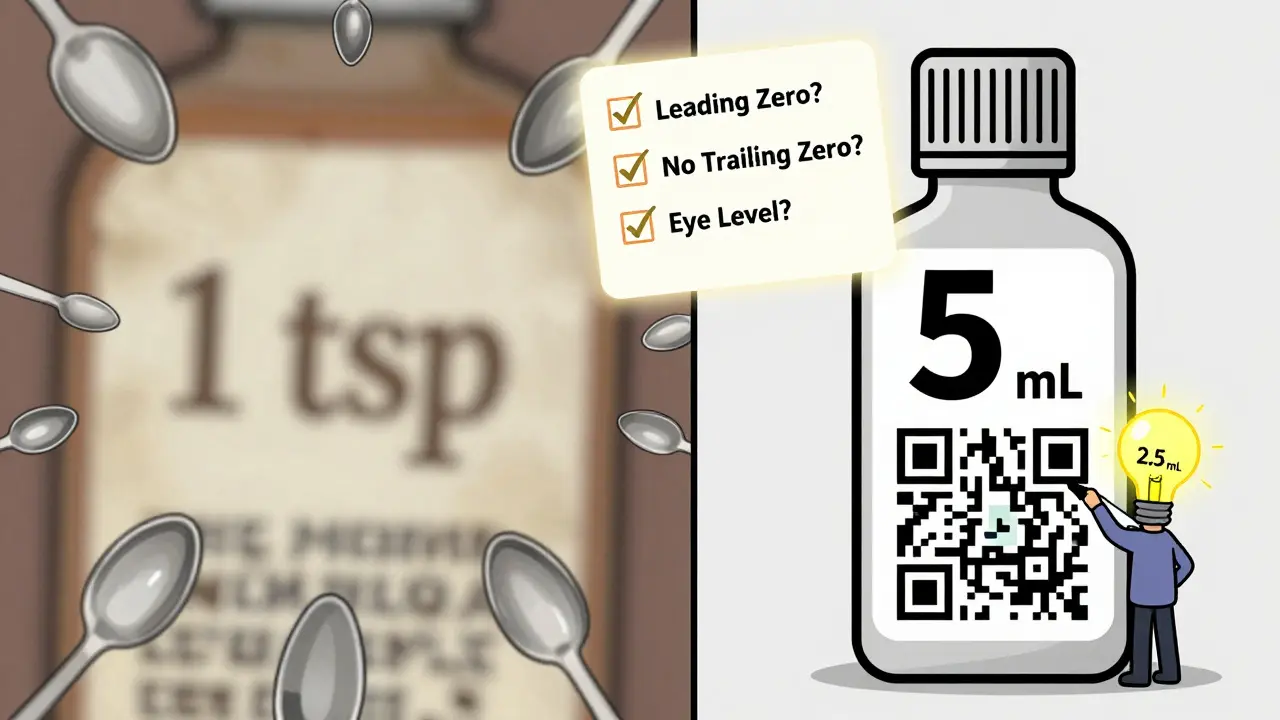
You might still see old labels or over-the-counter bottles that use teaspoons (tsp) or tablespoons (tbsp). Don’t trust them. The FDA and the National Council for Prescription Drug Programs (NCPDP) have been pushing for years to eliminate these units from prescription labels-and for good reason.A household teaspoon can hold anywhere from 2.5 mL to 7.5 mL. A tablespoon? It could be 5 mL or 20 mL. That’s a 300% difference. A 2016 study in the Journal of Pediatrics found parents using teaspoons were twice as likely to give the wrong dose compared to those using mL-only measuring tools. That’s why modern prescription labels now only use milliliters.
Here’s what you need to know about the numbers:
- Always use a leading zero: 0.5 mL, never .5 mL. That tiny zero stops someone from misreading it as 5 mL.
- Never use trailing zeros: 5 mL, never 5.0 mL. The extra zero can make someone think it’s more precise than it is-and lead to dangerous over-dosing.
- Leave space between the number and unit: 5 mL, not 5mL. That small gap helps your brain separate the number from the unit.
These rules aren’t suggestions. They’re based on research from Johns Hopkins that showed following them reduces 10-fold dosing errors by 47%. That’s nearly half the mistakes gone just by formatting the numbers right.
How to Use the Measuring Device That Comes With the Medicine
The bottle should come with a dosing tool-usually a syringe, cup, or spoon marked in milliliters. Never use a kitchen spoon. Even if it says "teaspoon" on the side, it’s not accurate.Here’s how to use the tool correctly:
- Check the markings. Does it show 0.1 mL, 0.5 mL, 1 mL, 2.5 mL, 5 mL? The smaller the increments, the more precise the dose.
- Hold the tool at eye level. Don’t tilt it. Pour slowly until the top of the liquid reaches the line for your dose.
- Don’t trust the cup if it also shows teaspoons. The mL markings are the only ones you should use. The tsp markings are there for legacy reasons, not accuracy.
- If the tool is hard to read or the lines are faded, ask the pharmacist for a new one. Most will give you a free oral syringe.
Some devices measure down to 0.001 mL-way more precise than you’ll ever need. Others max out at 5 mL. If your dose is 7.5 mL and the syringe only goes to 5 mL, you’ll need to take two doses. That’s fine. Just make sure you’re counting correctly.
What to Do When the Label Says "240 mg/5 mL" and Your Dose Is 120 mg
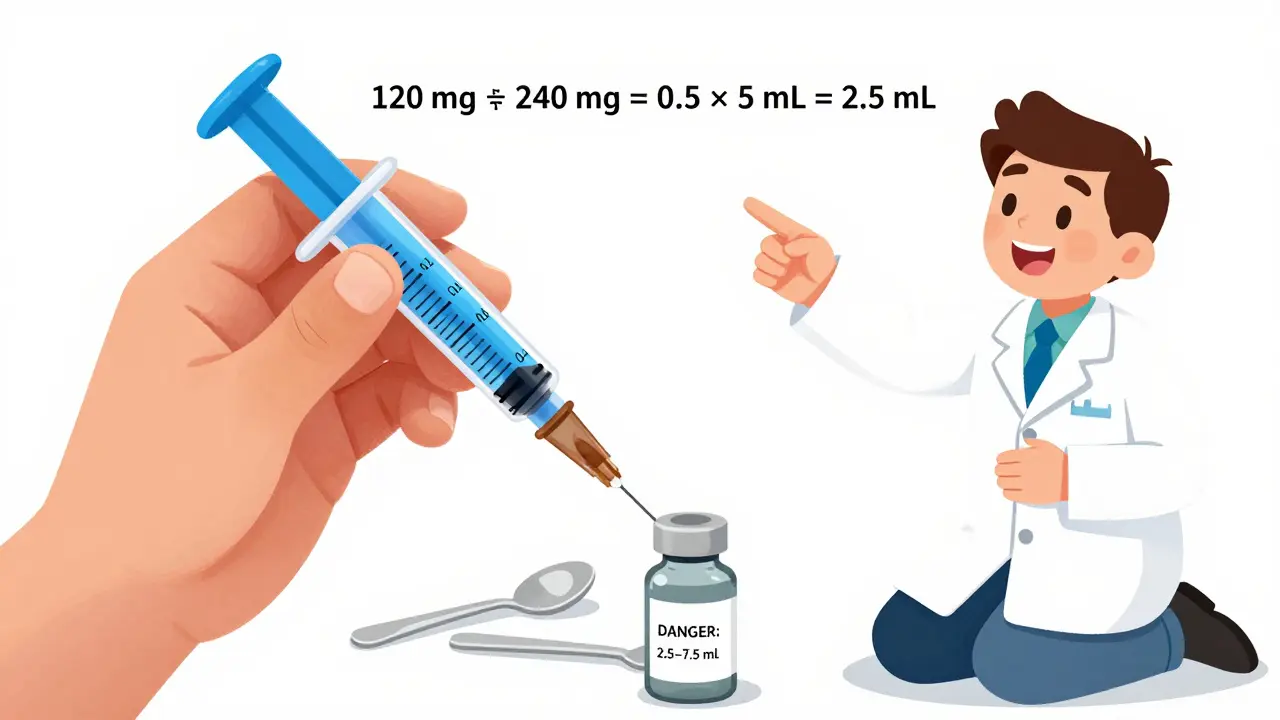
This trips up a lot of people. The concentration tells you how much medicine is in each 5 mL. But your dose might not be a full 5 mL.Let’s say the label says: 240 mg per 5 mL. Your doctor told you to take 120 mg.
That means you need half of the 5 mL dose because 120 is half of 240. So your dose is 2.5 mL.
Here’s the math in simple terms:
- 240 mg = 5 mL
- 120 mg = ? mL
- Divide 120 by 240 = 0.5
- Multiply 0.5 by 5 mL = 2.5 mL
If that feels confusing, ask the pharmacist to write it out for you. Or better yet, ask them to show you how to measure it. A 2022 study from Nationwide Children’s Hospital found that 78% of parents who got a live demonstration made zero dosing errors. Those who didn’t? Nearly 40% messed up.
What to Do If the Label Still Uses Teaspoons
Even though it’s against FDA guidelines, some pharmacies-especially small or independent ones-still use teaspoons on labels. This happens because of outdated systems or lack of staff training.If you see "1 tsp" or "2 tbsp" on your prescription:
- Ask the pharmacist to convert it to mL.
- Confirm the conversion: 1 tsp = 5 mL, 1 tbsp = 15 mL.
- Request a measuring device marked in mL.
- Write the mL dose on the bottle with a permanent marker if they don’t update the label.
Don’t assume it’s safe just because it’s on the label. A 2021 University of Pittsburgh study found that 32% of pharmacies still had at least some labels with non-metric units. That’s not rare-it’s common enough to be dangerous.
What to Do When You’re Still Unsure
You’re not alone if you’re confused. Only 12% of U.S. adults have proficient health literacy, according to the National Assessment of Adult Literacy. That means most people struggle to understand medical instructions-even when they’re written clearly.Here’s what you can do:
- Use the teach-back method. After the pharmacist explains the dose, say: "Just to make sure I got it right-I need to give my child 3 mL twice a day using this syringe, right?" Then show them how you’d measure it. If you’re wrong, they’ll correct you. Studies show this cuts errors by 63%.
- Take a photo of the label. Show it to a second pharmacist, a nurse, or even a trusted friend. Sometimes a fresh pair of eyes spots what you missed.
- Call the pharmacy. Don’t guess. Call and say: "I have this prescription for liquid medicine. Can you confirm the dose in mL?" Most pharmacies will call you back within minutes.
There’s no shame in asking. Medication errors aren’t your fault-they’re a system problem. The fact that you’re trying to get it right means you’re already ahead of most people.
What’s Changing in 2026
The rules are getting stricter. In 2023, the FDA proposed new rules requiring pictograms on liquid labels-simple pictures showing how to fill the syringe or cup. Early tests showed those pictures cut dosing errors by 37%.Some pharmacies are already testing QR codes on labels. Scan it, and you’ll see a 30-second video of how to measure the dose. Amazon Pharmacy, for example, saw 28% fewer error-related calls after adding these.
By 2026, the Partnership for Safe Medication predicts nearly all pharmacies will be fully compliant. But until then, you still need to know how to read the label yourself. Don’t wait for the system to fix itself. Learn now. Ask now. Double-check now.
Final Checklist: Before You Give the Medicine
Before you give any liquid medicine, run through this quick checklist:- Is the dose written in mL, not teaspoons or tablespoons?
- Is there a leading zero for doses under 1 mL? (e.g., 0.8 mL, not .8 mL)
- Is there a trailing zero? (e.g., 5 mL, not 5.0 mL)
- Is the concentration clearly marked? (e.g., 160 mg/5 mL)
- Are you using the measuring device that came with the bottle?
- Did you hold the device at eye level when measuring?
- Did you double-check the math if the dose isn’t a whole number?
If you answered yes to all of these, you’re doing better than most. If you’re unsure about even one, stop. Call the pharmacy. Ask someone. Don’t guess.
Can I use a kitchen spoon to measure liquid medicine?
No. Household spoons vary wildly in size-a teaspoon can hold anywhere from 2.5 mL to 7.5 mL. That’s a 200% difference. Using a spoon can lead to underdosing or dangerous overdosing. Always use the measuring device that comes with the medicine, marked in milliliters (mL).
Why does the label say "240 mg/5 mL" but my dose is 10 mL?
The "240 mg/5 mL" means each 5 mL of liquid contains 240 mg of the medicine. If your dose is 10 mL, you’re taking two times that amount-so you’re getting 480 mg total. The label tells you the concentration; your doctor’s instruction tells you the total volume to take.
What if the label still says "teaspoon" instead of mL?
Ask the pharmacist to convert it to mL. One teaspoon equals 5 mL, and one tablespoon equals 15 mL. Even if the label says "tsp," you should only measure using mL markings on the dosing tool. If the pharmacy won’t update it, write the correct mL dose on the bottle yourself with a permanent marker.
Is it safe to use a syringe if the label says "cup"?
Yes. Oral syringes are often more accurate than cups, especially for small doses. If the label says "take 2.5 mL," you can use a syringe marked in 0.1 mL increments. Just make sure the syringe’s markings match the dose on the label. Pharmacists will usually give you a free syringe if you ask.
How do I know if I’m giving too much or too little?
Watch for side effects. Too much might cause drowsiness, vomiting, or unusual behavior. Too little might mean the medicine doesn’t work. But don’t wait for symptoms. Always double-check the dose using the label, concentration, and measuring tool. If you’re unsure, call your pharmacist. It’s better to ask than to risk harm.
What to Do Next
If you’re caring for a child, elderly parent, or someone with low health literacy, take these steps today:- Ask the pharmacist to demonstrate how to measure the dose.
- Request a free oral syringe if one wasn’t included.
- Write the dose in mL on the bottle in big letters.
- Take a photo of the label and share it with another caregiver.
- Set a reminder to check the label every time you give the medicine.
Medication safety isn’t about being perfect. It’s about being careful. One wrong dose can change everything. But with the right tools and a little attention, you can make sure that never happens.

13 Comments
Just read this while giving my kid amoxicillin. I always used the cup until now. Got a syringe from the pharmacy today after reading this. So simple, so critical. Why isn't this taught in every pediatric visit?
so i just reallized i been giving my son 5ml when it was 0.5ml omg im so stupid
Thank you for this comprehensive breakdown. As a pharmacist, I can't stress enough how often we see patients confuse concentration with total volume. The leading zero rule alone prevents at least one preventable overdose per week in our clinic. Always double-check the math - even if it seems obvious. And yes, ask for a syringe. We keep them behind the counter for exactly this reason.
The statistical evidence presented here is compelling. The 47% reduction in 10-fold dosing errors through adherence to typographic conventions (leading zeros, absence of trailing zeros, spacing between numerals and units) aligns with cognitive load theory and human factors engineering principles. The institutional inertia surrounding non-metric units remains a systemic failure of patient safety infrastructure.
It's not about being careful. It's about designing systems that don't require care to be perfect. If the label can be misread by 88% of adults, the problem isn't the reader. It's the label.
My grandma still uses teaspoons. I printed this out and taped it to her medicine cabinet. She says she'll try the syringe. That's a win.
This is the kind of post that makes you realize how much we’ve been lied to by the system. We’re told to trust labels, but the labels are written by people who’ve never held a toddler with a fever. I’ve seen moms cry because they thought they were giving too much - when really, the label was written in ancient code. We need mandatory pictograms now. Not in 2026. Now.
Just shared this with my sister. She’s a single mom of three. She didn’t know the difference between concentration and total volume. She’s getting a syringe tomorrow. This post might have saved a life.
Of course the FDA doesn't act fast enough - they're all bought off by Big Pharma who profits from dosing errors because it means more ER visits and more prescriptions. And don't get me started on pharmacies still using teaspoons - it's not negligence, it's intentional. They want you to mess up so you come back for more. I'm calling my state rep.
While the information presented is undeniably vital, I must emphasize the profound responsibility we bear as caregivers: the absence of a leading zero is not merely a typographical oversight-it is a potential catalyst for catastrophic clinical outcomes. The data from Johns Hopkins is unequivocal; adherence to standardized typographic protocols reduces error rates by nearly half. We must, therefore, insist upon institutional compliance, and personally, I now verify every liquid medication label with a magnifying glass and a second pair of eyes.
I’m British and we use mL here, but I still had no idea about the trailing zero thing. This is gold. I’m printing it for my mum’s medication.
As a healthcare administrator, I can confirm: the 2026 timeline is optimistic. Many rural pharmacies still use legacy systems that auto-generate tsp/tbsp. Budget constraints prevent upgrades. We are working on a pilot program with QR codes. But until then, the onus remains on the patient. This guide is essential reading for every caregiver.
They don’t want you to know this. The whole system is rigged. If you read the label right, you don’t need to go back to the pharmacy. And if you don’t go back, they lose money. That’s why they still use teaspoons. That’s why they don’t train pharmacists to explain it. That’s why they buried the 2016 study. You’re not paranoid. You’re awake.