
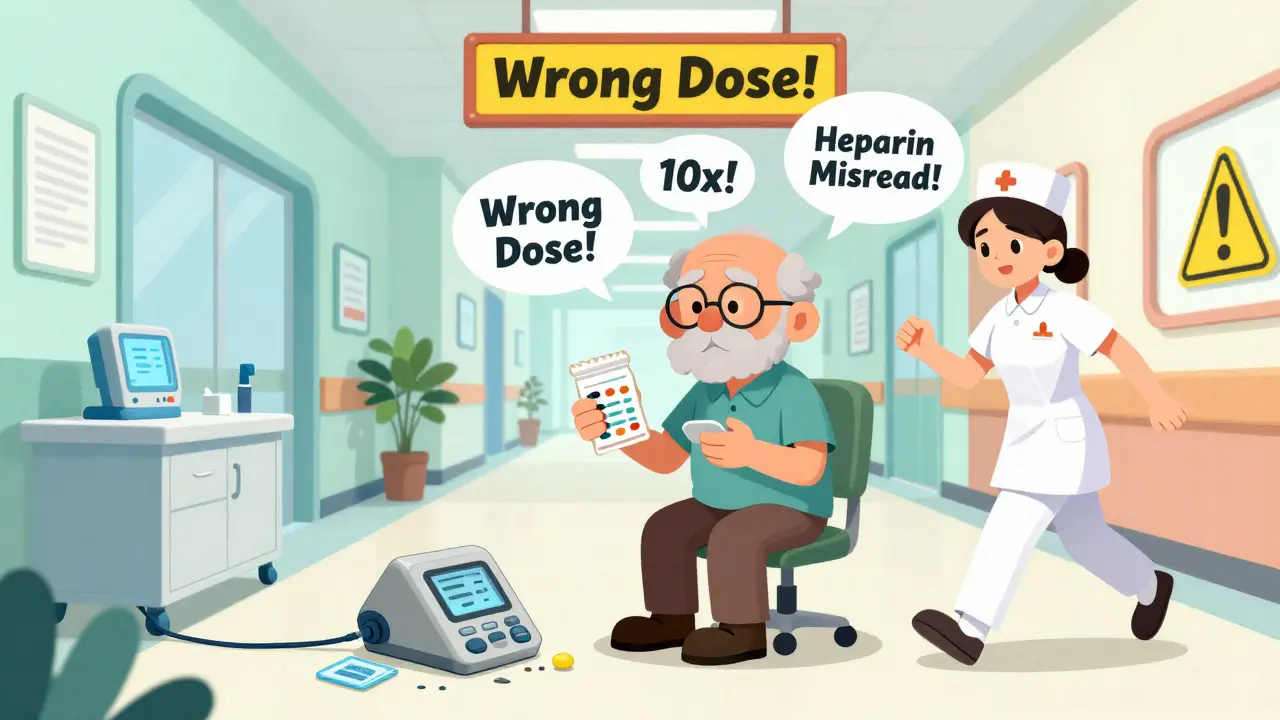
Every year, hundreds of thousands of patients in U.S. hospitals suffer harm because of medication errors - and most of them are completely preventable. It’s not about bad people or careless staff. It’s about broken systems. A patient gets the wrong dose of methotrexate because the electronic system didn’t block a daily order. A nurse administers insulin without double-checking the vial because the barcode scanner was broken. A senior citizen leaves the hospital with conflicting instructions for their blood thinner, and by the next week, they’re back in the ER with internal bleeding. These aren’t rare accidents. They’re systemic failures - and they happen every single day.
What Exactly Counts as a Medication Error?
A medication error isn’t just giving the wrong pill. It’s any mistake in the entire process - from when a doctor writes the order, to when the pharmacist fills it, to when the nurse gives it to the patient, to when the patient takes it at home. The American Society of Health-System Pharmacists defines it as any preventable event that leads to inappropriate use or harm. That includes wrong drug, wrong dose, wrong time, wrong route, wrong patient - even when the right thing is done but the patient doesn’t understand how to take it.
Studies show that on average, every hospital patient experiences at least one medication error per day. That’s not one error per month. Not one per week. Per day. And about 400,000 of those errors result in serious, preventable injuries each year. The cost? Around $21 billion annually in extra hospital stays, emergency visits, and legal claims. These aren’t abstract numbers. They’re real people - your neighbor, your parent, maybe even you.
The Big Players in Medication Safety
There are three major frameworks guiding hospitals today: the Institute for Safe Medication Practices (ISMP), The Joint Commission’s National Patient Safety Goals, and the ASHP Guidelines. Each has strengths and weaknesses.
ISMP’s Targeted Medication Safety Best Practices for Hospitals (2020-2021) is the most specific. It doesn’t just say “be careful with high-risk drugs.” It says: Block daily dosing of methotrexate unless the prescriber confirms it’s for cancer treatment. Remove glacial acetic acid from all hospital areas - it looks like sterile water and has killed patients when accidentally given intravenously. Require hard stops in the EHR system for vinca alkaloids, which can cause paralysis or death if given into the spinal fluid instead of the vein.
These aren’t suggestions. They’re mandatory actions based on real error reports. One hospital in Ohio reported preventing three near-misses in the first month after enabling the methotrexate hard stop. Another hospital in Texas stopped a fatal error when a nurse tried to give a high-dose opioid without a second verification - the system refused to let the order go through.
But ISMP’s rules are strict. They require major tech upgrades, staff training, and workflow changes. That’s expensive - an average of $285,000 per hospital. Smaller clinics and rural hospitals often can’t afford it. That’s where The Joint Commission’s guidelines come in. They’re broader: “Reconcile all medications at admission and discharge,” “Identify high-alert medications,” “Use two patient identifiers before giving any drug.” They’re easier to implement but lack the punch of ISMP’s targeted fixes. One 2021 study found hospitals following only Joint Commission standards had 37% more preventable harm than those fully using ISMP’s practices.
High-Alert Medications: The Real Killers
Not all drugs are created equal. Some are so dangerous that even a small mistake can kill. ISMP and ASHP agree on a list of high-alert medications: insulin, opioids, anticoagulants, IV potassium, neuromuscular blockers, and concentrated electrolytes. These aren’t rare drugs. They’re used every day.
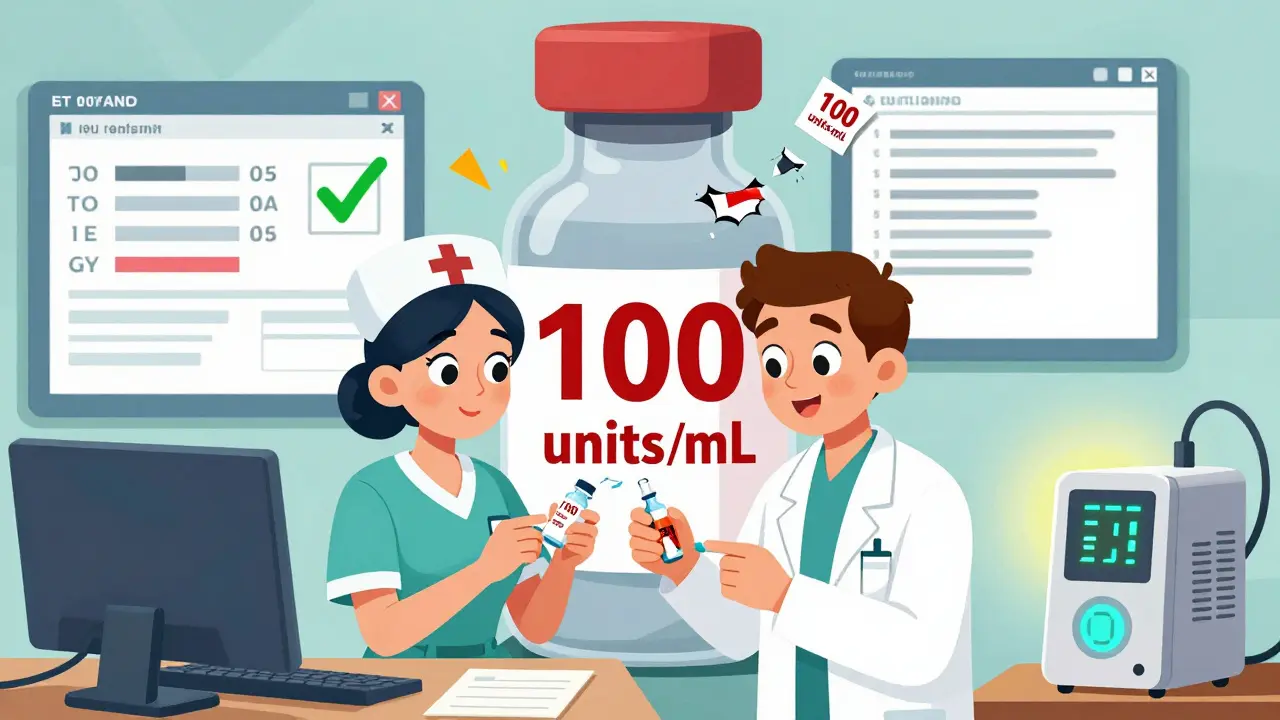
Insulin errors are the most common. A patient gets 10 units instead of 1. That’s a tenfold overdose. The result? Seizures, coma, death. The fix? Standardized concentrations. No more vials labeled “100 units/mL” next to “10 units/mL.” All insulin must be the same strength. Automated dose range checks in the EHR. Independent double-checks by two staff members. And no more sliding scale orders without clear guidelines.
Opioids are another nightmare. A patient gets fentanyl for pain, but the pump is programmed wrong. They stop breathing. Hospitals now require special protocols: limit initial doses, use pulse oximeters, require documentation of respiratory rate every 15 minutes for the first hour. Some hospitals use smart pumps that won’t allow a dose higher than the prescribed limit.
And then there’s heparin. A wrong dose can cause internal bleeding. The fix? Pre-filled syringes. No more drawing up from vials. No more decimal points that get misread. And always, always check the patient’s weight - dosing is based on kilograms, not pounds.
Technology Isn’t Magic - But It Helps
Barcode medication administration (BCMA) systems are now standard in most large hospitals. The nurse scans the patient’s wristband. Scans the medication. The system says: “Yes, this is correct.” Or “No - this patient doesn’t have this order.” Simple. Effective. Studies show BCMA cuts errors by up to 55%.
But here’s the catch: it only works if people use it. A nurse in a rural hospital told an interviewer: “We had the scanner, but it kept glitching. So we just scanned the patient and skipped the drug. We were too busy to wait for IT to fix it.” That’s the reality. Technology fails when it’s not reliable or when staff are overwhelmed.
Electronic health records (EHRs) with clinical decision support are another key tool. They can flag drug interactions, allergies, kidney function issues. But many systems are clunky. One survey found 63% of hospitals struggled to build hard stops in their EHR because the vendor software didn’t allow it. So they created workarounds - like requiring pharmacists to manually review every high-risk order. That’s not ideal. But it’s better than nothing.
Human Factors Matter More Than You Think
Even with the best tech, people still make mistakes. Fatigue. Distractions. Poor communication. A nurse gets called to the ER while preparing a patient’s meds. The IV bag gets mixed up. A pharmacist fills a prescription while on a phone call. A doctor writes “QD” for daily - but the nurse reads it as “QID” (four times a day).
That’s why verbal double-checks are still required for high-alert drugs. Two people look at the label. Two people confirm the dose. Two people verify the patient. It slows things down. But it saves lives. One ICU nurse shared a story on a professional forum: “We had a neuromuscular blocker error because only one person checked it. The patient stopped breathing. We had to intubate on the spot. After that, we made it mandatory - no exceptions.”
And then there’s patient education. Too often, patients are handed a bag of pills and told to “take as directed.” That’s not enough. Especially for older adults. A 2022 survey found 68% of seniors felt safer when hospitals used the “Right Patient Check” - verifying name, birth date, and wristband before every dose. And when discharge instructions were given both verbally and in writing - with pictures, not just text - medication errors at home dropped by nearly half.
What’s Changing in 2025?
Medication safety isn’t standing still. In 2023, ISMP added new rules for compounded sterile preparations after a fungal meningitis outbreak killed dozens. The FDA now requires clearer labeling on high-concentration electrolytes - like calcium and potassium - by the end of 2024.
Artificial intelligence is starting to play a role. By 2025, 75% of U.S. hospitals are expected to use AI to flag potential errors in real time - like spotting a pattern of repeated insulin overdoses or unusual drug combinations. Pilot programs at Mayo Clinic and Johns Hopkins are already using patient feedback to catch errors. If a patient says, “I didn’t get my pill this morning,” the system flags it for review. That’s powerful. Patients are the last line of defense.
And now, ISMP is expanding its best practices to outpatient clinics. That’s huge. Over 40% more medication errors have been reported in clinics since 2019. Patients are getting prescriptions from urgent cares, oncology offices, and primary care clinics - places with fewer resources, less training, and no barcode systems. The next big battle isn’t just in hospitals. It’s in the doctor’s office down the street.
What Can You Do?
If you’re a patient - don’t be silent. Ask questions. “What is this for?” “How many times a day?” “What happens if I miss a dose?” Bring a list of all your meds - including supplements - to every appointment. Ask for written instructions. If something doesn’t feel right, speak up.
If you’re a healthcare worker - follow the protocols. Even when it’s slow. Even when you’re tired. Use the barcode scanner. Do the double-check. Document everything. If your system won’t let you block a dangerous order, push for change. Report near-misses. They’re not failures - they’re warnings.
Medication safety isn’t about perfection. It’s about layers. Technology. Training. Communication. Culture. And always, always putting the patient first. The tools exist. The knowledge exists. What’s missing is the consistent, unwavering commitment to use them - every single time.


8 Comments
My mom nearly died from a methotrexate mix-up back in '19. They didn't have the hard stop on her EHR and the resident just clicked through. We got lucky she was monitored close. Now I ask every nurse: 'Is there a safety check on this?' and they all roll their eyes. But I don't care. I'd rather be annoying than dead.
People think it's about training. Nah. It's about systems that let you fail. Fix the system, not the person.
Oh wow. So we're just supposed to trust that Big Pharma and EHR vendors aren't in on this? The same companies that made the glitchy barcode scanners that cost lives? And now AI is gonna save us? LOL. Who coded the AI? Someone who got paid by the hospital vendor? Tell me the name of the person who got fired after that fungal meningitis outbreak. Go ahead. I'll wait.
They’ll put a sticker on the vial and call it a day while the nurses are still doing 12-hour shifts with no breaks. This isn’t safety. It’s PR.
I get why this feels overwhelming. But here’s the thing - every single one of these fixes has already worked somewhere. The methotrexate block? Saved lives. Pre-filled heparin syringes? Cut errors by 80% in one rural clinic I read about.
We don’t need perfection. We just need consistency. One nurse doing the double-check. One pharmacist pushing back. One patient asking, ‘What’s this for?’ - that’s the chain.
It’s not magic. It’s just… showing up. Every time.
And yeah, tech sucks sometimes. But if we stop using it because it glitches, we’re letting fear replace progress. We can fix the glitches. We can’t fix silence.
Let me tell you about the time I watched a nurse cry in the supply closet because she had to re-do 17 med passes because the scanner didn’t read one vial. She wasn’t mad at the system. She was mad at herself. Because she thought she messed up.
But she didn’t. The system did.
And now? She’s the one training new nurses to always double-check - even when the system says it’s fine. She’s the quiet hero. No awards. No headlines. Just a woman who refuses to let someone die because a screen froze.
That’s the real story here. Not the tech. Not the policy. The people. Still showing up.
And we owe them better.
For anyone thinking this doesn’t affect outpatient clinics - it does. My dad got prescribed warfarin by his cardiologist’s office. No pharmacist on-site. No barcode. No double-check. He got the wrong dose because the script said ‘5mg’ but the label said ‘50mg’. He bled internally for three days before anyone noticed.
ISMP’s new outpatient guidelines? Long overdue. If your clinic doesn’t have a protocol for high-alert meds, ask why. And if they say ‘We’re too small,’ tell them size doesn’t save lives - systems do.
Let’s deconstruct the epistemological framework of pharmaceutical safety, shall we? The ISMP’s ‘best practices’ are merely symptomatic interventions within a capitalist medical-industrial complex that commodifies human vulnerability. The ‘hard stops’ are not safety mechanisms - they are algorithmic pacifiers designed to absolve institutions of moral responsibility while extracting surplus value from compliance labor.
Meanwhile, the patient, reduced to a data point in the EHR ontology, is expected to self-advocate as a form of bio-political resilience. This is not progress. It is neoliberal necropolitics dressed in clinical white coats.
Everyone’s talking about tech fixes but no one mentions the real problem: nurses aren’t trained to read handwriting anymore. I’ve seen ‘.5’ written like ‘5’ a hundred times. And yes, some EHRs still allow ‘QD’ instead of ‘daily’. That’s not a system failure - that’s a competency failure.
Stop blaming the scanner. Start requiring pharmacists to verify every handwritten order. And make them sign off. Not just click ‘yes’.
Also - insulin vials labeled ‘100 units/mL’? That’s not a design flaw. That’s negligence. And if your hospital still allows it, you’re one mistake away from a lawsuit.
Wow. Just… wow. You people really think a barcode scanner is the answer? Honey, I’ve worked in three hospitals. The scanners are always broken. The alarms are always ignored. The nurses are always running. And the patients? They’re just numbers with wristbands.
But hey - at least we have AI now. So the algorithm can decide who lives and who dies. How progressive. How modern.
I’m just glad I’m not the one getting the wrong dose.