
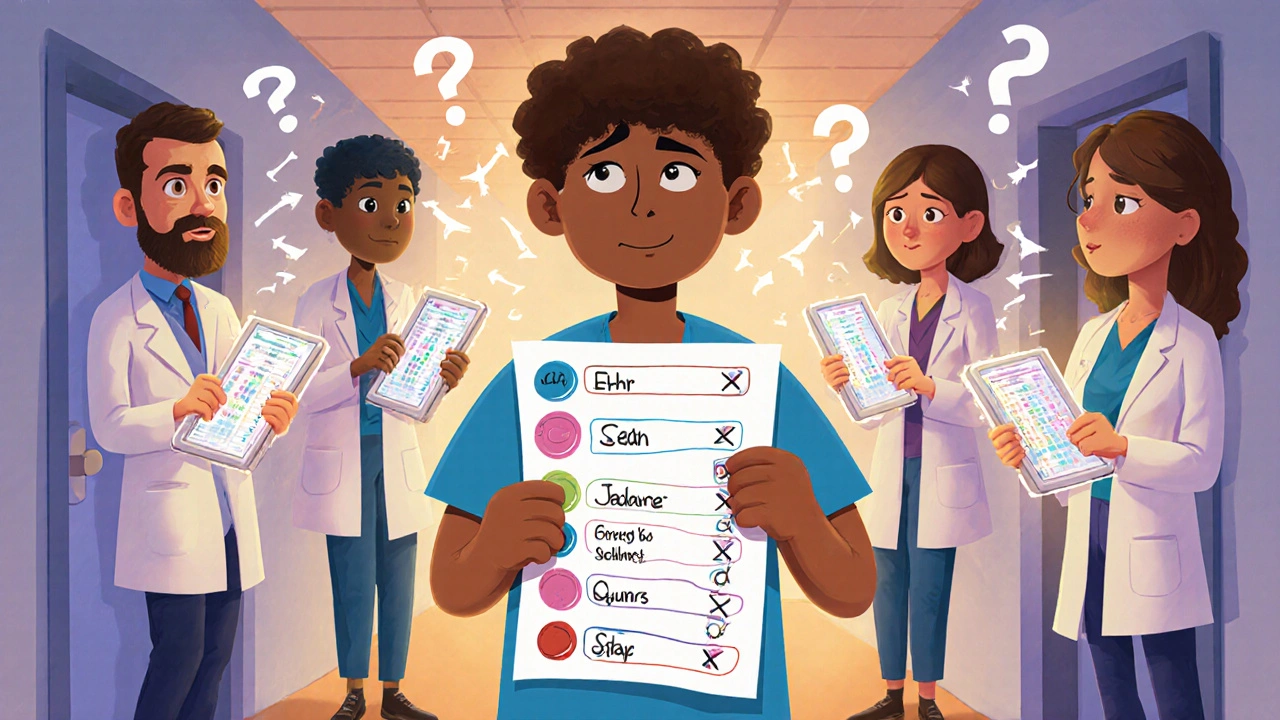
Imagine you’re seeing three different doctors for separate conditions - one for your blood pressure, another for diabetes, and a third for arthritis. Each prescribes a new medication. None of them know what the others have written. A month later, you end up in the emergency room because two of those drugs clashed, sending your heart rate into overdrive. This isn’t a rare story. It happens more often than you think.
When you’re managing multiple medications across several providers, communication isn’t just helpful - it’s life-saving. The Institute of Medicine found that medication errors cause about 7,000 deaths each year in the U.S. alone. And a 2022 NIH study showed that patients seeing three or more providers are over three times more likely to face dangerous drug conflicts. The problem isn’t that doctors are careless. It’s that the system doesn’t make it easy for them to talk to each other.
Why Medication Communication Breaks Down
Most healthcare providers aren’t working in the same building, let alone the same system. Your primary care doctor uses one electronic health record (EHR). Your cardiologist uses another. Your pharmacist might not even have access to either. Even when systems are supposed to talk to each other - thanks to laws like the 21st Century Cures Act - only 38% of providers can reliably pull up a full medication history across different networks, according to a 2023 federal report.
Specialists often prescribe without checking what’s already on your list. One study found that 57% of patients said specialists changed their meds without talking to their main doctor. And patients? Most assume their doctors are already talking. In fact, 83% of patients wrongly believe their providers regularly update each other on medication changes.
Fragmented care leads to dangerous gaps. A 2023 Tulane University study found that 30% of medication errors in complex cases came from multiple providers trying to read the same file - but none of them had the full picture. And when transitions happen - like moving from hospital to home - medication reconciliation errors occur in 56% of cases, with nearly a third of those being potentially harmful.
What You Need to Know About Your Medications
You don’t need to be a medical expert to keep yourself safe. You just need to know four basic facts about every medication you take:
- Name - both brand and generic, if applicable
- Dosage - how much you take each time
- Frequency - how often (once a day? every 6 hours?)
- Purpose - why you’re taking it (e.g., “for high blood pressure,” “for pain”)
Write these down. Keep them in your phone, on a piece of paper, in a notebook - wherever you can find them quickly. Update them every time a new med is added, changed, or stopped. This simple list is your most powerful tool.
Don’t rely on memory. Don’t trust your pill organizer to tell you everything. A 2022 study by Happier at Home showed that patients who kept an updated list had 37% fewer medication errors. That’s not a small number - it’s the difference between a minor side effect and a hospital visit.
How to Get Your Providers to Talk to Each Other
Waiting for your doctors to coordinate on their own is risky. You have to take the lead.
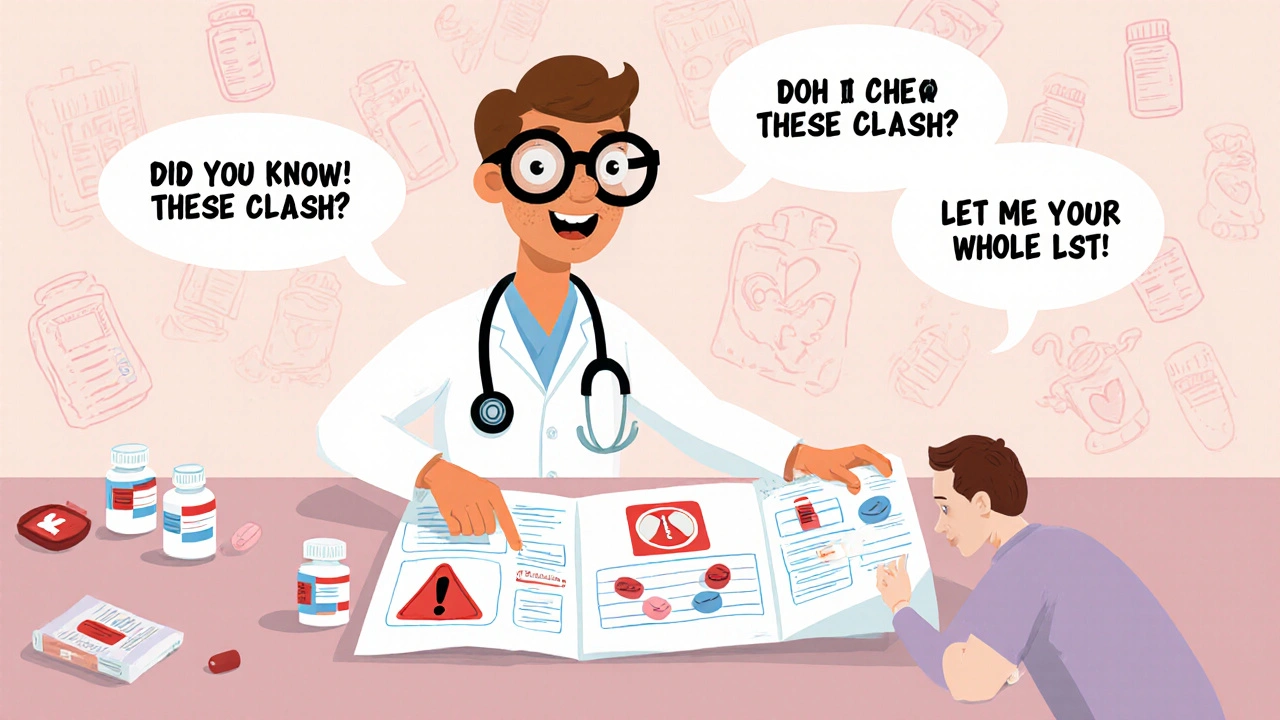
Bring your list to every appointment. Even if you’ve given it before, bring it again. Say: “Here’s my current list. Can you check if anything here conflicts with what you’re prescribing?”
Ask directly: “Are you aware of what my other doctors have prescribed?” If the answer is no, say: “I’d like you to coordinate with my primary care doctor. Can you send a note or call them?”
Use your pharmacist. Pharmacists are trained medication experts - and they often see all your prescriptions. Many pharmacies now offer free Medication Therapy Management (MTM) services. Ask your pharmacist to review your entire list. In a 2023 study by Asteroid Health, patients who worked with pharmacists saw a 32% increase in medication adherence and 63% higher confidence in their regimen.
Request a care coordinator. If you’re on Medicare or part of an Accountable Care Organization (ACO), you may have access to a care coordinator - a person whose job is to make sure all your providers are on the same page. Ask your primary care office: “Do you have a care coordinator who can help manage my medications?”
Track Your Body’s Response
Medications don’t always work the same way for everyone. Side effects can show up days or weeks later. That’s why keeping a simple health journal matters.
Write down:
- Any new symptoms (dizziness, nausea, rash, sleep changes)
- Changes in mood or energy
- Any missed doses or confusion about timing
- When you feel better or worse
Bring this journal to your appointments. It gives your providers real, personal data - not just a list of pills. A 2023 study from UC San Francisco found that patients who kept this kind of journal had 22% fewer adverse drug events.
Don’t wait until you feel terrible to speak up. If something feels off, say something. Even if it seems small.
The Teach-Back Method: Make Sure You Understand
Doctors and nurses are busy. They might explain your new medication quickly. And you might nod along, thinking you got it - but later, you’re unsure when to take it or why.
Use the Teach-Back Method. After your provider explains something, say: “Just to make sure I got it right - can you let me explain it back to you?” Then, in your own words, tell them what you’re supposed to do.
For example: “So I take this pill once a day, with breakfast, to lower my blood pressure - and if I feel dizzy, I should call you, not stop it?”
The Agency for Healthcare Research and Quality found this simple trick reduces misunderstandings by 45%. It’s not about testing you - it’s about making sure the information stuck.

What Works Best: Integrated Care vs. Fragmented Care
Not all systems are created equal. Patients in Accountable Care Organizations (ACOs) - where providers are paid to keep people healthy, not just treat them - have 27% fewer medication-related hospital readmissions, according to CMS data.
Why? Because ACOs have care teams that meet regularly, share records, and hold each other accountable. They use standardized medication reconciliation processes. They assign someone to track all prescriptions.
Compare that to traditional fee-for-service care, where each provider gets paid for each visit, each test, each prescription - with little incentive to coordinate. That’s where most communication breakdowns happen.
If you have a choice - like when selecting a new primary care provider - ask: “Do you use a care coordination system for patients on multiple medications?” If they say no, ask how they handle medication safety. Their answer will tell you a lot.
What’s Changing - and What’s Coming
The system is slowly improving. CMS now requires participating practices in the Primary Care First model to implement structured medication reconciliation at every transition - by January 1, 2024. That means hospitals, clinics, and home care teams must check your meds every time you move between settings.
Pharmacists are stepping into the gap. By 2025, 78% of independent pharmacies in the U.S. are expected to offer formal medication therapy management - up from just 42% in 2022. That’s a big shift. Your local pharmacist may soon be your most reliable medication navigator.
AI tools are starting to help too. At Mayo Clinic, new software can scan your entire medication list and flag potential interactions in under a minute - down from 15 minutes manually. These tools aren’t perfect yet, but they’re getting better fast.
The bottom line? Better communication saves lives - and money. The Commonwealth Fund found that every $1 invested in strong medication communication returns $7.30 through fewer ER visits and hospital stays.
What You Can Do Today
You don’t need to wait for the system to fix itself. Here’s your action plan:
- Make or update your medication list - name, dose, frequency, purpose - right now.
- Take it to your next appointment - even if you’ve given it before.
- Ask your pharmacist for a free medication review.
- Start a simple health journal - track how you feel each day.
- Use the Teach-Back Method at every visit.
- If you have multiple providers, ask one of them to be your coordinator - usually your primary care doctor.
Medication safety isn’t just the job of your doctors. It’s yours too. And the more you take charge, the safer you’ll be.



8 Comments
lol they just want you to be your own damn pharmacist now 🤡
This is so true. I had a similar scare last year - my cardiologist prescribed a new beta-blocker, my rheumatologist added a steroid, and my PCP didn’t know until I showed up with a rash and my heart doing the cha-cha. Now I keep a laminated card in my wallet. Best thing I ever did.
Love this post! 🙌 Seriously, we’re all just trying to stay alive in a system that treats us like a spreadsheet. The teach-back method changed my life - I used to nod and smile, now I say, 'Okay, so if I feel dizzy, I call you, not stop it cold?' And they’re like, 'Yes, exactly!' It feels good to actually understand.
I’ve been thinking… this whole mess isn’t just about tech or paperwork - it’s about capitalism. Doctors get paid per visit, per script, per test… not for keeping you alive. The system rewards fragmentation. We’re not broken - we’re designed this way. And now they want us to fix it? With a notebook?!? 😅
I used to think my doctors were all talking. Turns out they weren’t. My mom almost died because two meds canceled each other out. Now I have a Google Doc. I share it with everyone. Even my cousin’s dog walker knows my meds. Just kidding… but not really.
The medication list is essential. I recommend using a standardized template with generic and brand names, dosages, frequencies, indications, and start dates. Many patients overlook the indication, which is critical for identifying potential interactions. Pharmacists are underutilized resources - they are trained specifically for this purpose.
I’ve been doing the journal thing for six months now. Not just meds - mood, sleep, weird tingles, when I forget to take something. It’s weirdly empowering. Like I’m not just a patient anymore. I’m a data point… and maybe a little detective. My doctor was shocked at how much I noticed. Turns out, I’m the one living this body. 🤔
Honestly? This post should be mandatory reading for anyone over 50. I’m 68 and I’ve got 11 meds. I didn’t even know my kidney doc didn’t know about the blood thinner my heart doc gave me. Now I ask every provider: 'Who else are you talking to?' And I bring my list. It’s not rude - it’s responsible. We’ve got to stop waiting for the system to save us.