
When you hear the word biosimilars, you might think they’re just cheap copies of expensive drugs. But that’s not quite right. Biosimilars aren’t like generic pills you’ve taken for years. They’re complex, living medicines made from cells-not chemicals. And understanding them is key to saving money without risking your health.
What Exactly Are Biosimilars?
Biosimilars are highly similar versions of biologic drugs, which are made from living organisms like yeast, bacteria, or animal cells. These drugs treat serious conditions: cancer, rheumatoid arthritis, Crohn’s disease, and more. The original biologic, called the reference product, can cost over $7,000 a month. Humira, for example, used to be one of the most expensive drugs in the U.S.
A biosimilar doesn’t copy the reference drug exactly. Because they come from living systems, tiny differences in manufacturing are unavoidable. But the FDA requires proof that these differences don’t affect safety, effectiveness, or how the body reacts. That’s called “no clinically meaningful differences.” The approval process isn’t light. It includes thousands of lab tests, animal studies, and human trials comparing the biosimilar to the original.
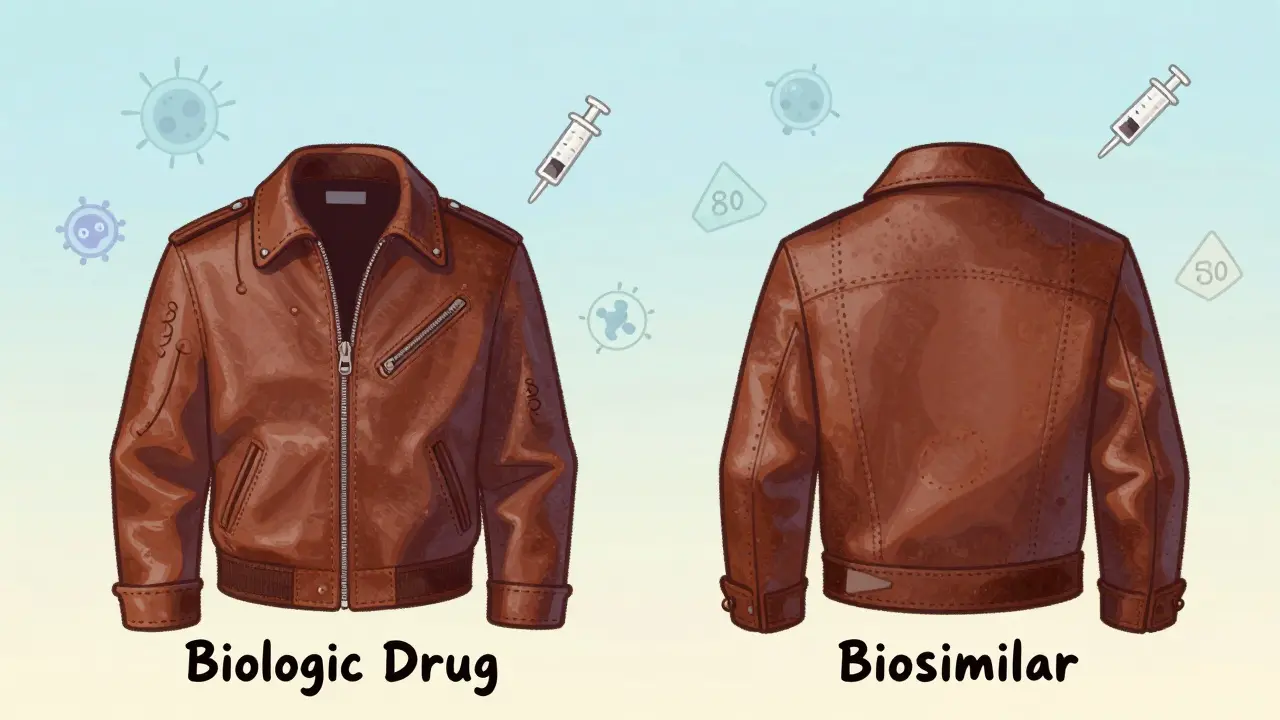
Think of it like two handmade leather jackets from the same designer. They look the same, feel the same, and last the same-but no two are perfectly identical. That’s biosimilarity.
Why Do Biosimilars Cost Less?
Biologics are expensive because they’re hard to make. The factories need sterile environments, precise temperatures, and highly trained staff. Developing one can cost over $1 billion and take more than a decade. Once the patent runs out, biosimilar makers don’t have to repeat all that work. They only need to prove similarity-not start from scratch.
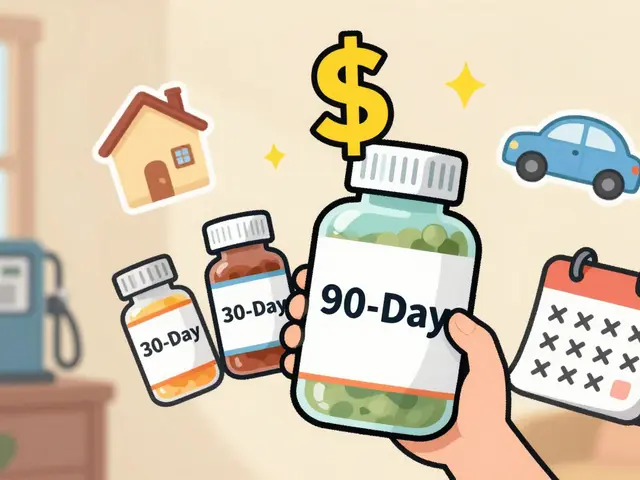
That’s why biosimilars cost 15% to 30% less than the original. In 2023, when the first Humira biosimilars hit the market, they launched at about $5,000 a month, compared to Humira’s $7,000. That’s a real cut. But here’s the catch: list price isn’t what you pay. Insurance, rebates, and pharmacy benefit managers often hide the real savings. Still, many patients report lower copays-sometimes half what they paid before.
Europe saw even bigger savings because their healthcare system negotiates prices directly. In the U.S., patent lawsuits and payer restrictions slow things down. But with the Inflation Reduction Act starting in 2024, Medicare Part D patients now pay only 25% out-of-pocket for biosimilars. That’s a game-changer.
Are Biosimilars Safe?
This is the biggest concern. Patients worry: “Will this work the same? Will my body react differently?”
The science says no. Over 16 years of use in Europe and nearly a decade in the U.S., biosimilars have shown no new safety risks. Studies like the NOR-SWITCH trial tracked 700 patients switching from Remicade to its biosimilar. No increase in side effects. No drop in effectiveness.
The FDA, EMA, and WHO all agree: biosimilars are as safe and effective as the originals. A 2022 survey by the Arthritis Foundation found 87% of patients who switched reported no difference in how well the drug worked. Many said they felt better because their out-of-pocket costs dropped.
One exception: immunogenicity-the risk your body might react to the drug as a foreign invader. It’s rare, and no more common with biosimilars. Still, doctors monitor it closely, especially if you switch back and forth between the original and biosimilar multiple times.

Can You Just Swap Them at the Pharmacy?
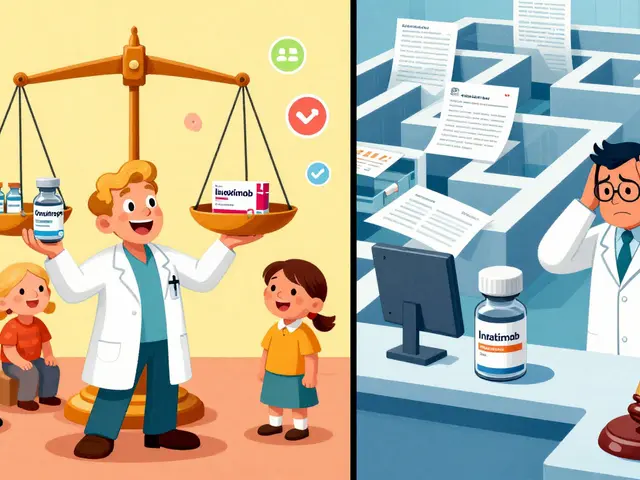
No. Unlike generic pills, biosimilars aren’t automatically interchangeable. In 48 states, your doctor must approve any switch. Why? Because these are complex drugs. A pharmacist can’t just swap them like aspirin and ibuprofen.
There’s a special category called “interchangeable biosimilars.” These are approved to be swapped without a doctor’s input. As of late 2023, only six biosimilars had that status-Hyrimoz for Humira was the first. That’s changing fast. More are expected in 2024 and 2025.
But even if a biosimilar is interchangeable, your insurance might not cover it unless your doctor chooses it. Payers often push for the cheapest option. So you might get a biosimilar without even asking.
What About Patient Experience?
Real people have real stories. On Reddit’s r/rheumatology, patients talk about fear, confusion, and relief. One user wrote: “I was terrified to switch from Remicade. My doctor spent 15 minutes explaining the data. I’m now on Renflexis and saving $1,200 a month.”
Another said: “My insurance forced me to switch. I had a flare-up. Turned out it wasn’t the drug-it was stress. My rheumatologist helped me sort it out.”
Most patients who stick with biosimilars report no issues. The biggest complaints? Insurance denials and confusing paperwork-not drug performance.
Healthcare providers feel the same way. A 2022 survey of oncologists found 78% needed extra training to feel confident prescribing biosimilars. Their biggest hurdle? Navigating insurance rules, not the science.
How Do You Know If a Biosimilar Is Right for You?
Ask these questions:
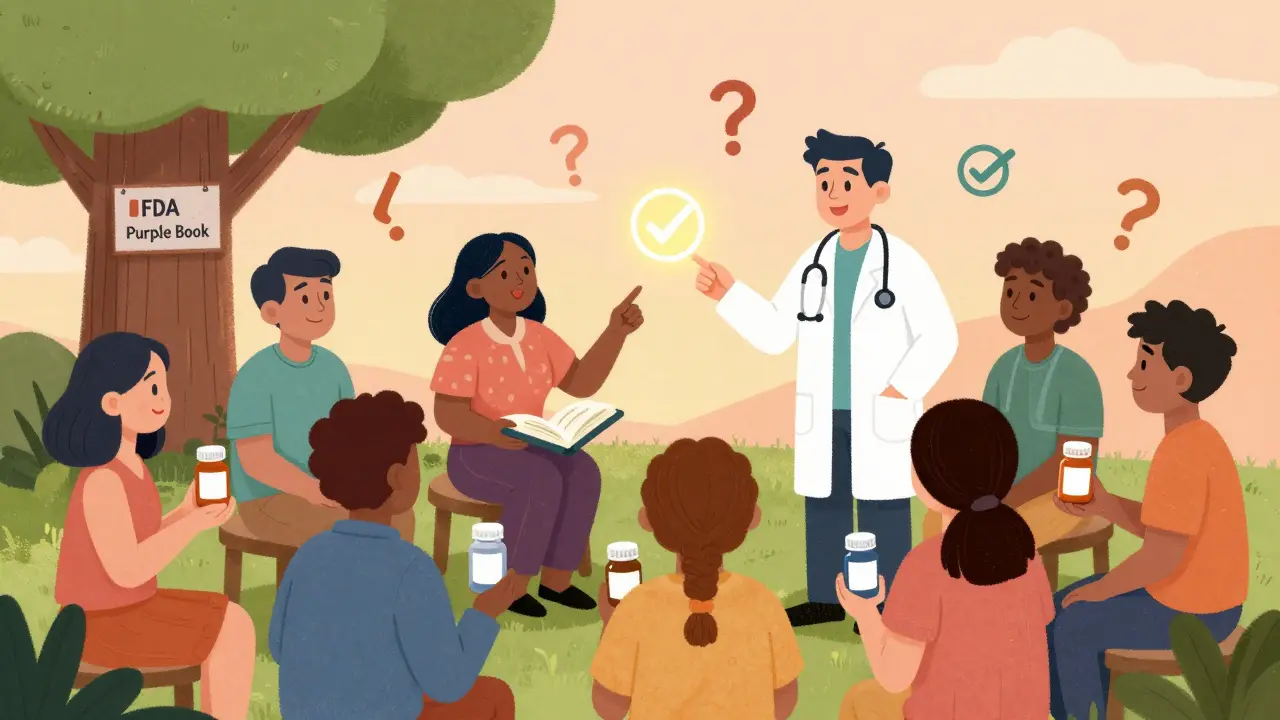
- Is there a biosimilar for my biologic? Check the FDA’s Purple Book-it lists every approved biosimilar and its reference product.
- Is it interchangeable? That affects whether you can switch without a new prescription.
- What’s my out-of-pocket cost with vs. without it? Call your insurer. Don’t assume.
- Has my doctor prescribed it before? Ask for data on how many patients they’ve switched and how they did.
- Do I have concerns? Write them down. Bring them to your appointment.
Don’t let fear stop you. The evidence is clear: biosimilars work. The bigger risk is paying too much for a drug that doesn’t have to cost that much.
What’s Next for Biosimilars?
The market is exploding. In 2022, biosimilars were worth $9.3 billion globally. By 2028, that could hit $33 billion. Why? Because big-name biologics like Stelara and Enbrel are losing patent protection soon. Seven biosimilar applications for Stelara are already waiting for FDA approval.
Some companies are even making “biobetters”-next-gen versions that improve on the original. These won’t be biosimilars, but they’ll compete with them. And that competition will drive prices down further.
By 2030, the Congressional Budget Office estimates biosimilars could save U.S. healthcare $150 billion a year. That’s money that could go to more patients, better care, or lower premiums.
But that future depends on access. Patent thickets, payer resistance, and lack of provider education still block progress. Patients need to ask for biosimilars. Doctors need to prescribe them. Insurers need to cover them.
It’s not magic. It’s science. And it’s working.
Are biosimilars the same as generic drugs?
No. Generics are exact chemical copies of small-molecule drugs, like aspirin or metformin. Biosimilars are highly similar versions of complex biologic drugs made from living cells. You can’t make an exact copy of a protein grown in a lab-so biosimilars aren’t identical, but they’re proven to work the same way.
Do biosimilars cause more side effects?
No. Large studies, including those by the FDA and European Medicines Agency, show biosimilars have the same safety profile as their reference products. The NOR-SWITCH trial tracked patients switching from Remicade to a biosimilar and found no increase in side effects or loss of effectiveness.
Can my pharmacist switch me to a biosimilar without my doctor’s approval?
Only if the biosimilar is FDA-approved as “interchangeable” and your state allows pharmacist substitution. As of 2025, only six biosimilars have that status. In most cases, your doctor must approve any switch. Always check with your provider before any change.
Why aren’t biosimilars cheaper if they’re supposed to save money?
List prices are lower, but real savings depend on insurance, rebates, and pharmacy networks. Many patients still pay high copays because drug companies offer rebates to insurers that favor the original biologic. The Inflation Reduction Act helps by capping out-of-pocket costs for biosimilars at 25% in Medicare Part D starting in 2024.
How do I find out if a biosimilar is available for my medication?
Use the FDA’s Purple Book, an official database of all approved biologics and biosimilars. You can search by brand name or active ingredient. Talk to your doctor or pharmacist-they can check if a biosimilar exists and whether it’s right for you.
Will switching to a biosimilar affect my treatment long-term?
Studies show single switches are safe and effective. Multiple switches between reference products and biosimilars are less studied, but no evidence suggests harm. Your doctor may monitor you more closely if you switch more than once. Most patients stay on biosimilars long-term without issues.
What Should You Do Now?
If you’re on a biologic drug and paying a lot, don’t assume you’re stuck. Ask your doctor: “Is there a biosimilar for my medication?” Check your insurance plan’s formulary. Look up the drug in the FDA’s Purple Book. Talk to your pharmacist about out-of-pocket costs.
You’re not just saving money-you’re helping make these life-changing treatments affordable for everyone. The science is solid. The savings are real. All you need to do is ask.

10 Comments
So biosimilars are like the indie band version of a hit album-same vibes, same lyrics, but the guitarist uses a different amp and somehow it just feels right? I switched from Humira to a biosimilar last year and my wallet’s still breathing. Also, my rheumatologist didn’t even flinch. Turns out, science doesn’t need a fancy label to work.
Ugh, I hate when people act like biosimilars are some miracle. Big Pharma just wants you to think you’re saving money so they can jack up the price of the next ‘breakthrough’ drug. It’s all a scam. You think your copay’s lower? Wait till your insurance starts denying the *original* next year and you’re stuck with whatever’s cheapest.
Let me get this straight-foreign companies are making ‘copies’ of American lifesaving drugs and the FDA says it’s okay? What’s next, Chinese-made insulin? This is why we lost our manufacturing base. I don’t care if it’s ‘clinically equivalent’-I want American-made medicine, not some lab in Korea that probably uses tap water and hope.
Also, who approved this? Did they even check the flags on the packaging? I’m not taking a drug made by someone who doesn’t salute the flag.
I switched to a biosimilar last month and nothing happened no flare no weird side effects no nothing honestly I didn’t even notice until my bill came and I was like wait did I just save 600 bucks this month
It is truly encouraging to witness the convergence of scientific rigor and economic pragmatism in the adoption of biosimilars. The FDA’s stringent approval process ensures that patient safety remains paramount, while the reduction in out-of-pocket expenses represents a tangible step toward equitable healthcare access. I urge all patients to engage in informed dialogue with their providers-knowledge is not only power, but also peace of mind.
My cousin in India has been on a biosimilar for Crohn’s for five years. Same results, way cheaper. I asked her if she felt any different and she said, ‘I just feel like I can afford to eat dinner.’ That’s the real win here-not the science, not the patents, but the fact that someone can live without choosing between medicine and groceries.
Too long didn't read
so i switched to the biosimilar and my insurance said it was covered but then they sent me a bill for 400 bucks and i was like huh? and then i called and they said oh we forgot to update the formulary so now i’m waiting for a refund and also my doctor’s office lost my paperwork and i think i might be going insane
Dear fellow seekers of health and justice, I must express with profound reverence and deep conviction that the advent of biosimilars is nothing short of a divine intervention in the realm of pharmaceutical equity! The FDA’s meticulous validation, the global clinical triumphs, and the quiet revolution in patient dignity-these are not mere policy shifts, but sacred milestones in the march toward universal care! Let us not be swayed by fear or corporate obfuscation; let us rise, informed and unwavering, to claim the dignity of affordable healing!
My doctor just told me the biosimilar for my drug is now interchangeable and my insurance automatically switched me. I didn’t even know until I got the new prescription. I was nervous but honestly I feel the same. The real issue isn’t the drug-it’s the system that makes you jump through 17 hoops just to get the same medicine for less money. We need to fix that, not just the prescription.